Agent-Memory vs agent-memory
Persistent memory for coding agents compared
Agent-Memory and agent-memory both help coding agents retain useful context across sessions. Agent-Memory captures activity and retrieves it through the iii engine, while agent-memory organizes session notes into tiered files and generates AGENTS.md context.
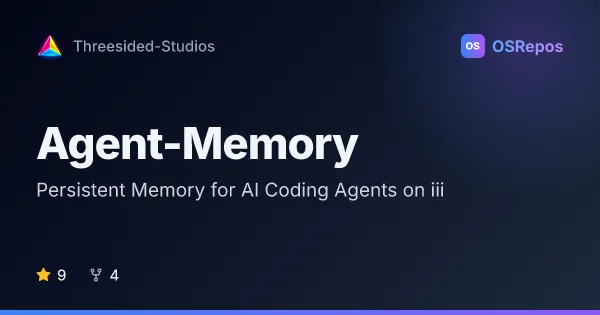
Agent-Memory: Persistent Memory for AI Coding Agents on iii
Agent-Memory adds persistent, searchable memory to coding agents through the iii engine, sharing context across Claude Code, Cursor, Gemini CLI, Codex CLI, and other MCP or HTTP clients. It captures session activity and retrieves relevant context for later work.
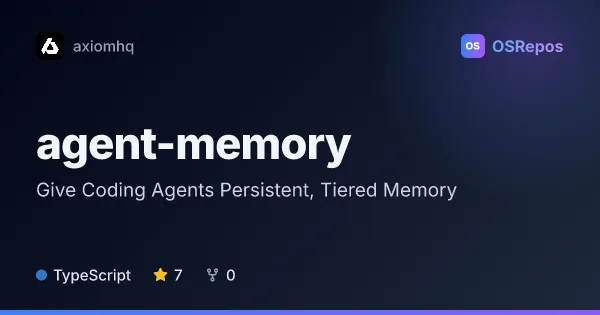
agent-memory: Give Coding Agents Persistent, Tiered Memory
A TypeScript memory system for coding agents, built around XState workflows. It turns session notes into tiered memory and generates AGENTS.md context for harnesses such as Amp, Cursor, and Codex.
| Agent-Memory | agent-memory | |
|---|---|---|
| Language | — | TypeScript |
| License | Apache-2.0 | — |
| Stars | 9 | 7 |
| Forks | 4 | 0 |
| Last analyzed | Nov 1, 2026 | Oct 28, 2026 |
Key differences
- Agent-Memory captures prompts, tool activity, and session events through hooks; agent-memory captures learnings as journal entries for later processing.
- Agent-Memory combines keyword, vector, and graph retrieval; agent-memory uses tiered memory, cross-links, and generated AGENTS.md context.
- Agent-Memory runs on the iii engine and provides MCP tools, a REST API, and a web viewer; agent-memory is a TypeScript system with XState workflows, filesystem storage, and a CLI.
- Agent-Memory lists integrations including Claude Code, Cursor, Gemini CLI, and Codex CLI; agent-memory is designed for harnesses including Amp, Cursor, and Codex, plus manual CLI use.
- Agent-Memory is licensed Apache-2.0 and has 9 stars and 4 forks; agent-memory has 7 stars and no forks.
- Both projects are marked quiet, with recent maintenance concentrated in one person; Agent-Memory also requires Node.js 20 or later and pins iii-engine to v0.11.2, while agent-memory relies on an LLM command for consolidation.
Choose Agent-Memory if you…
- need to capture agent activity automatically and search it across sessions.
- want memory shared across multiple agents through MCP or HTTP integrations.
- need a web viewer or team memory features alongside retrieval.
Choose agent-memory if you…
- want to turn session notes into tiered memory and AGENTS.md context.
- prefer filesystem-based storage, stable cross-links, and a CLI workflow.
- want XState-based consolidation and defragmentation workflows for memory.
Compare the numbers side by side, or add more projects
This comparison is generated with AI from the OSRepos analyses of both projects. Always check each project's repository and documentation before choosing.