trafilatura vs Scrapling
Python web extraction and scraping frameworks compared
trafilatura extracts readable text and metadata from web pages and HTML, with tools for content discovery and structured export. Scrapling combines fetching, parsing, and crawling, with adaptive selectors designed to handle changes in page structure.
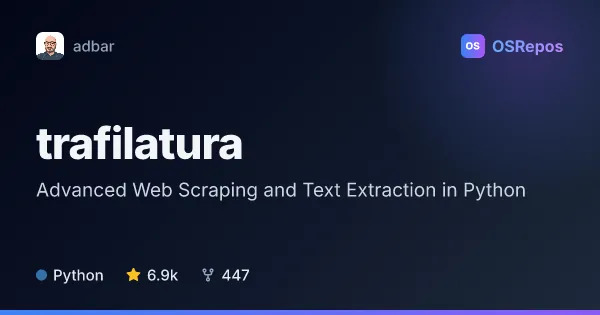
trafilatura: Extract Text and Metadata from Web Pages
Trafilatura is a Python library and CLI for discovering web content and extracting readable text and metadata from HTML. It suits developers and researchers building crawlers, web corpora, or content-processing pipelines that need structured output.
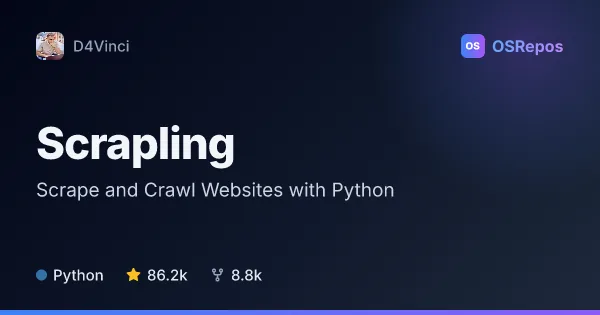
Scrapling: Scrape and Crawl Websites with Python
Scrapling is a Python framework for extracting data from static and dynamic websites, with selectors that can adapt to page changes and tools for scaling from individual requests to concurrent crawls. It also offers browser-based fetching, a CLI, and an MCP server.
| trafilatura | Scrapling | |
|---|---|---|
| Language | Python | Python |
| License | Apache-2.0 | BSD-3-Clause |
| Stars | 6.9k | 86.2k |
| Forks | 447 | 8.8k |
| Last analyzed | Oct 3, 2026 | Oct 8, 2026 |
Key differences
- trafilatura focuses on extracting structured text and metadata, while Scrapling provides a broader framework for fetching, parsing, and crawling.
- trafilatura can discover URLs through sitemaps and feeds and process downloaded HTML; Scrapling offers HTTP and browser-based fetching, plus concurrent spiders.
- trafilatura preserves document structure and exports formats including TXT, Markdown, JSON, and XML-TEI; Scrapling offers CSS, XPath, text, and filter-based selection.
- trafilatura is licensed under Apache-2.0; Scrapling is licensed under BSD-3-Clause.
- Scrapling's base installation includes the parser, while fetchers and spiders require optional dependencies; browser-based fetching also requires browser installation.
- trafilatura lists 6.9k stars and 447 forks, while Scrapling lists 85.5k stars and 8.8k forks.
Choose trafilatura if you…
- need readable text, article metadata, or document structure from web pages and HTML.
- want to discover content through sitemaps or feeds and export structured records in multiple formats.
- are building a corpus or content-processing pipeline that can use offline HTML files.
Choose Scrapling if you…
- need adaptive selectors that can relocate elements after page changes.
- want HTTP or browser-based fetching and concurrent crawling with sessions or pause-and-resume support.
- are building AI-connected scraping workflows using the MCP server or Markdown for retrieval.
Compare the numbers side by side, or add more projects
This comparison is generated with AI from the OSRepos analyses of both projects. Always check each project's repository and documentation before choosing.