OmniParse vs xberg
Document and media extraction tools compared
OmniParse and xberg both extract content from varied inputs for AI and search workflows. OmniParse is a self-hosted Python service focused on local parsing of documents and media, while xberg is a Rust engine offering several integration styles and language bindings.
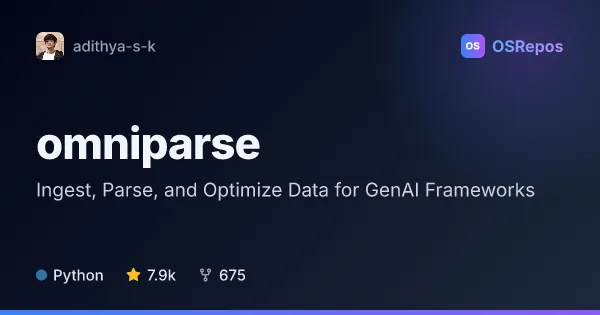
OmniParse: Turn Documents and Media into AI-Ready Data
OmniParse is a self-hosted Python service that converts documents, images, audio, video, and web pages into structured output for GenAI workflows. It suits teams building ingestion pipelines that want local parsing, but requires Linux and a GPU with at least 8–10 GB of VRAM.
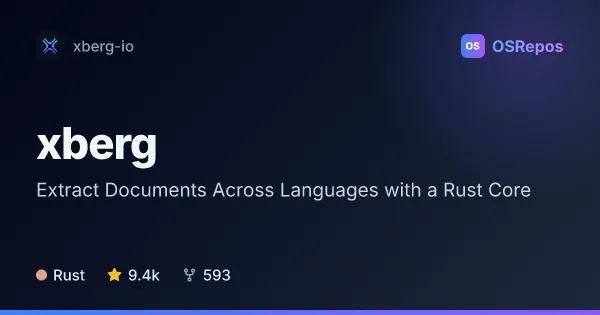
xberg: Extract Documents Across Languages with a Rust Core
Xberg is a polyglot document-intelligence engine built on a Rust core, with bindings for 15 languages and CLI, REST API, and MCP interfaces. It extracts text, tables, metadata, and structured data from many document formats, and uses Whisper for optional audio transcription.
| OmniParse | xberg | |
|---|---|---|
| Language | Python | Rust |
| License | GPL-3.0 | MIT |
| Stars | 7.9k | 9.4k |
| Forks | 675 | 593 |
| Last analyzed | Oct 3, 2026 | Oct 15, 2026 |
Key differences
- OmniParse handles documents, images, audio, video, and web pages; xberg also extracts from archives and source code, with syntax-aware code processing.
- OmniParse exposes an HTTP API and Gradio UI and supports Docker deployment; xberg can be used as a library, CLI, REST API, or MCP server.
- OmniParse is written in Python and licensed under GPL-3.0; xberg is written in Rust and licensed under MIT.
- OmniParse requires Linux and a GPU with at least 8–10 GB of VRAM for its deep-learning models; xberg supports CPU operation, though some capabilities depend on optional features, runtimes, or models.
- OmniParse focuses on converting mixed inputs into structured Markdown for AI workflows; xberg offers multiple output formats, including HTML, JSON tree, and DocTags.
- Both repositories are unarchived; OmniParse notes 75 open issues, while xberg is described as the next iteration of Kreuzberg, which may require migration review for existing integrations.
Choose OmniParse if you…
- need a self-hosted service for processing documents, images, audio, video, and web pages locally.
- want an HTTP API and interactive Gradio UI for an ingestion pipeline.
- can run Linux with a GPU meeting the stated VRAM requirement and want Whisper-based transcription.
Choose xberg if you…
- need a Rust-based extraction engine available as a library, CLI, REST API, or MCP server.
- want bindings for multiple languages or CPU operation.
- need source-code structure extraction, syntax-aware chunking, or a choice of several output formats.
Compare the numbers side by side, or add more projects
This comparison is generated with AI from the OSRepos analyses of both projects. Always check each project's repository and documentation before choosing.