FinGPT vs FinRL-Trading
Financial language models and quantitative trading compared
FinGPT supports adapting and evaluating language models for financial text tasks, while FinRL-Trading provides a modular workflow for developing, backtesting, and executing quantitative strategies. The main distinction is NLP model research versus portfolio strategy infrastructure with brokerage execution.
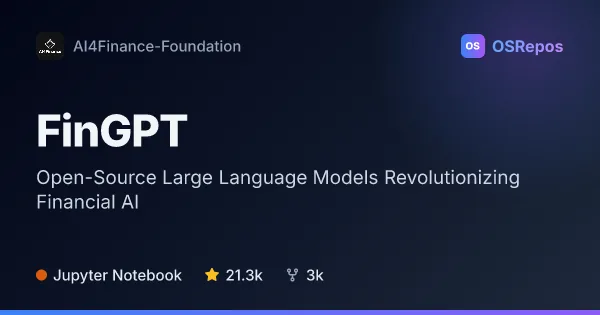
FinGPT: Adapt Language Models for Financial Tasks
FinGPT provides financial datasets, fine-tuned language models, benchmarks, and workflows for tasks such as sentiment analysis and forecasting. It suits researchers and developers adapting open models to finance, with local GPU inference or supported cloud APIs.
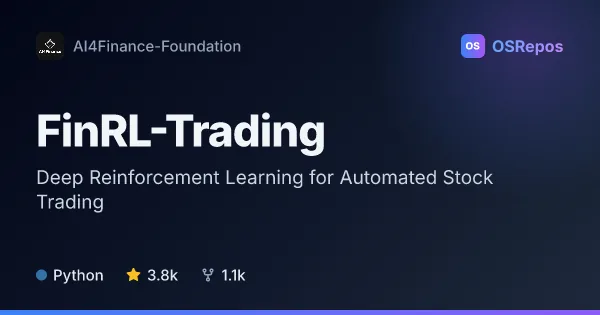
FinRL-Trading: Build and Deploy Quantitative Trading Strategies
FinRL-Trading is a modular Python system for developing, backtesting, and executing quantitative trading strategies. Its shared portfolio-weight interface connects strategy components to backtests and Alpaca trading, making it useful for researchers and practitioners evaluating end-to-end workflows.
| FinGPT | FinRL-Trading | |
|---|---|---|
| Language | Jupyter Notebook | Python |
| License | MIT | Apache-2.0 |
| Stars | 21.3k | 3.8k |
| Forks | 3k | 1.1k |
| Last analyzed | Oct 3, 2026 | Oct 3, 2026 |
Key differences
- FinGPT focuses on financial NLP, including sentiment analysis, information extraction, retrieval-augmented analysis, and a stock-forecasting demo; FinRL-Trading focuses on stock selection, portfolio allocation, timing, risk overlays, and execution.
- FinGPT emphasizes curated datasets, parameter-efficient fine-tuning, model adapters, and benchmarks; FinRL-Trading connects replaceable pipeline components through a shared target-portfolio-weight interface.
- FinGPT is described as using Jupyter Notebook, while FinRL-Trading is a Python system with a stated Python 3.11-or-later requirement.
- FinGPT is licensed under MIT; FinRL-Trading is licensed under Apache-2.0.
- FinGPT offers local inference and documented cloud LLM options; FinRL-Trading integrates market-data sources and supports Alpaca paper or live trading, with credentials needed for execution.
- FinGPT has 21.3k stars and 3k forks; FinRL-Trading has 3.8k stars and 1.1k forks. Both are listed as not archived.
Choose FinGPT if you…
- need financial NLP datasets, benchmarks, or fine-tuning workflows for language models.
- want to explore sentiment analysis, information extraction, financial RAG, or the Dow 30 Forecaster demo.
- prefer a project focused on adapting open models to financial tasks, with local or documented cloud inference options.
Choose FinRL-Trading if you…
- need a modular workflow for combining stock selection, portfolio allocation, backtesting, and execution.
- want to compare allocation methods using a shared portfolio-weight interface across backtests and trading workflows.
- plan to explore Alpaca paper or live trading and can meet its credential and environment requirements.
Compare the numbers side by side, or add more projects
This comparison is generated with AI from the OSRepos analyses of both projects. Always check each project's repository and documentation before choosing.