piko vs darkflare
TCP tunneling and traffic routing compared
piko and darkflare are Go projects that carry network traffic through tunnels to services that are not directly reachable. piko is a self-hosted reverse proxy designed to route HTTP(S) and TCP traffic through outbound connections, while darkflare carries TCP connections in HTTP(S) requests routed through a CDN.
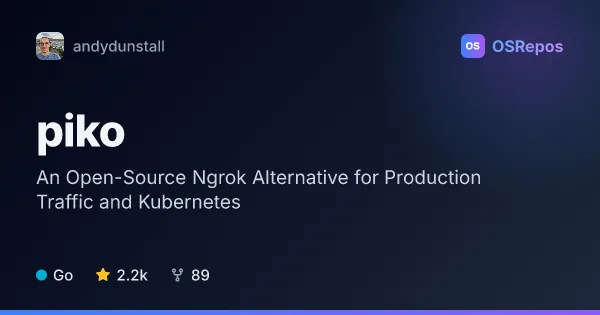
piko: Route Traffic to Services Behind Outbound Tunnels
Piko is a Go reverse proxy for securely exposing services that cannot accept public inbound connections. It suits teams that need a self-hosted tunnel with clustering and Kubernetes-friendly deployment for production traffic.

darkflare: Tunnel TCP Traffic Through a CDN
DarkFlare is a Go client-server tool that carries TCP connections through HTTP(S) requests routed via a CDN. It is intended for authorized access to TCP services across restrictive networks, with encryption for sensitive traffic supplied separately.
| piko | darkflare | |
|---|---|---|
| Language | Go | Go |
| License | MIT | — |
| Stars | 2.2k | 1.6k |
| Forks | 89 | 90 |
| Last analyzed | Oct 3, 2026 | Oct 3, 2026 |
Key differences
- piko routes HTTP(S) by host name or endpoint header and also supports TCP forwarding; darkflare focuses on TCP-over-CDN tunneling.
- piko is designed for clustered server deployments, including Kubernetes setups; darkflare uses a client and server, with the server reachable through a CDN.
- piko targets platform teams and operators exposing private-network services; darkflare targets authorized access to TCP services across restrictive networks, including SSH workflows.
- piko supports upstream balancing and includes a Prometheus endpoint, access logging, and a status API; darkflare offers proxy options, destination validation, and debug or silent logging modes.
- Both are written in Go and are not archived. piko is MIT licensed, with 2.2k stars and 89 forks; darkflare has 1.6k stars and 90 forks.
Choose piko if you…
- need to expose services behind outbound-only connections using HTTP(S) or TCP routing.
- want a clustered, self-hosted tunnel service with Kubernetes-friendly deployment.
- need upstream balancing and operational endpoints such as Prometheus metrics and a status API.
Choose darkflare if you…
- need to carry TCP connections through HTTP(S) requests routed via a CDN.
- want local-port forwarding or stdin/stdout integration for SSH workflows.
- need optional outbound SOCKS5, HTTP, or HTTPS proxy support, and can provide separate encryption for sensitive traffic.
Compare the numbers side by side, or add more projects
This comparison is generated with AI from the OSRepos analyses of both projects. Always check each project's repository and documentation before choosing.