model-harness vs OxyGent
AI agent frameworks for .NET and Python compared
model-harness and OxyGent both help developers build AI agents from reusable components. model-harness focuses on controlling an agent loop with context, safety and budget controls, while OxyGent focuses on assembling agents that collaborate in multi-agent systems.
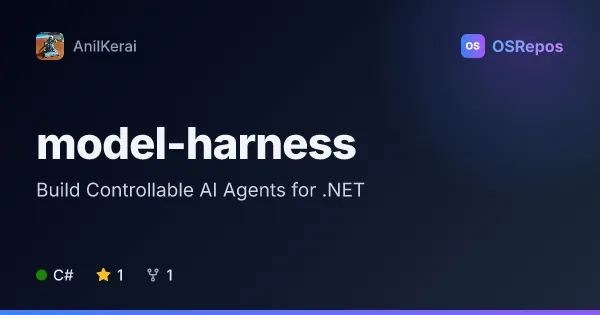
model-harness: Build Controllable AI Agents for .NET
Model Harness is a ports-and-adapters agent framework for .NET 8 and .NET 10. It wraps model calls in a configurable loop with guides for context and sensors for checks, budgets, and interventions.
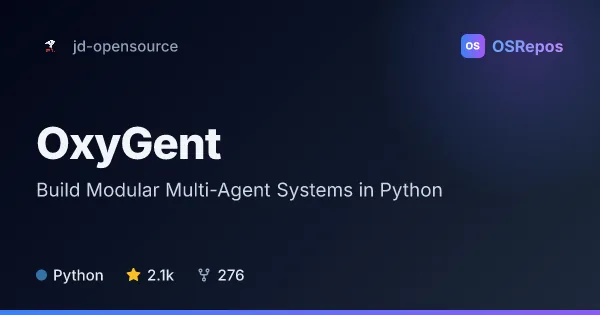
OxyGent: Build Modular Multi-Agent Systems in Python
OxyGent is a Python framework that uses its Oxy abstraction to assemble tools, models, and agents into observable, evolvable multi-agent systems. It is aimed at developers building and running agent teams with flexible collaboration patterns.
| model-harness | OxyGent | |
|---|---|---|
| Language | C# | Python |
| License | MIT | — |
| Stars | 1 | 2.1k |
| Forks | 1 | 276 |
| Last analyzed | Oct 18, 2026 | Oct 29, 2026 |
Key differences
- model-harness is a C# framework for bounded agents; OxyGent is a Python framework for modular multi-agent applications.
- model-harness provides guides and sensors around a model loop, with controls for turns, tokens, cost and runtime; OxyGent emphasizes agent relationships, planning and collaboration.
- model-harness includes adapters for Anthropic, Azure OpenAI and Ollama; OxyGent describes compatible API endpoints for local models and requires provider configuration for LLM use.
- model-harness uses an MIT license; OxyGent's repository reports NOASSERTION while its README advertises Apache 2.0, so confirm the applicable license.
- model-harness has 1 star and 1 fork, with development currently from one person; OxyGent has 2.1k stars and 276 forks.
- model-harness is suited to .NET teams seeking replaceable control and safety components; OxyGent is suited to Python teams building reusable, collaborative agent workflows.
Choose model-harness if you…
- need a .NET framework with a replaceable model loop and adapters for Anthropic, Azure OpenAI or Ollama.
- want controls for turn, token, cost and wall-clock limits, including partial results when a limit is reached.
- plan to customize context guides or safety sensors without changing the central agent loop.
Choose OxyGent if you…
- need Python components for assembling agents, tools and language models into multi-agent systems.
- want agents to collaborate through defined relationships, sub-agents and planning approaches.
- plan to reuse components across applications or explore multi-step workflows with tool use.
Compare the numbers side by side, or add more projects
This comparison is generated with AI from the OSRepos analyses of both projects. Always check each project's repository and documentation before choosing.