courses vs pytorch-deep-learning
Hands-on courses for Claude API and PyTorch learning
courses teaches developers Claude API use, prompting, evaluation, and tool use through guided materials. pytorch-deep-learning teaches PyTorch and deep learning through notebooks, exercises, and projects; it is aimed primarily at beginners with Python experience.
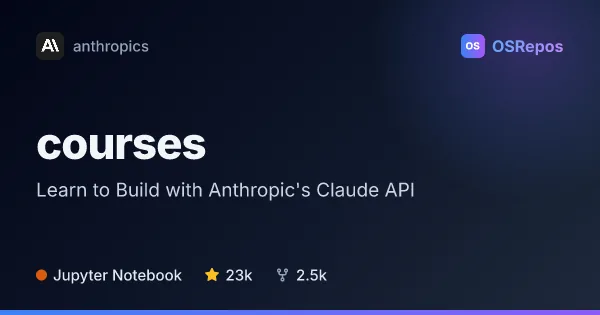
courses: Learn to Build with Anthropic's Claude API
Anthropic's courses is a set of educational notebooks and tutorials for learning to build with Claude, from API fundamentals and prompt engineering to evaluations and tool use. It suits developers and teams who want guided, practical exercises rather than a standalone software package.
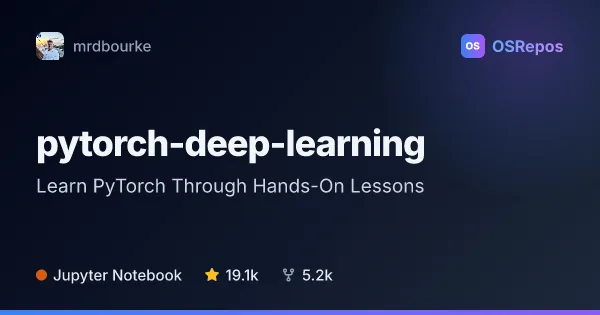
pytorch-deep-learning: Learn PyTorch Through Hands-On Courses
A free, code-first PyTorch course for beginners, with notebooks, exercises, solutions, slides, and an online book. Follow a path from tensor fundamentals to computer vision, transfer learning, paper replication, and model deployment.
| courses | pytorch-deep-learning | |
|---|---|---|
| Language | Jupyter Notebook | Jupyter Notebook |
| License | — | MIT |
| Stars | 23k | 19.1k |
| Forks | 2.5k | 5.2k |
| Last analyzed | Nov 2, 2026 | Oct 6, 2026 |
Key differences
- courses focuses on applying Claude through its API, while pytorch-deep-learning covers deep learning and PyTorch model-building.
- courses progresses from API fundamentals to prompting and tool use; pytorch-deep-learning moves from PyTorch fundamentals through computer vision, transfer learning, and deployment projects.
- courses is archived and lists its license as NOASSERTION; pytorch-deep-learning is not archived and uses the MIT license.
- courses often favors Claude 3 Haiku to keep student API costs down; pytorch-deep-learning exercises may require suitable compute, depending on the exercise.
- pytorch-deep-learning offers an online book, notebooks, exercises, solutions, and slides, while courses emphasizes structured, self-guided lessons and notebook-based examples.
Choose courses if you…
- want to learn Claude API fundamentals and prompting techniques.
- need guided material on prompt evaluation or Claude tool use.
- prefer a learning sequence focused on Claude workflows.
Choose pytorch-deep-learning if you…
- want to learn PyTorch by writing and experimenting with code.
- need practice with computer vision, custom datasets, or transfer learning.
- want project-based lessons covering experiment tracking, paper replication, or model deployment.
Compare the numbers side by side, or add more projects
This comparison is generated with AI from the OSRepos analyses of both projects. Always check each project's repository and documentation before choosing.