aport-agent-guardrails vs intent-plane
Agent action authorization projects compared
aport-agent-guardrails and intent-plane both place authorization checks between agents and actions. aport-agent-guardrails focuses on supported agent integrations and repository checks, while intent-plane centers on declared intents, signed policies, and independently verifiable decision records.
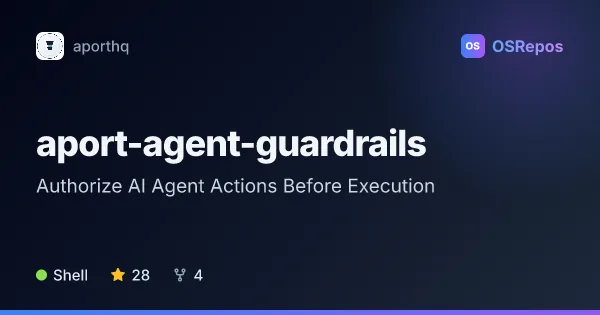
aport-agent-guardrails: Authorize AI Agent Actions Before Execution
APort Agent Guardrails checks supported AI agent tool calls against a passport and policy before execution. It provides runtime hooks and plugins for agent frameworks, plus a GitHub Actions repository guard; Node.js 18 or newer is required for the setup wizard.
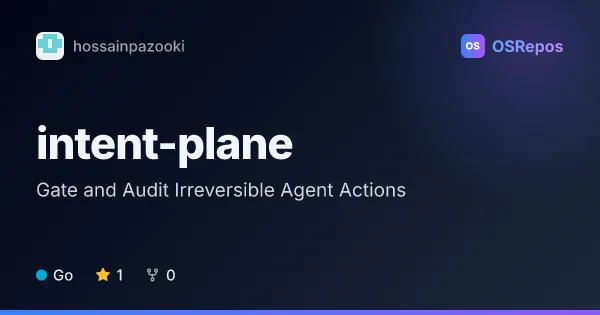
intent-plane: Gate and Audit Irreversible Agent Actions
intent-plane is a Go-based authorization gate for AI agents taking irreversible actions. Agents declare intent, the gate fails closed against a human-signed policy, and independent Go and Python verifiers can re-derive decisions from the durable feed.
| aport-agent-guardrails | intent-plane | |
|---|---|---|
| Language | Shell | Go |
| Stars | 28 | 1 |
| Forks | 4 | 0 |
| Last analyzed | Oct 23, 2026 | Nov 6, 2026 |
Key differences
- aport-agent-guardrails checks supported tool calls through framework hooks, plugins, and adapters; intent-plane evaluates declared intents at the tool-call boundary, with a focus on irreversible actions.
- aport-agent-guardrails supports local evaluation or hosted API verification; intent-plane uses signed policy artifacts and refuses requests when evaluation is uncertain.
- aport-agent-guardrails integrates with Claude Code, Cursor, OpenClaw, LangChain, and CrewAI, among others; intent-plane offers Go and Python SDKs plus optional LangChain and MCP adapters.
- aport-agent-guardrails is written in Shell and reports its license as NOASSERTION, while its README describes it as Apache 2.0; intent-plane is written in Go.
- aport-agent-guardrails records allow and deny decisions and supports rollout modes; intent-plane provides durable records designed for independent recomputation with Go and Python verifier tools.
- aport-agent-guardrails reports 27 stars and 4 forks; intent-plane reports 0 stars and 0 forks. intent-plane also describes key authority and record signing as staged or test-grade.
Choose aport-agent-guardrails if you…
- need runtime checks across supported coding-agent tools and frameworks.
- want to evaluate policies locally or use hosted verification, with options to audit before enforcing.
- need a GitHub Actions workflow for repository policy checks.
Choose intent-plane if you…
- need a fail-closed gate for declared intents before potentially irreversible actions.
- want Go or Python tools to independently recompute decisions from a durable feed.
- need derived idempotency keys to detect duplicate actions across retries and replicas.
Compare the numbers side by side, or add more projects
This comparison is generated with AI from the OSRepos analyses of both projects. Always check each project's repository and documentation before choosing.