cactus vs colibri
Local AI inference engines compared
cactus and colibri both run AI inference locally, but target different workloads and hardware constraints. cactus focuses on language, vision, and speech on mobile and edge devices, while colibri streams large Mixture-of-Experts models from storage to reduce memory requirements.
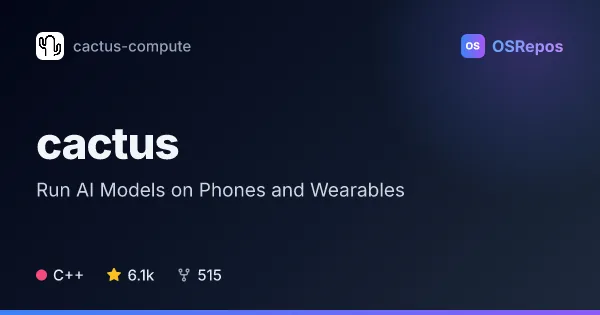
cactus: Run AI Models on Phones and Wearables
Cactus is a C++ inference engine for running quantized language, vision, and speech models on mobile and edge devices, with optional cloud handoff. It suits teams building on-device AI features who need native APIs and mobile bindings.

colibri: Run Large MoE Models on Local Hardware
colibri is a C inference engine that streams mixture-of-experts model weights from disk, letting large open models run on machines with limited RAM and no required GPU. It also provides a local dashboard and OpenAI- and Anthropic-compatible APIs.
| cactus | colibri | |
|---|---|---|
| Language | C++ | C |
| License | — | Apache-2.0 |
| Stars | 6.1k | 40k |
| Forks | 515 | 4.4k |
| Last analyzed | Oct 11, 2026 | Oct 6, 2026 |
Key differences
- cactus is a C++ engine for language, vision, and speech; colibri is a C engine focused on Mixture-of-Experts models.
- cactus targets phones, wearables, and other edge devices with quantization and device-focused kernels; colibri uses disk streaming, caching, and placement to run models that exceed available RAM or VRAM.
- cactus offers Swift, Kotlin, Flutter, React Native, Python, and Rust bindings; colibri provides CPU inference and optional CUDA, Metal, and Vulkan backends, with Python used for its launcher and gateway.
- Both offer OpenAI-compatible interfaces, but cactus provides a local HTTP server and colibri includes an API gateway and browser dashboard.
- cactus reports its license as NOASSERTION; colibri uses Apache-2.0.
- cactus supports optional cloud handoff for difficult queries; colibri focuses on local inference and storage-backed execution.
Choose cactus if you…
- need language, vision, or speech inference on mobile and edge devices.
- want quantization options and bindings for mobile or cross-platform applications.
- need local inference with optional cloud handoff for harder queries.
Choose colibri if you…
- need to run large MoE models when their full expert sets do not fit in RAM or VRAM.
- want to experiment with storage-backed inference, model placement, or caching.
- prefer a C inference engine with optional GPU backends and included serving tools.
Compare the numbers side by side, or add more projects
This comparison is generated with AI from the OSRepos analyses of both projects. Always check each project's repository and documentation before choosing.