cactus vs modular
Mobile edge inference compared with AI development tools
cactus is a C++ inference engine focused on running language, vision, and speech models on mobile and edge devices. modular brings together MAX for model development and deployment with Mojo, a programming language and compiler, so it spans model serving and accelerator development as well as language tooling.
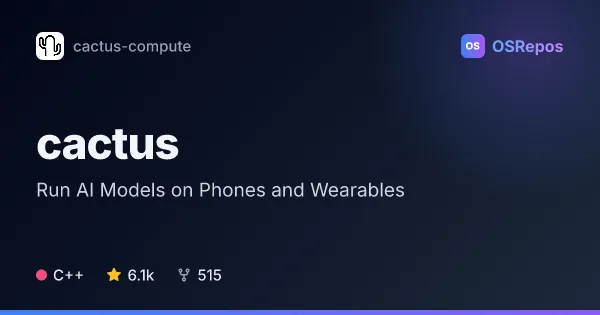
cactus: Run AI Models on Phones and Wearables
Cactus is a C++ inference engine for running quantized language, vision, and speech models on mobile and edge devices, with optional cloud handoff. It suits teams building on-device AI features who need native APIs and mobile bindings.

modular: Build AI Software with MAX and Mojo
The Modular Platform combines the MAX Framework and Mojo language for AI development and deployment. It includes source for Mojo, MAX runtimes and compilers, GPU kernels, model pipelines, and an inference server.
| cactus | modular | |
|---|---|---|
| Language | C++ | Mojo |
| Stars | 6.1k | 30.1k |
| Forks | 515 | 3.2k |
| Last analyzed | Oct 11, 2026 | Nov 6, 2026 |
Key differences
- cactus centers on local inference for phones, wearables, and embedded devices, while modular covers broader AI development and deployment alongside Mojo tooling.
- cactus uses a C++ runtime with device-focused kernels and quantization; modular provides Python-based MAX model pipelines, an accelerator library, and the Mojo compiler and standard library.
- cactus offers mobile and cross-platform bindings, local command-line tools, and an optional cloud handoff; modular offers a MAX inference server with an OpenAI-compatible endpoint.
- Both repositories report NOASSERTION metadata, but their licensing notes differ: cactus advises checking its terms, while modular describes Apache License 2.0 with LLVM Exceptions for the repository and a separate Modular Community License for MAX use and distribution.
- cactus is aimed at developers adding on-device AI features; modular serves developers working on model pipelines, serving systems, accelerator kernels, or Mojo software.
Choose cactus if you…
- need local language, vision, or speech inference on mobile or edge devices.
- want device-focused quantization, kernels, and bindings for mobile app frameworks.
- plan to combine local inference with optional cloud handoff for difficult queries.
Choose modular if you…
- want to build Python-based model pipelines or explore model serving with MAX.
- need tools for accelerator kernels or want to develop with Mojo.
- prefer a repository that brings together AI deployment components and programming-language tooling.
Compare the numbers side by side, or add more projects
This comparison is generated with AI from the OSRepos analyses of both projects. Always check each project's repository and documentation before choosing.