oh-my-pi vs openinterpreter
Terminal coding agents compared
oh-my-pi and openinterpreter are terminal-based coding agents that can also connect to editor workflows. oh-my-pi emphasizes IDE-aware code tools and extensible interfaces, while openinterpreter focuses on a Rust-based Codex-derived implementation, low-cost models, and multiple agent harnesses.
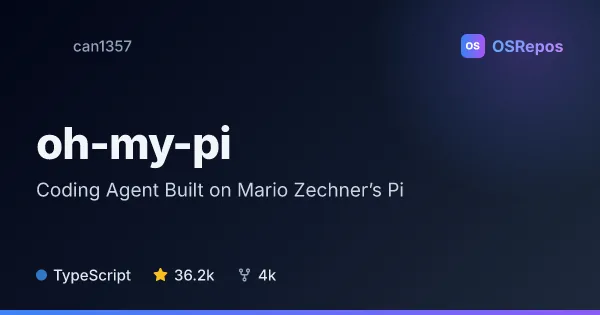
oh-my-pi: Coding Agent Built on Mario Zechner’s Pi
oh-my-pi is a terminal-first coding agent and IDE-aware fork of Mario Zechner’s Pi, with built-in code tools, subagents, and editor integration. It runs on macOS, Linux, and Windows, and can also be embedded as a TypeScript SDK.
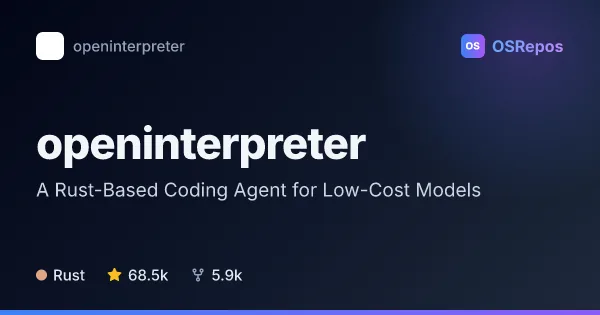
openinterpreter: Run Coding Agents in Your Terminal
Open Interpreter is a Rust-based terminal coding agent designed to get useful results from low-cost language models. It supports multiple agent harnesses and connects to ACP-compatible editors and Codex SDK clients.
| oh-my-pi | openinterpreter | |
|---|---|---|
| Language | TypeScript | Rust |
| License | MIT | Apache-2.0 |
| Stars | 36.2k | 68.5k |
| Forks | 4k | 5.9k |
| Last analyzed | Oct 21, 2026 | Oct 3, 2026 |
Key differences
- oh-my-pi combines a TypeScript agent and CLI with a Rust native core; openinterpreter is implemented in Rust.
- oh-my-pi includes language-server operations, debugging through DAP, persistent code execution, and parallel subagents; openinterpreter highlights harness switching, command sandboxing, and a QA skill.
- oh-my-pi offers terminal, one-shot, SDK, RPC, and ACP entry points; openinterpreter supports terminal sessions, ACP, the Codex exec protocol, and a Codex SDK binary override.
- oh-my-pi is licensed under MIT, while openinterpreter is licensed under Apache-2.0.
- oh-my-pi supports configurable model and provider routing; openinterpreter focuses on low-cost models and supports OpenAI-compatible providers through Chat Completions mode.
Choose oh-my-pi if you…
- need language-server operations, debugging, or persistent code execution for repository work.
- want parallel subagents, isolated worktrees, or structured results.
- need a TypeScript SDK, RPC interface, or configurable provider routing.
Choose openinterpreter if you…
- want a Rust-based agent with support for several model-specific harnesses.
- need native command sandboxing across macOS, Linux, and Windows.
- want ACP or Codex exec protocol compatibility, or shared AGENTS.md and skills conventions.
Compare the numbers side by side, or add more projects
This comparison is generated with AI from the OSRepos analyses of both projects. Always check each project's repository and documentation before choosing.