observers vs langwatch
LLM observability and operations tools compared
observers records interactions from supported generative AI clients and syncs them to selected storage backends. langwatch combines observability with simulation testing, prompt management, an AI gateway, and governance, making it broader in scope.
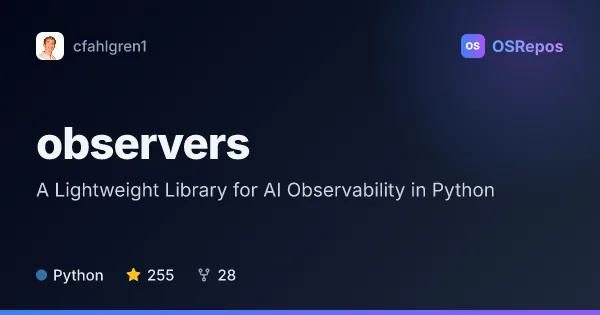
observers: Track and Store AI API Interactions
Observers wraps generative AI clients to capture interactions and sync them to storage backends. It suits Python teams that need lightweight observability across supported LLM providers, with storage options ranging from DuckDB to OpenTelemetry-compatible services.
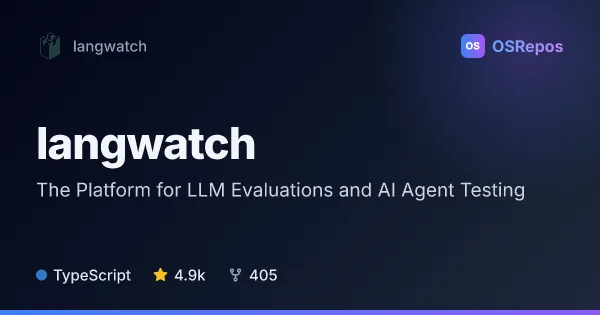
langwatch: Test and Monitor LLM Applications and AI Agents
LangWatch helps teams evaluate, test, and monitor LLM applications and AI agents in production. It combines observability, simulation testing, prompt management, an AI gateway, and governance, with cloud and self-hosted options.
| observers | langwatch | |
|---|---|---|
| Language | Python | TypeScript |
| License | — | Apache-2.0 |
| Stars | 255 | 4.9k |
| Forks | 28 | 405 |
| Last analyzed | Oct 3, 2026 | Oct 3, 2026 |
Key differences
- observers is a Python library that wraps clients and separates interaction capture from storage; langwatch is a TypeScript platform spanning testing and production operations.
- observers focuses on recording requests and responses for inspection or querying through backends such as DuckDB, Argilla, and OpenTelemetry-compatible services; langwatch adds agent simulations, prompt management, gateway routing, and organizational governance.
- observers supports synchronous and asynchronous observers for several client integrations; langwatch also covers coding-agent sessions, usage-cost analysis, and voice-agent simulations.
- observers lists no license in the supplied project details; langwatch describes its core as Apache-2.0, with commercial licensing required for production use of enterprise modules and MIT-licensed SDKs.
- observers offers local and hosted storage options, with backend capabilities varying; langwatch offers cloud and self-hosted options, and self-hosting requires Node.js.
- The supplied repository figures list observers at 255 stars and 28 forks, and langwatch at 4.9k stars and 405 forks.
Choose observers if you…
- need a Python library to capture interactions through supported clients without replacing the familiar client workflow.
- want to send observations to a backend such as DuckDB, Hugging Face Datasets, Argilla, or an OpenTelemetry-compatible service.
- prefer a focused observation layer for inspecting or querying model requests and responses.
Choose langwatch if you…
- need to evaluate agents with simulation tests as well as monitor them in production.
- want prompt management, an AI gateway with virtual keys and budgets, or organizational AI governance workflows.
- need to inspect coding-agent sessions and analyze costs across teams or pull requests.
Compare the numbers side by side, or add more projects
This comparison is generated with AI from the OSRepos analyses of both projects. Always check each project's repository and documentation before choosing.