ttsfm vs GPT-SoVITS
Self-hosted text-to-speech projects compared
ttsfm provides an OpenAI-compatible API, Python client, CLI, and web playground backed by the openai.fm service. GPT-SoVITS is a toolkit for voice cloning, speech conversion, and text-to-speech, with workflows for preparing data and fine-tuning models.
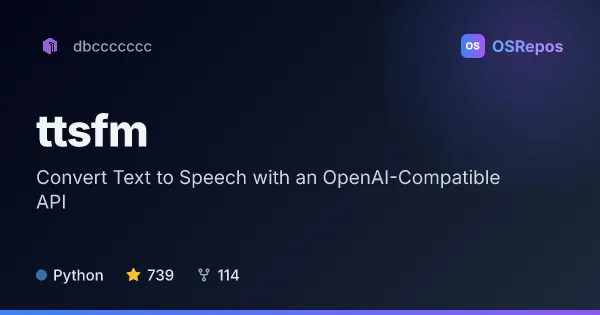
ttsfm: Convert Text to Speech with an OpenAI-Compatible API
TTSFM provides a Python client, REST API, and web playground for text-to-speech through a service modeled on OpenAI’s interface. It can suit prototypes and self-hosted integrations, but it relies on a reverse-engineered backend and has had no commits in the last 90 days.
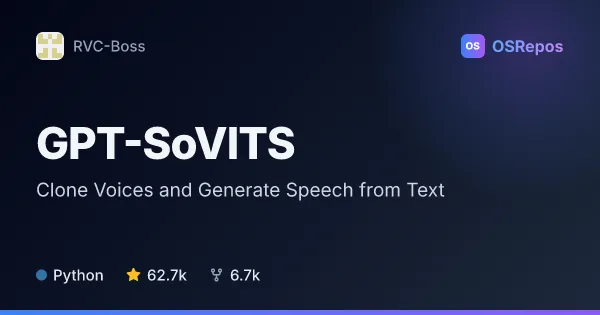
GPT-SoVITS: Clone Voices and Generate Speech from Text
GPT-SoVITS is a Python voice-cloning and text-to-speech toolkit with a WebUI for training and inference. It supports zero-shot synthesis from a short voice sample and fine-tuning with a small speaker dataset.
| ttsfm | GPT-SoVITS | |
|---|---|---|
| Language | Python | Python |
| License | MIT | MIT |
| Stars | 739 | 62.7k |
| Forks | 114 | 6.7k |
| Last analyzed | Oct 11, 2026 | Oct 12, 2026 |
Key differences
- ttsfm exposes a reverse-engineered speech service, while GPT-SoVITS supports workflows for adapting and using voice models.
- ttsfm offers an OpenAI-compatible endpoint and client; GPT-SoVITS centers on its WebUI for data preparation, training, and speech generation.
- GPT-SoVITS lists multilingual inference and voice conversion; ttsfm lists voice and audio-format choices, long-input handling, and streaming support.
- Both are Python projects with MIT licenses, but ttsfm warns against commercial or production use because it relies on a reverse-engineered backend.
- GPT-SoVITS documents Windows, Linux, macOS, and Docker installation, while ttsfm supports package use and Docker.
- GPT-SoVITS has 62.3k stars and 6.7k forks; ttsfm has 739 stars and 114 forks, and is marked quiet with no commits in the last 90 days.
Choose ttsfm if you…
- need an OpenAI-compatible speech API for a prototype or self-hosted integration.
- want a Python client, CLI, or playground to try speech generation without building an API client.
- are exploring the reverse-engineered service within its stated non-commercial scope.
Choose GPT-SoVITS if you…
- want to clone or adapt a voice using a short reference clip or a small amount of training audio.
- need WebUI tools for audio segmentation, transcription, labeling, and fine-tuning.
- want to experiment with multilingual speech workflows or speech conversion.
Compare the numbers side by side, or add more projects
This comparison is generated with AI from the OSRepos analyses of both projects. Always check each project's repository and documentation before choosing.