seclab-taskflow-agent vs ruflo
YAML-driven security workflows versus a coding-agent harness
seclab-taskflow-agent defines multi-agent workflows in YAML, with a focus on security research and vulnerability triage. ruflo provides a broader coordination and automation layer for Claude Code and Codex, including persistent memory and agent integrations.
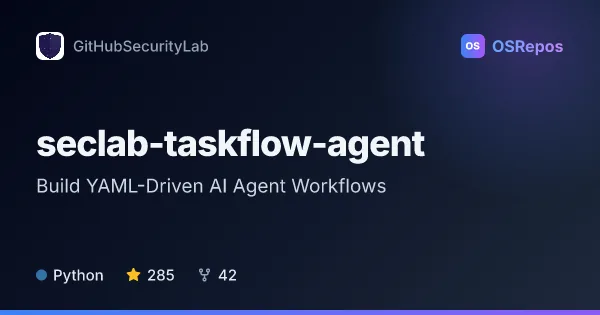
seclab-taskflow-agent: Build YAML-Driven AI Agent Workflows
GitHub Security Lab’s Taskflow Agent is an MCP-enabled, multi-agent framework for defining workflows in YAML. Built on OpenAI’s Agents SDK, it targets security research and vulnerability triage without requiring users to write workflow code.
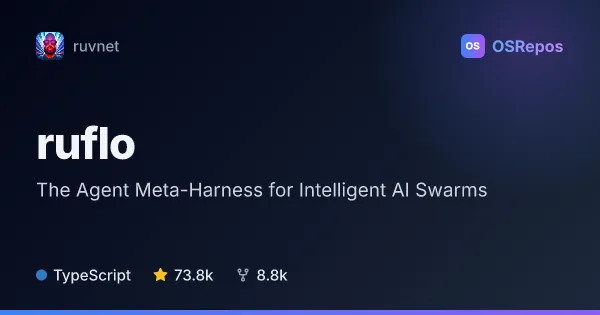
ruflo: Coordinate AI Agents and Autonomous Workflows
Ruflo is a TypeScript agent harness for Claude Code and Codex. It adds coordinated agent teams, persistent memory, workflow automation, and MCP integrations for developers building multi-agent systems.
| seclab-taskflow-agent | ruflo | |
|---|---|---|
| Language | Python | TypeScript |
| License | MIT | MIT |
| Stars | 285 | 73.8k |
| Forks | 42 | 8.8k |
| Last analyzed | Nov 3, 2026 | Oct 3, 2026 |
Key differences
- seclab-taskflow-agent is written in Python, while ruflo is written in TypeScript.
- seclab-taskflow-agent centers on declarative YAML taskflows; ruflo offers a CLI setup path, plugins, workflows, and agent coordination topologies.
- seclab-taskflow-agent targets security research and vulnerability triage, while ruflo focuses on coding workflows and collaboration among agents.
- seclab-taskflow-agent supports OpenAI Agents, GitHub Copilot, and Anthropic SDK backends; ruflo lists integrations including Claude, GPT, Gemini, Cohere, and Ollama.
- seclab-taskflow-agent describes itself as experimental and highlights backend capability differences; ruflo advises reviewing its broad feature set and evaluating plugin permissions and federation trust.
- Both projects use the MIT license; seclab-taskflow-agent has 285 stars and 42 forks, while ruflo has 73.8k stars and 8.8k forks.
Choose seclab-taskflow-agent if you…
- need YAML-defined workflows for repeatable security research or vulnerability triage.
- want offline linting, task checkpointing, and run manifests for agent workflows.
- prefer a focused framework built around MCP tools and configurable model backends.
Choose ruflo if you…
- want to coordinate agents in Claude Code or Codex workflows.
- need persistent memory, reusable agent roles, and workflow automation in a coding harness.
- want to explore agent collaboration across installations, with documented identity and data-handling controls.
Compare the numbers side by side, or add more projects
This comparison is generated with AI from the OSRepos analyses of both projects. Always check each project's repository and documentation before choosing.