open-r1 vs torchtune
LLM training and post-training projects compared
open-r1 documents a DeepSeek-R1 reproduction pipeline, including data generation, training, and evaluation. torchtune provides editable PyTorch recipes for a broader range of LLM post-training workflows; both projects are no longer actively maintained.
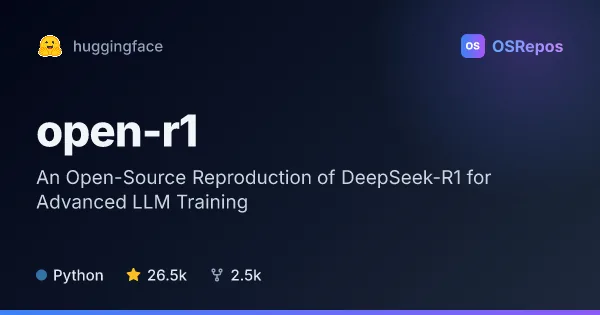
open-r1: Reproduce DeepSeek-R1 Training and Evaluation
Open R1 is Hugging Face’s toolkit and research project for reproducing the DeepSeek-R1 pipeline with open datasets, training scripts, and evaluation workflows. It is no longer maintained; its training work has moved to TRL.
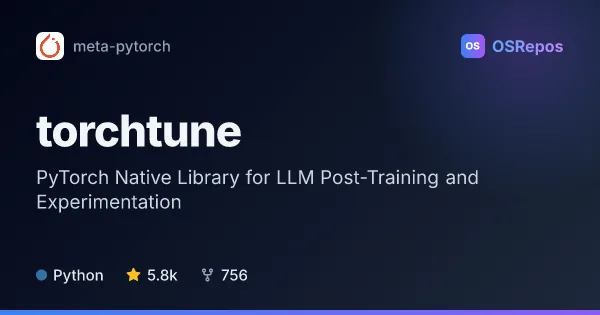
torchtune: Fine-Tune and Post-Train Large Language Models
torchtune is a PyTorch library for configuring and running LLM post-training workflows, from supervised fine-tuning to preference optimization. It is aimed at developers who want editable recipes and model-specific configs, but is no longer actively maintained.
| open-r1 | torchtune | |
|---|---|---|
| Language | Python | Python |
| License | Apache-2.0 | BSD-3-Clause |
| Stars | 26.5k | 5.8k |
| Forks | 2.5k | 756 |
| Last analyzed | Oct 3, 2026 | Oct 3, 2026 |
Key differences
- open-r1 focuses on reproducing DeepSeek-R1, while torchtune covers post-training methods such as SFT, DPO, PPO, GRPO, distillation, and quantization-aware training.
- open-r1 includes dataset-generation and decontamination workflows plus reasoning and code-generation evaluation; torchtune emphasizes configurable training recipes and model implementations.
- open-r1 documents distributed workflows using Accelerate, DeepSpeed, and Slurm; torchtune offers single-device, multi-device, and some multi-node options.
- open-r1 uses the Apache-2.0 license, while torchtune uses BSD-3-Clause.
- open-r1 is explicitly no longer maintained; torchtune's development wound down in 2025 and it is no longer actively maintained.
Choose open-r1 if you…
- want a reference for reproducing the DeepSeek-R1 pipeline with open datasets and training scripts.
- need examples of reasoning-data generation, contamination checks, or reasoning and code-generation evaluation.
- are comfortable adapting GPU-oriented research workflows and their supporting infrastructure.
Choose torchtune if you…
- want editable PyTorch recipes for a range of LLM post-training methods.
- need model-specific configs or options such as LoRA, QLoRA, and activation offloading.
- are maintaining an existing torchtune workflow or studying its training recipes.
This comparison is generated with AI from the OSRepos analyses of both projects. Always check each project's repository and documentation before choosing.