OxyGent vs Agentarium
Python frameworks for multi-agent systems compared
OxyGent and Agentarium are Python frameworks for building applications with multiple AI agents. OxyGent emphasizes reusable components, agent collaboration, and planning, while Agentarium focuses on interactive agent behavior, memory, and simulation checkpoints.
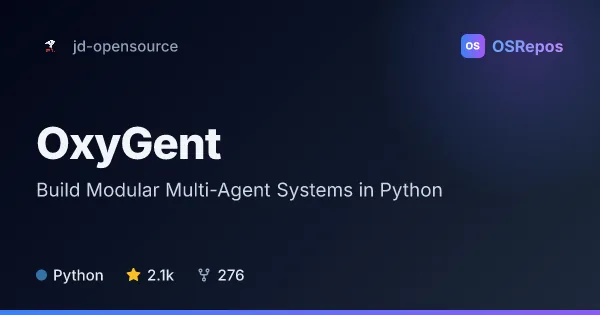
OxyGent: Build Modular Multi-Agent Systems in Python
OxyGent is a Python framework that uses its Oxy abstraction to assemble tools, models, and agents into observable, evolvable multi-agent systems. It is aimed at developers building and running agent teams with flexible collaboration patterns.
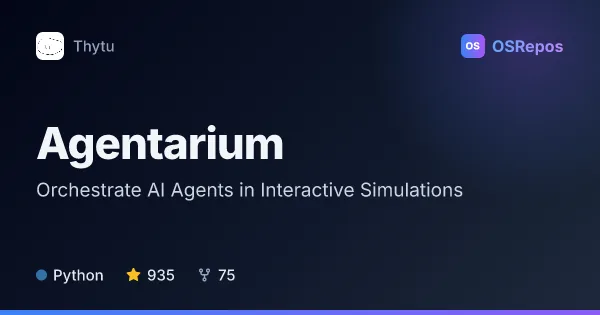
Agentarium: Orchestrate AI Agents in Interactive Simulations
Agentarium is a Python framework for creating and coordinating AI agents in interactive environments, with support for memory, custom actions, and checkpoints. It integrates AI providers through aisuite, making it useful for prototyping multi-agent workflows and simulations.
| OxyGent | Agentarium | |
|---|---|---|
| Language | Python | Python |
| License | — | Apache-2.0 |
| Stars | 2.1k | 935 |
| Forks | 276 | 75 |
| Last analyzed | Oct 29, 2026 | Oct 15, 2026 |
Key differences
- OxyGent combines tools, language models, and agents through a shared component model; Agentarium centers on agents with individual characteristics and capabilities.
- OxyGent describes dynamic and hybrid planning, dependency mapping, and decision auditability; Agentarium highlights context-based actions, direct agent communication, and memories of past interactions.
- OxyGent includes a web service entry point for running a multi-agent system; Agentarium supports saving and restoring agent state and interactions with checkpoints.
- OxyGent reports a NOASSERTION license, while Agentarium lists Apache-2.0.
- OxyGent reports 2.1k stars and 276 forks; Agentarium reports 935 stars and 74 forks.
Choose OxyGent if you…
- need reusable tools, models, and agents assembled as modular components.
- want to define agent relationships and explore dynamic or hybrid planning in Python.
- need a web service entry point or features for inspecting execution and decisions.
Choose Agentarium if you…
- want to prototype interactive agent scenarios with context-based actions and direct communication.
- need agents to retain memories or save and restore simulation state with checkpoints.
- want to extend agents with custom actions implemented as Python functions.
Compare the numbers side by side, or add more projects
This comparison is generated with AI from the OSRepos analyses of both projects. Always check each project's repository and documentation before choosing.