faker vs mimesis
Python synthetic data generators compared
faker and mimesis are Python libraries for generating realistic-looking synthetic data for development and testing. faker highlights localization, command-line generation, seeding, and a pytest fixture, while mimesis includes schema-based and relational data generation and lists support for 47 locales.
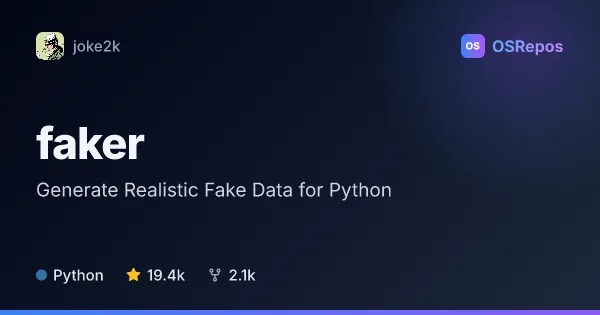
faker: Generate Realistic Fake Data for Python
Faker is a Python library for generating randomized, localized data for tests, database bootstrapping, load testing, and anonymization workflows. It offers bundled and custom providers, plus a command-line interface and pytest fixture.

mimesis: Generate Realistic Fake Data in Python
Mimesis generates realistic synthetic data across languages and locales for Python development and testing. Use it to create test records, API fixtures, sample datasets, or structured and relational data.
| faker | mimesis | |
|---|---|---|
| Language | Python | Python |
| License | MIT | MIT |
| Stars | 19.4k | 4.8k |
| Forks | 2.1k | 364 |
| Last analyzed | Oct 9, 2026 | Oct 3, 2026 |
Key differences
- faker reports 19.4k stars and 2.1k forks; mimesis reports 4.8k stars and 364 forks.
- faker supports selecting or combining locales; mimesis lists support for 47 locales.
- faker provides command-line generation options and a pytest fixture; mimesis focuses on schema generation, including nested structures, and relational datasets with foreign keys.
- faker documents seeding, unique-value generation, and a `use_weighting` option; mimesis highlights typed APIs for editor autocompletion.
- faker lists Python 3.8 or newer as its current requirement; mimesis lists Python 3.10 through 3.14 and PyPy among supported runtimes.
- Both projects use the MIT License and are not archived.
Choose faker if you…
- need command-line generation or a pytest fixture.
- want controls for seeded or unique values, or the `use_weighting` option.
- need to select or combine locales.
Choose mimesis if you…
- need to generate nested or schema-based data.
- want relational datasets with foreign keys.
- need typed APIs for editor autocompletion or support for 47 locales.
Compare the numbers side by side, or add more projects
This comparison is generated with AI from the OSRepos analyses of both projects. Always check each project's repository and documentation before choosing.