motion vs theatre
Web animation libraries compared
motion and theatre are TypeScript libraries for animating web experiences. motion focuses on framework APIs and interaction patterns such as gestures, springs, and layout transitions, while theatre combines code with a visual editor for detailed choreography across 3D, HTML, SVG, and JavaScript values.
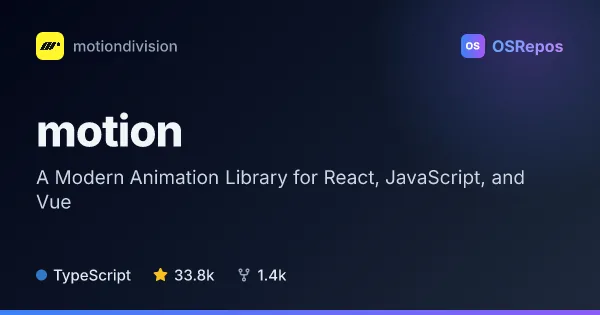
motion: Animate Interfaces with JavaScript, React, and Vue
Motion is an animation library for JavaScript, React, and Vue. It provides a shared toolkit for gestures, spring animations, layout transitions, and scroll-linked effects, for projects that need interactive motion without building an animation system from scratch.
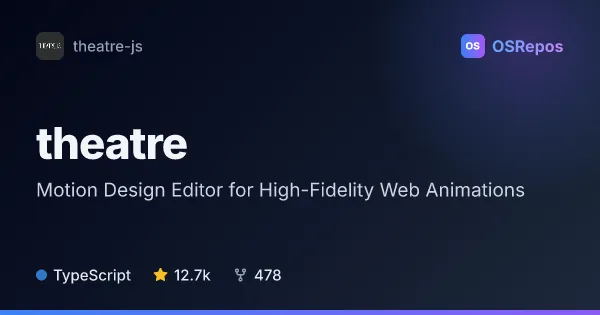
theatre: Create and Edit Motion Graphics for the Web
Theatre.js is a TypeScript animation library with visual tools for creating detailed motion graphics on the web. Use it to animate 3D scenes, HTML and SVG, or other JavaScript values, either programmatically or through its editor.
| motion | theatre | |
|---|---|---|
| Language | TypeScript | TypeScript |
| License | MIT | Apache-2.0 |
| Stars | 33.8k | 12.7k |
| Forks | 1.4k | 478 |
| Last analyzed | Oct 3, 2026 | Oct 3, 2026 |
Key differences
- motion provides APIs for JavaScript, React, and Vue; theatre supports animation through React or other libraries and can animate arbitrary JavaScript values.
- motion emphasizes gestures, spring animations, layout transitions, and scroll-linked effects; theatre emphasizes visual editing, precise timing, and choreographed sequences.
- theatre includes a visual editor alongside its code library; motion describes declarative and JavaScript animation APIs and timelines.
- motion is MIT licensed; theatre uses Apache 2.0 for core and most packages, while its studio package uses AGPL 3.0.
- theatre's development has temporarily moved to a private repository as its team works toward version 1.0; motion is not described as archived.
Choose motion if you…
- need animation APIs for JavaScript, React, or Vue.
- want gestures, springs, layout transitions, or scroll-linked effects.
- prefer a core library described as MIT licensed.
Choose theatre if you…
- want to design and edit animations with a visual editor as well as code.
- need to choreograph 3D scenes or animate HTML, SVG, and JavaScript values.
- are building detailed motion graphics, generative visuals, or interactive art.
Compare the numbers side by side, or add more projects
This comparison is generated with AI from the OSRepos analyses of both projects. Always check each project's repository and documentation before choosing.