plur vs deja-vu
Local memory for coding agents compared
plur and deja-vu help coding agents reuse knowledge across sessions and tools. plur saves explicit memories as local YAML, while deja-vu indexes existing agent session history for search and recall.

plur: Share Persistent Memory Across AI Agents
PLUR gives AI agents a shared, local-first memory store of readable YAML files. It suits developers who want corrections and project conventions to carry across sessions and tools without relying on a hosted memory service.
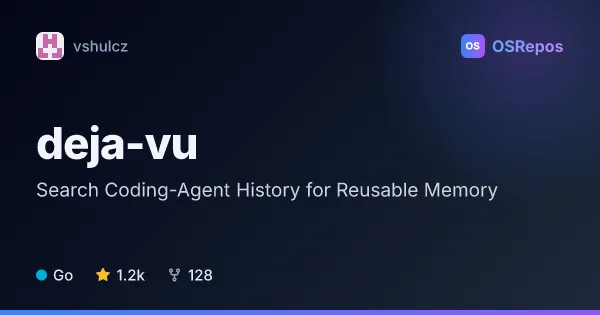
deja-vu: Search Coding-Agent History for Reusable Memory
deja-vu is a Go-based local memory tool that indexes existing session history from Claude Code, Codex, Cursor and 39 more coding agents. It provides search, MCP recall and hooks without requiring an LLM, so agents can reuse earlier decisions and fixes.
| plur | deja-vu | |
|---|---|---|
| Language | TypeScript | Go |
| License | Apache-2.0 | MIT |
| Stars | 298 | 1.2k |
| Forks | 36 | 128 |
| Last analyzed | Oct 10, 2026 | Oct 19, 2026 |
Key differences
- plur stores corrections, preferences, conventions, and events as editable YAML; deja-vu builds an index from existing agent session files.
- plur supports keyword and embedding-based search, with keyword fallback; deja-vu works without an LLM and offers optional semantic search through configured embedding services.
- plur is written in TypeScript and licensed under Apache-2.0; deja-vu is written in Go and licensed under MIT.
- plur connects agent environments through MCP and integrations, and can sync selected memory using Git; deja-vu offers CLI and terminal search, MCP recall, and hooks for automatic recall.
- plur highlights project and personal memory scopes, while deja-vu includes history-oriented tools for inspecting prior work, handoffs, and session resumption.
- plur notes a substantial open-issue backlog; deja-vu describes macOS and Linux as its more established platforms and asks for Windows field reports.
Choose plur if you…
- want readable, directly editable YAML memories that persist across sessions.
- need to share selected project knowledge while keeping personal memories separate.
- want explicit corrections, preferences, conventions, or event timelines available across supported agent tools.
Choose deja-vu if you…
- want to search existing agent history without writing memory notes first.
- need CLI or terminal search, MCP recall, or hooks to surface prior work.
- want history tools for investigating past fixes, commands, discussions, or file-related sessions.
Compare the numbers side by side, or add more projects
This comparison is generated with AI from the OSRepos analyses of both projects. Always check each project's repository and documentation before choosing.