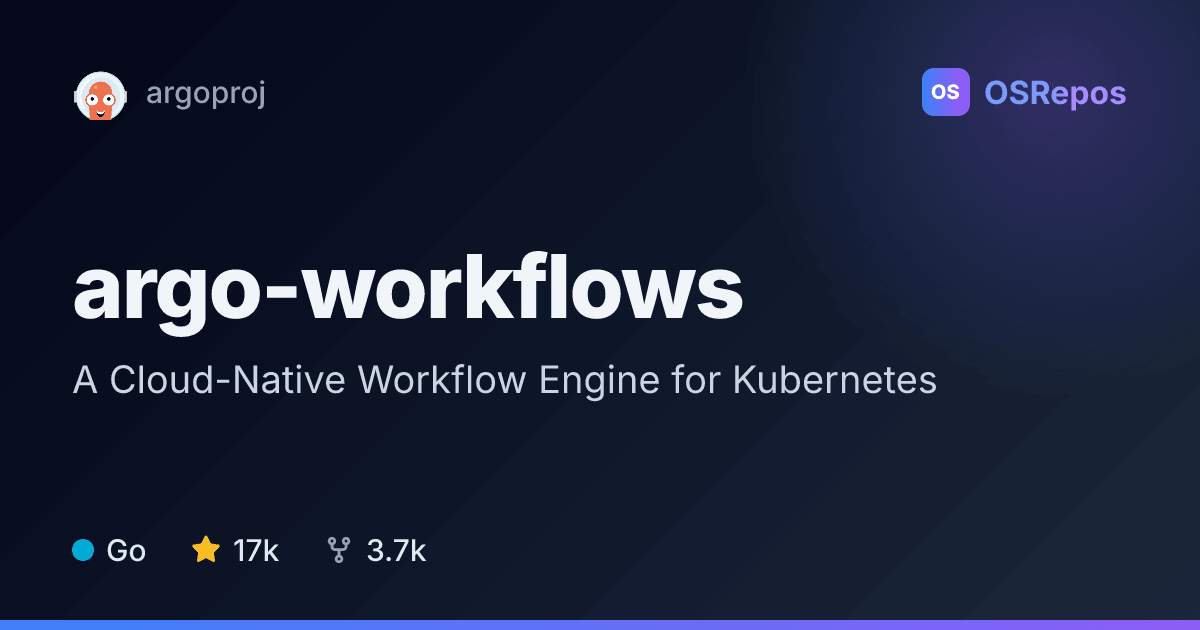
argo-workflows: Run Container Workflows on Kubernetes
Summary
Argo Workflows runs container-based jobs on Kubernetes as step sequences or dependency graphs. It suits teams building batch, data, machine-learning, and CI/CD pipelines that need Kubernetes-native execution and orchestration.
At a glance
- Language
- Go
- License
- Apache-2.0
- Stars
- 17k
- Forks
- 3.7k
- Added to OSRepos
- February 12, 2026
- Last analyzed
- October 3, 2026
Topics
Click on any tag to explore related repositories
Use at your own risk
OSRepos shares public repositories for knowledge and discovery only. Any installation, execution, configuration, or use of code from these repositories is the user's own responsibility. Always review the repository, source code, dependencies, licenses, and security implications before running or installing anything. OSRepos is not responsible for issues, damages, or losses resulting from third-party repositories.
Overview
Argo Workflows is a workflow engine that represents workflows as Kubernetes custom resources. It runs each workflow step in a container and supports both ordered steps and DAGs, helping teams coordinate parallel jobs without relying on a separate VM- or server-based execution environment.
It is a fit for teams already operating Kubernetes who need to define, run, and manage repeatable pipelines there. Workflow definitions can express dependencies, inputs and outputs, retries, and other execution behavior, while the project provides a UI, CLI, and server API for interacting with workflows.
Key Features
- Define workflows as sequences of steps or directed acyclic graphs.
- Run containerized jobs in parallel on Kubernetes.
- Pass parameters and artifacts between steps, with support for multiple artifact storage backends.
- Use templates, loops, conditionals, retries, timeouts, and workflow scheduling.
- Inspect and manage workflows through a UI, CLI, or REST and gRPC server interfaces.
- Configure workflow suspension, resumption, cancellation, and cleanup of completed workflows.
- Integrate with Kubernetes scheduling options, volumes, and resource orchestration.
- Use client libraries for Go, Java, Python through Hera, and TypeScript through Juno.
Use Cases
- Data and batch processing teams can run parallel container jobs when work needs to scale across a Kubernetes cluster.
- Machine-learning practitioners can orchestrate multi-step training or data preparation pipelines using containerized tasks.
- Platform and infrastructure teams can define repeatable automation workflows that interact with Kubernetes resources.
- CI/CD teams can use workflow graphs to coordinate build, test, and deployment jobs on Kubernetes.
Project Facts
- Language: Go
- License: Apache-2.0
- Stars: 17k
- Forks: 3.7k
- Topics: airflow, argo, argo-workflows, batch-processing, cloud-native, cncf, dag, data-engineering, gitops, hacktoberfest, k8s, knative, kubernetes, machine-learning, mlops, pipelines, workflow, workflow-engine
- Archived: No
Getting Started
Start with the quick-start guide and walk-through examples. See the repository README for project details and links to the full documentation.
Alternatives
- Flyte: Flyte focuses on reproducible data, machine-learning, and analytics pipelines, while Argo Workflows provides general-purpose Kubernetes workflow orchestration.
- Dagger: Dagger runs programmable build and delivery pipelines across environments, while Argo Workflows orchestrates container workflows directly on Kubernetes.
Considerations
Argo Workflows requires a Kubernetes cluster and runs workflow steps as containers, so it is most relevant when Kubernetes is already part of the operating environment. Teams should account for the work of operating Kubernetes and configuring workflow storage, permissions, and scheduling to suit their needs. The project is distributed under the Apache-2.0 license.
Source repository
Open the original repository on GitHub.
21 counted GitHub visits
Related repositories
Similar repositories that may be relevant next.
e2a: Email API for Applications and AI Agents
September 29, 2026
e2a provides an email API and relay for applications and AI agents. It supports transactional sending, inbound mailboxes, and agent replies, with optional human review and hosted or Docker-based deployment.
router: Route AI Requests to the Best Model
September 28, 2026
weave-os/router is a Go proxy that routes AI requests across configured model providers, while accepting Anthropic, OpenAI, and Gemini API formats. It suits developers who want model choice and routing behind one endpoint, including agent and coding-tool users.
ksail: Create and Operate Kubernetes Clusters
September 27, 2026
KSail is a Go-based toolkit for creating and operating Kubernetes clusters across local, nested, and cloud providers. It brings provisioning, GitOps, secrets, cluster operations, and AI interfaces into one tool, for developers and platform teams who want a unified workflow.
Memoh: Give AI Agents Dedicated Cloud Computers
September 26, 2026
Memoh is a multi-agent platform that gives each agent an isolated, always-on workspace with a desktop, browser, network access, and long-term memory. Use your own API keys or host agents such as Claude Code and Codex, either in Memoh Cloud or on your own infrastructure.