LogoAI: AI-Powered Logo Generator with Next.js and Nebius AI
This repository profile is provided by osrepos.com, an open source repository discovery platform.

Summary
LogoAI is an innovative web application that leverages artificial intelligence to create unique and professional logos. Built with Next.js and TypeScript, and powered by Nebius AI, it offers a streamlined experience for generating custom logos for various brands. Users can explore multiple AI models, customize designs, and manage their generation history.
Repository Information
Topics
Click on any tag to explore related repositories
Use at your own risk
OSRepos shares public repositories for knowledge and discovery only. Any installation, execution, configuration, or use of code from these repositories is the user's own responsibility. Always review the repository, source code, dependencies, licenses, and security implications before running or installing anything. OSRepos is not responsible for issues, damages, or losses resulting from third-party repositories.
Introduction
LogoAI is a modern, full-stack web application designed to simplify logo creation using artificial intelligence. This project, developed by Arindam200, provides a seamless platform for generating unique and professional logos powered by Nebius AI. It features multiple AI models like FLUX and Stability AI SDXL, extensive customization options, user history tracking, and a public gallery.
Installation
To get LogoAI up and running locally, follow these steps. You will need Node.js 18+ and accounts with API keys for NeonDB, Nebius AI, Clerk, Vercel, Upstash, Helicone, and Umami.
- Clone the repository:
git clone https://github.com/Arindam200/logo-ai.git cd logo-ai - Install dependencies:
npm install - Configure environment variables:
Create a
.env.localfile in the root directory and populate it with your API keys and connection strings as specified in the repository's README. - Run database migrations:
npm run db:migrate - Start the development server:
npm run devYou can then access the application at http://localhost:3000 in your browser.
Examples
LogoAI allows users to generate logos by selecting various style presets such as Minimal, Tech, Corporate, Creative, Abstract, or Flashy. Users can also choose custom colors, different sizes (256x256, 512x512, 1024x1024), and quality settings (Standard, HD). The platform integrates multiple AI models, including FLUX and Stability AI SDXL, to produce diverse and high-quality logo designs based on user input. Generated logos can be viewed in a personal history or shared in a public gallery.
Why Use
LogoAI stands out for its powerful AI integration, offering a user-friendly way to create professional logos without design expertise. Its full-stack architecture, built with Next.js, TypeScript, and a robust set of modern technologies, ensures a scalable and performant application. The project's use of Nebius AI provides access to cutting-edge generative AI models, making logo creation efficient and innovative. With features like rate limiting, secure authentication, and a comprehensive tech stack, LogoAI is a great example of a modern AI-powered web application.
Links
Related repositories
Similar repositories that may be relevant next.
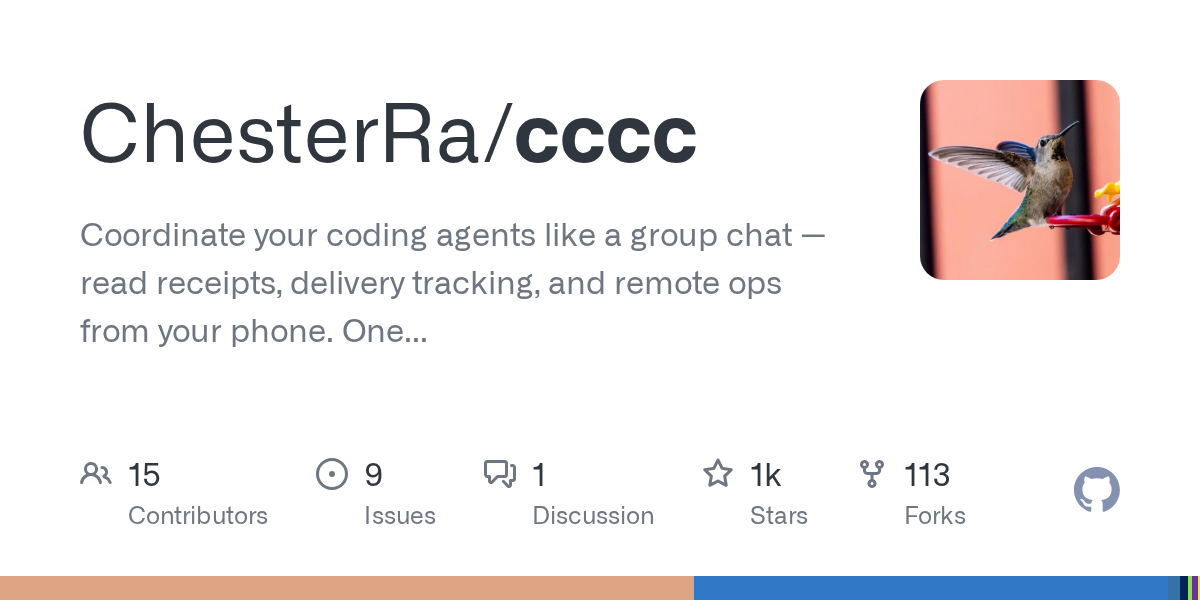
CCCC: Coordinate Your Coding Agents Like a Group Chat
September 29, 2026
CCCC is a production-minded orchestrator designed to coordinate coding agents like a group chat, offering features such as read receipts, delivery tracking, and remote operations from your phone. It enables 24/7 workflow for multi-agent teams with a single `pip install` and zero infrastructure. This tool helps manage diverse AI runtimes, ensuring persistent collaboration across different machines and trusted working groups.
AI Session Search: Ultra-Fast AI Agent Session Analysis
September 29, 2026
AI Session Search (aise) is an ultra-fast, Rust-powered tool designed for searching and analyzing local AI agent coding sessions. It seamlessly integrates and indexes nine different session formats, including those from Claude, Codex, Cursor, and Gemini CLI. This powerful utility enables developers to quickly recover context, track agent behavior, and efficiently manage their AI-generated code history.
Pydantic AI Harness: Enhancing Your AI Agents with Robust Capabilities
September 28, 2026
Pydantic AI Harness is the official capability and harness library for Pydantic AI, designed to extend agents for complex, long-running tasks. It provides a modular system of "capabilities" for functionalities like file system interaction, web research, memory, and sub-agent delegation. This library enables developers to build sophisticated and durable AI agents with ease.
Router: Optimize AI Model Selection and Costs for Agentic Systems
September 28, 2026
The Weave-OS Router is an intelligent model router for agentic systems, optimizing AI model selection for every request. It acts as a drop-in proxy for major AI providers, routing prompts to the most suitable model in under 50ms. This solution helps users significantly cut costs, often by 40-70%, simply by changing an endpoint.
Source repository
Open the original repository on GitHub.
18 counted GitHub visits