Watchtower: Automating Docker Container Updates with Ease
This repository profile is provided by osrepos.com, an open source repository discovery platform.
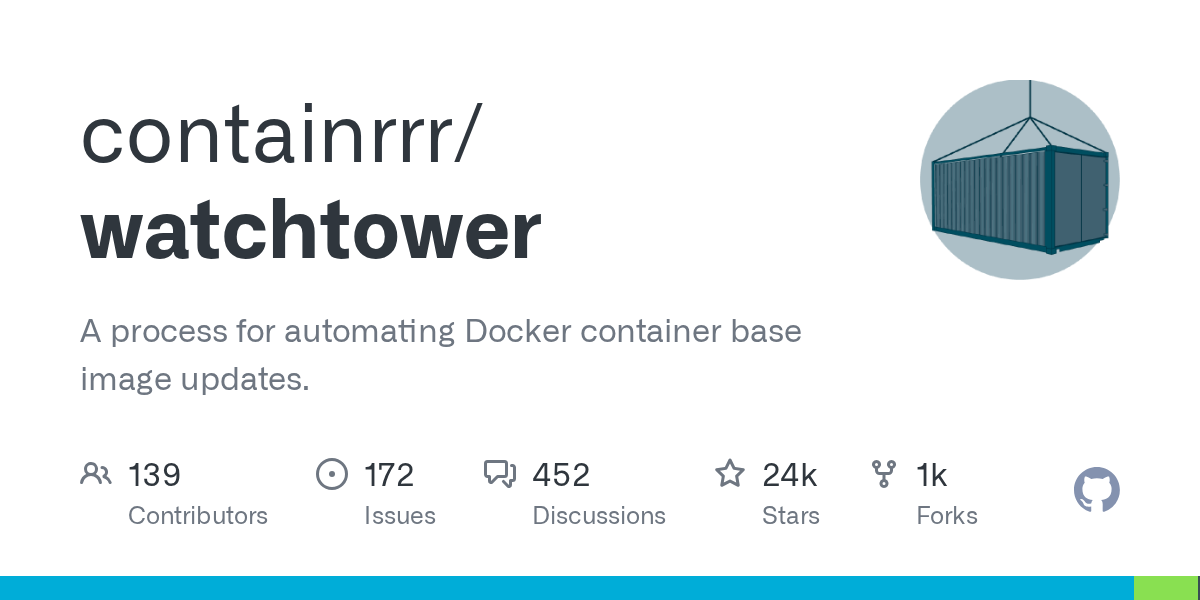
Summary
Watchtower is an open-source tool that automates the process of updating Docker container base images. It monitors your running containers and automatically pulls new images, gracefully shutting down and restarting containers with their original configurations. This simplifies maintenance for personal projects, homelabs, and local development environments.
Repository Information
Topics
Click on any tag to explore related repositories
Use at your own risk
OSRepos shares public repositories for knowledge and discovery only. Any installation, execution, configuration, or use of code from these repositories is the user's own responsibility. Always review the repository, source code, dependencies, licenses, and security implications before running or installing anything. OSRepos is not responsible for issues, damages, or losses resulting from third-party repositories.
Introduction
Watchtower by containrrr is an innovative tool designed to automate the process of updating Docker container base images. It continuously monitors your running Docker containers and, upon detecting a new image available in the Docker Hub or your private registry, it will automatically pull the updated image. Watchtower then gracefully shuts down your existing container and restarts it with the exact same options it was initially deployed with, ensuring your applications are always running the latest versions without manual intervention.
It's important to note that Watchtower is primarily intended for use in environments like homelabs, media centers, and local development setups. For commercial or production environments, the developers strongly recommend exploring more robust orchestration solutions such as Kubernetes, MicroK8s, or k3s.
Installation
Getting Watchtower up and running is straightforward. You can deploy it as a Docker container itself, giving it access to the Docker daemon to manage other containers.
To install and run Watchtower, use the following Docker command:
docker run --detach \
    --name watchtower \
    --volume /var/run/docker.sock:/var/run/docker.sock \
    containrrr/watchtower
Examples
Once Watchtower is running, it will automatically begin monitoring your other Docker containers. For instance, if you have a nginx container running and a new nginx image is pushed to Docker Hub, Watchtower will detect this. It will then pull the new nginx image, stop your old nginx container, and start a new one using the updated image, all while preserving your original container configuration (like port mappings, volumes, and environment variables). This hands-free approach ensures your services are always current.
Why Use It
The primary benefit of Watchtower is the significant reduction in manual effort required to keep your Docker containers updated. For personal projects, self-hosted applications, or development environments, it provides a "set it and forget it" solution for maintaining up-to-date software. This automation helps in patching security vulnerabilities faster and accessing new features without constant manual checks and restarts. Its simplicity makes it an excellent choice for users who want to leverage Docker's power without diving deep into complex orchestration tools for non-critical applications.
Links
- GitHub Repository: https://github.com/containrrr/watchtower
- Official Documentation: https://containrrr.dev/watchtower
Related repositories
Similar repositories that may be relevant next.
OpenMake LLM: Self-Hosted AI Workspace for Local and Open-Weight LLMs
October 1, 2026
OpenMake LLM is an open-source, self-hosted AI workspace for local and open-weight LLMs. It coordinates specialized models, autonomous agents, and tools for deep research and artifact generation. This platform supports vLLM, LiteLLM, and BYOK providers, offering a robust environment for managing AI workloads.
e2a: Open-Source Email API for Applications and AI Agents
September 29, 2026
e2a is an open-source email API designed for applications and AI agents, offering robust transactional email capabilities and real two-way inboxes. It supports both managed hosting and self-hosting with Docker, providing features like human-in-the-loop approval and advanced content screening. Built in Go, e2a aims to bridge email's universal addressability with the structured data world of AI agents.
KSail: The All-in-One Kubernetes SDK for Cluster Management and GitOps
September 27, 2026
KSail is a comprehensive Kubernetes SDK designed to simplify cluster creation, management, and operation across multiple distributions like Kind, K3d, Talos, and VCluster. It integrates essential features such as GitOps, secrets management, an AI assistant, and an MCP server, making cloud-native development accessible with just Docker or a cloud provider.
Local LLM Linux Troubleshoot: An AI Agent for Linux Diagnostics
September 14, 2026
Local LLM Linux Troubleshoot is an AI-powered agent designed to diagnose and resolve issues on Linux systems. It leverages llama.cpp for local AI processing, offering system diagnostics, safe command execution, and support for Docker, CLI, and a web GUI. This tool provides a privacy-first approach to managing and troubleshooting your Linux environment.
Source repository
Open the original repository on GitHub.
22 counted GitHub visits