ggml: A Low-Level Tensor Library for Machine Learning
This repository profile is provided by osrepos.com, an open source repository discovery platform.

Summary
ggml is an innovative tensor library designed for machine learning, emphasizing low-level, cross-platform implementation. It offers features like integer quantization, automatic differentiation, and broad hardware support, all while maintaining zero third-party dependencies and efficient memory usage. This project is actively developed and forms the backbone for other popular projects like llama.cpp and whisper.cpp.
Repository Information
Topics
Click on any tag to explore related repositories
Use at your own risk
OSRepos shares public repositories for knowledge and discovery only. Any installation, execution, configuration, or use of code from these repositories is the user's own responsibility. Always review the repository, source code, dependencies, licenses, and security implications before running or installing anything. OSRepos is not responsible for issues, damages, or losses resulting from third-party repositories.
Introduction
ggml is a powerful tensor library specifically engineered for machine learning applications. It stands out for its low-level, cross-platform implementation, making it highly versatile and efficient. The library is under active development, with significant contributions also happening within related projects such as llama.cpp and whisper.cpp.
Key features of ggml include integer quantization support, broad hardware compatibility, and built-in automatic differentiation. It also incorporates ADAM and L-BFGS optimizers, all without relying on any third-party dependencies, ensuring a lean and performant codebase. A notable design principle is its commitment to zero memory allocations during runtime, which contributes to its exceptional efficiency.
Installation
To get started with ggml, clone the repository and follow the build steps:
git clone https://github.com/ggml-org/ggml
cd ggml

# install python dependencies in a virtual environment
python3.10 -m venv .venv
source .venv/bin/activate
pip install -r requirements.txt

# build the examples
mkdir build && cd build
cmake ..
cmake --build . --config Release -j 8
Examples
Here's an example of how to run GPT-2 inference using ggml:
# run the GPT-2 small 117M model
../examples/gpt-2/download-ggml-model.sh 117M
./bin/gpt-2-backend -m models/gpt-2-117M/ggml-model.bin -p "This is an example"
For more detailed examples and usage scenarios, explore the examples folder within the repository.
Why Use ggml?
ggml offers several compelling advantages for machine learning developers:
- Low-level and Cross-platform: Provides fine-grained control and runs efficiently across various operating systems and architectures.
- Integer Quantization Support: Enables efficient model deployment on resource-constrained devices by reducing model size and computational requirements.
- Broad Hardware Support: Designed to work across a wide range of hardware, including specialized accelerators.
- Automatic Differentiation: Simplifies the implementation of complex machine learning models and training algorithms.
- Optimizers Included: Comes with ADAM and L-BFGS optimizers built-in, ready for use in training processes.
- No Third-Party Dependencies: Reduces complexity, potential conflicts, and improves portability.
- Zero Memory Allocations During Runtime: Ensures highly efficient memory usage, crucial for performance-critical applications.
Links
- GitHub Repository: https://github.com/ggml-org/ggml
- Roadmap: https://github.com/users/ggerganov/projects/7
- Manifesto: https://github.com/ggerganov/llama.cpp/discussions/205
- Introduction to ggml (Hugging Face Blog): https://huggingface.co/blog/introduction-to-ggml
- The GGUF file format: https://github.com/ggerganov/ggml/blob/master/docs/gguf.md
Related repositories
Similar repositories that may be relevant next.
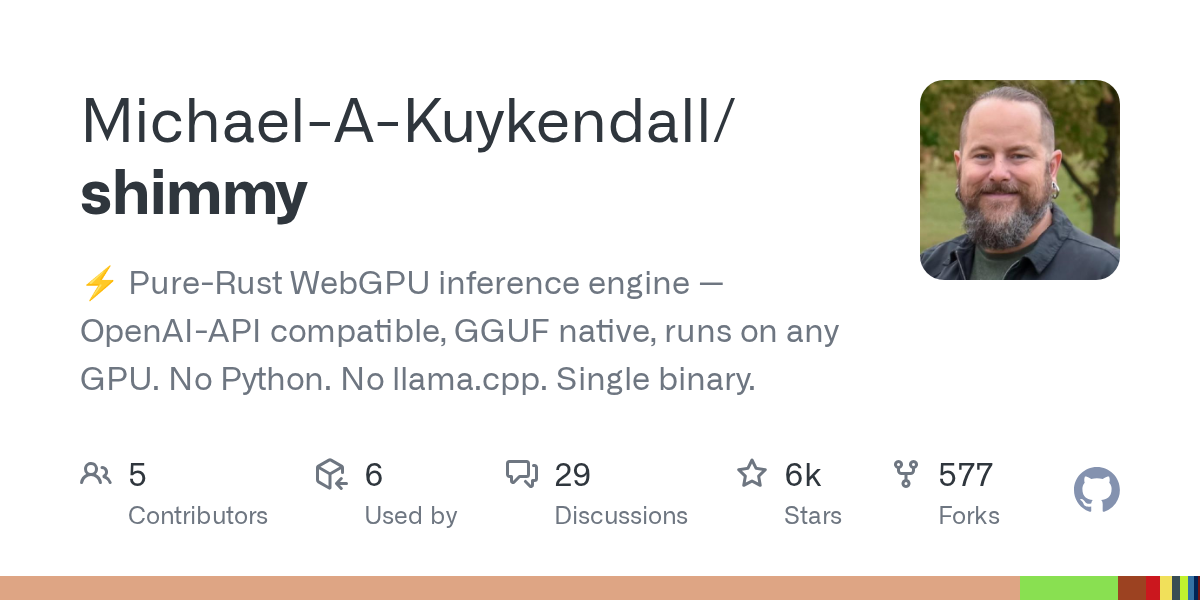
Shimmy: A Pure-Rust WebGPU Inference Engine for GGUF Models
September 28, 2026
Shimmy is a high-performance, pure-Rust WebGPU inference engine designed for GGUF models. It offers OpenAI-API compatibility, enabling local and private execution of large language models without Python or C++ dependencies. This single-binary solution provides rapid startup and a low memory footprint, making it an efficient alternative for local AI inference.
Awesome-Self-Evolving-Agents: A Curated List for AI Agent Research
September 14, 2026
Awesome-Self-Evolving-Agents is a comprehensive GitHub repository offering a curated collection of resources on self-evolving agents. It includes a systematic survey, research papers, benchmarks, and open-source projects, providing valuable insights into this rapidly advancing field of AI. This repository serves as an essential guide for researchers and developers exploring model-centric, environment-centric, and co-evolutionary approaches.
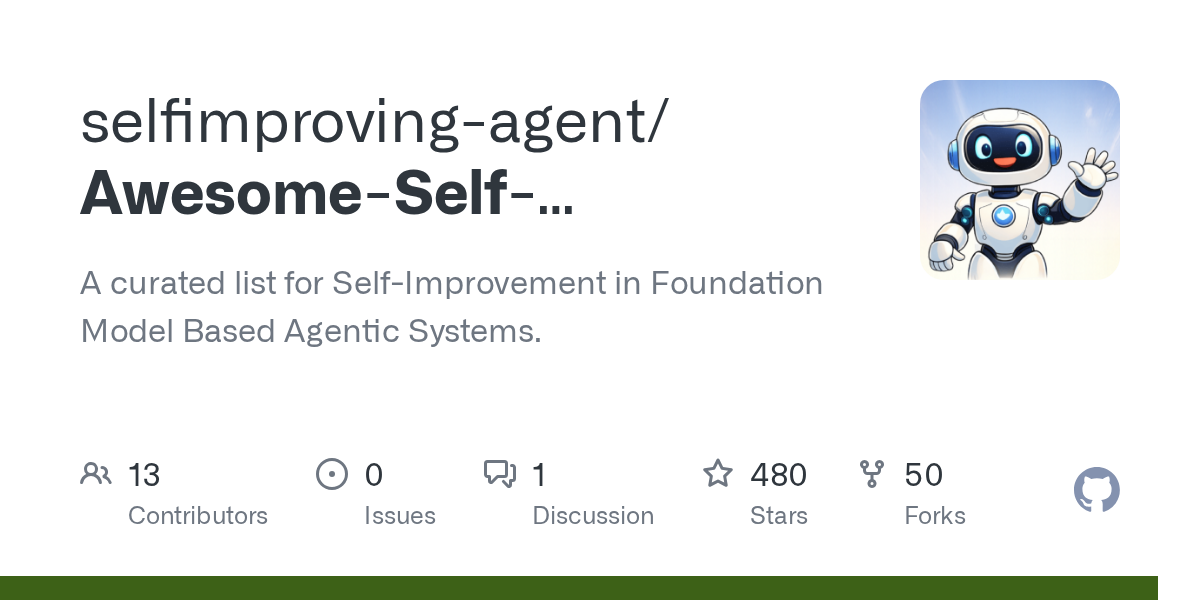
Awesome-Self-Improving-Agents: A Curated List for Agentic AI Self-Improvement
September 14, 2026
Awesome-Self-Improving-Agents is a comprehensive GitHub repository featuring a curated and continuously updated list of resources on self-improvement in foundation model-based agentic systems. It serves as a central hub for researchers and practitioners, offering papers, benchmarks, and various media. This resource is essential for anyone exploring the cutting edge of self-evolving AI agents.
CQ: An Open Standard for Shared Agent Learning by Mozilla.ai
September 5, 2026
CQ is an open standard designed to prevent AI agents from repeatedly making the same mistakes by enabling them to persist, share, and query collective knowledge. It facilitates a structured exchange of ideas, allowing agents to learn from each other's experiences and accelerate development. This system helps agents avoid redundant debugging and discover solutions more efficiently.
Source repository
Open the original repository on GitHub.
15 counted GitHub visits