VoxCPM: Tokenizer-Free TTS for Multilingual Speech, Voice Design, and Cloning
This repository profile is provided by osrepos.com, an open source repository discovery platform.
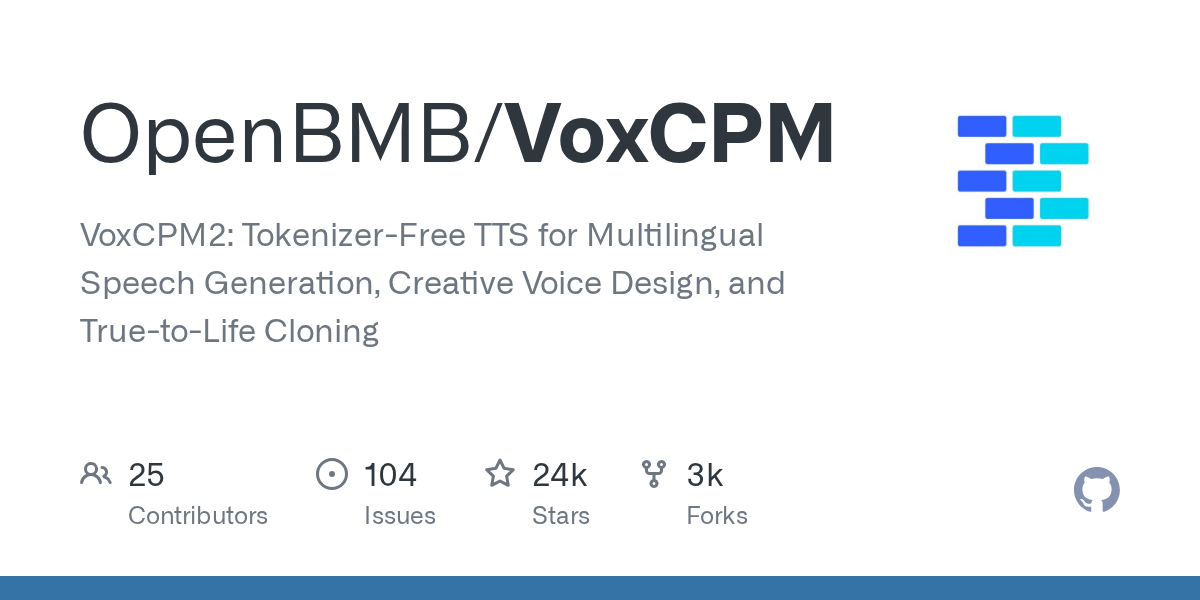
Summary
VoxCPM2 is a groundbreaking tokenizer-free Text-to-Speech system, offering highly natural and expressive synthesis across 30 languages. It enables creative voice design from natural language descriptions and provides advanced controllable voice cloning capabilities. With its 2B parameter model, VoxCPM2 delivers 48kHz studio-quality audio, making it a powerful tool for diverse speech generation needs.
Repository Information
Topics
Click on any tag to explore related repositories
Use at your own risk
OSRepos shares public repositories for knowledge and discovery only. Any installation, execution, configuration, or use of code from these repositories is the user's own responsibility. Always review the repository, source code, dependencies, licenses, and security implications before running or installing anything. OSRepos is not responsible for issues, damages, or losses resulting from third-party repositories.
Introduction
VoxCPM2 is a cutting-edge, tokenizer-free Text-to-Speech (TTS) system developed by OpenBMB. It directly generates continuous speech representations using an end-to-end diffusion autoregressive architecture, bypassing discrete tokenization for highly natural and expressive synthesis. The latest major release, VoxCPM2, is a 2B parameter model trained on over 2 million hours of multilingual speech data, now supporting 30 languages. It introduces innovative features like Voice Design, Controllable Voice Cloning, and delivers 48kHz studio-quality audio output. Built on a MiniCPM-4 backbone, VoxCPM2 is fully open-source and commercial-ready under the Apache-2.0 license.
Installation
Getting started with VoxCPM is straightforward. Ensure you have Python ? 3.10 (<3.13), PyTorch ? 2.5.0, and CUDA ? 12.0 installed.
pip install voxcpm
For more detailed installation instructions, refer to the official documentation.
Examples
VoxCPM provides a flexible Python API for various speech synthesis tasks.
Text-to-Speech
Generate speech from text with ease:
from voxcpm import VoxCPM
import soundfile as sf

model = VoxCPM.from_pretrained("openbmb/VoxCPM2", load_denoiser=False)

wav = model.generate(
    text="VoxCPM2 is a powerful multilingual speech synthesis system.",
    cfg_value=2.0,
    inference_timesteps=10,
)
sf.write("demo.wav", wav, model.tts_model.sample_rate)
print("saved: demo.wav")
Voice Design
Create a brand-new voice from a natural-language description, no reference audio needed. Simply put the description in parentheses at the start of your text:
wav = model.generate(
    text="(A young woman, gentle and sweet voice)Hello, welcome to VoxCPM2!",
    cfg_value=2.0,
    inference_timesteps=10,
)
sf.write("voice_design.wav", wav, model.tts_model.sample_rate)
Controllable Voice Cloning
Clone any voice from a short reference clip, with optional style guidance to steer emotion, pace, and expression while preserving the original timbre:
wav = model.generate(
    text="(slightly faster, cheerful tone)This is a cloned voice with style control.",
    reference_wav_path="path/to/voice.wav",
    cfg_value=2.0,
    inference_timesteps=10,
)
sf.write("controllable_clone.wav", wav, model.tts_model.sample_rate)
Why Use VoxCPM?
VoxCPM2 stands out with several key advantages for speech generation:
- 30-Language Multilingual Support: Synthesize text in any of the 30 supported languages without needing language tags.
- Creative Voice Design: Generate unique voices purely from natural-language descriptions, eliminating the need for reference audio.
- Controllable Voice Cloning: Clone voices from short clips and fine-tune style, emotion, and pace while maintaining the original timbre.
- 48kHz High-Quality Audio: Output studio-quality audio directly, with built-in super-resolution.
- Real-Time Streaming: Achieve low Real-Time Factor (RTF) for efficient, high-throughput serving, especially with Nano-vLLM or vLLM-Omni.
- Fully Open-Source & Commercial-Ready: Released under the Apache-2.0 license, making it free for commercial use.
Links
Explore VoxCPM further through these official resources:
Related repositories
Similar repositories that may be relevant next.
LibrePods: Liberate Your AirPods on Android and Linux
June 27, 2026
LibrePods is an open-source project that brings Apple AirPods features to non-Apple devices. It implements the proprietary protocol, allowing users to control listening modes, monitor battery, and utilize ear detection on Android and Linux. This project aims to free AirPods from the Apple ecosystem, enhancing their versatility.
MOSS-TTS Family: Open-Source High-Fidelity Speech and Sound Generation
May 31, 2026
The MOSS-TTS Family offers an open-source suite of models for high-fidelity, highly expressive speech and sound generation. Designed for complex real-world scenarios, it covers stable long-form speech, multi-speaker dialogue, voice design, environmental sound effects, and real-time streaming TTS. This comprehensive family of models from MOSI.AI and OpenMOSS team provides robust solutions for diverse audio generation needs.

pyAudioAnalysis: A Python Library for Audio Feature Extraction and Analysis
April 6, 2026
pyAudioAnalysis is an open-source Python library designed for a wide range of audio analysis tasks. It provides robust functionalities for feature extraction, classification, and segmentation of audio data, making it a valuable tool for researchers and developers. This library simplifies complex audio signal processing and machine learning applications.
Riffusion (hobby): Real-time Music Generation with Stable Diffusion
November 22, 2025
Riffusion (hobby) is an innovative Python library that applies stable diffusion models to generate music and audio in real-time. This project enables creative exploration of soundscapes through spectrogram image processing, offering tools for command-line use, an interactive Streamlit app, and a Flask API server. While no longer actively maintained, it remains a significant open-source contribution to AI-driven audio synthesis.
Source repository
Open the original repository on GitHub.
36 counted GitHub visits