Podcastfy: Transform Multimodal Content into AI-Generated Multilingual Podcasts
This repository profile is provided by osrepos.com, an open source repository discovery platform.
Summary
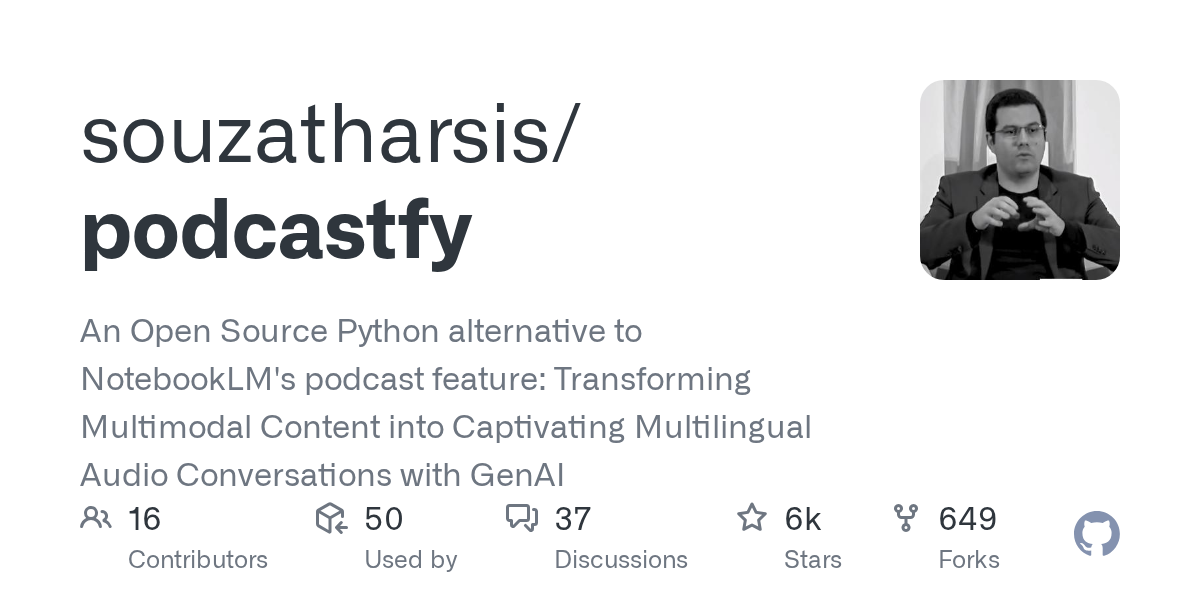
Podcastfy is an open-source Python package that transforms diverse multimodal content, such as text, images, and videos, into engaging multilingual audio conversations. Utilizing generative AI, it offers a flexible and programmatic alternative to tools like NotebookLM, focusing on customization and scalability. This makes it an excellent solution for content creators, educators, and researchers aiming to broaden their audience reach and improve content accessibility.
Repository Information
Topics
Click on any tag to explore related repositories
Use at your own risk
OSRepos shares public repositories for knowledge and discovery only. Any installation, execution, configuration, or use of code from these repositories is the user's own responsibility. Always review the repository, source code, dependencies, licenses, and security implications before running or installing anything. OSRepos is not responsible for issues, damages, or losses resulting from third-party repositories.
Introduction
Podcastfy is an innovative open-source Python package that transforms diverse multimodal content into captivating multilingual audio conversations using Generative AI. Positioned as a flexible alternative to tools like NotebookLM, Podcastfy emphasizes programmatic control, extensive customization, and scalability for generating engaging audio content. It can process a wide array of input sources, including websites, PDFs, images, YouTube videos, and user-provided topics, generating both short (2-5 minutes) and longform (30+ minutes) podcasts.
Installation
Getting started with Podcastfy is straightforward.
Prerequisites
Ensure you have Python 3.11 or higher installed. You will also need ffmpeg for audio processing, which can typically be installed via pip:
pip install ffmpeg
Setup
- Install from PyPI:
pip install podcastfy - Set up your API keys:
Refer to the official documentation for detailed instructions on configuring your API keys for various services.
Examples
Podcastfy offers both Python and CLI interfaces for generating podcasts.
Python
from podcastfy.client import generate_podcast

audio_file = generate_podcast(urls=["<url1>", "<url2>"])
CLI
python -m podcastfy.client --url <url1> --url <url2>
Podcastfy supports generating audio from images, text, and even multi-lingual content, providing versatile options for your content creation needs.
Why Use Podcastfy?
- Versatile Content Input: Convert content from websites, PDFs, images, YouTube videos, and custom topics into engaging audio.
- AI-Powered Conversations: Leverage advanced Generative AI models to create natural and dynamic podcast-style audio.
- Multilingual Support: Reach a global audience by generating podcasts in multiple languages.
- Extensive Customization: Tailor every aspect of your podcast, including conversation format, style, voices, and even integrate local LLMs for enhanced privacy and control.
- Enhanced Accessibility: Transform written and visual content into auditory formats, making information more accessible to individuals with visual impairments or those who prefer listening.
- Open Source and Community-Driven: Benefit from a transparent, flexible, and community-supported platform that encourages contributions and continuous improvement.
Links
- GitHub Repository: https://github.com/souzatharsis/podcastfy
- PyPI Package: https://pypi.org/project/podcastfy/
- Web App (OpenPod): https://openpod.fly.dev/
- Documentation: https://podcastfy.readthedocs.io/en/latest/
- Colab Notebook: https://colab.research.google.com/github/souzatharsis/podcastfy/blob/main/podcastfy.ipynb
Related repositories
Similar repositories that may be relevant next.
Uni-Agent: A Scalable Framework for Training Long-Horizon AI Agents
October 1, 2026
Uni-Agent is a powerful Python framework designed for training long-horizon agents at scale. It allows users to integrate existing agent harnesses, unify diverse agent tasks through an extensible interface, and run thousands of sessions concurrently for efficient data collection and training.
Benchmark Radar: A Living Database for AI Benchmarks and Evaluation
September 29, 2026
Benchmark Radar is an extensive open-source project that tracks over 20,710 AI benchmark, evaluation, dataset, and data-quality records from 37 public sources. It provides daily updates, linked evidence, and tools for researchers and developers to discover and analyze AI benchmarks. This project is essential for anyone needing to stay current with AI evaluation trends and model performance.
Pydantic AI Harness: Enhancing Your AI Agents with Robust Capabilities
September 28, 2026
Pydantic AI Harness is the official capability and harness library for Pydantic AI, designed to extend agents for complex, long-running tasks. It provides a modular system of "capabilities" for functionalities like file system interaction, web research, memory, and sub-agent delegation. This library enables developers to build sophisticated and durable AI agents with ease.
Bernstein: Open-Source Governance and Orchestration for AI Agents
September 28, 2026
Bernstein is an open-source framework designed for the governance and orchestration of AI agents, allowing users to define rules declaratively. It enforces these policies and generates verifiable, replayable records of all agent activities. This Python-based solution provides a robust layer for managing complex AI agent workflows with transparency and accountability.
Source repository
Open the original repository on GitHub.
20 counted GitHub visits