otto vs lagent
LLM-powered workflows and agents compared
otto and lagent help developers build applications that use language models, tools, and sessions. otto integrates with Frappe workflows and document events, while lagent is a general Python framework for composing agents and multi-agent workflows.
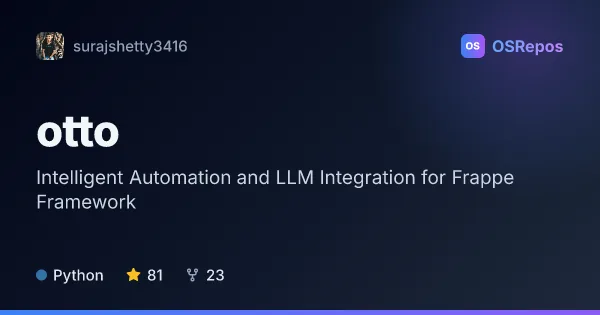
otto: Add LLM-Powered Automation to Frappe Apps
Otto is an experimental Frappe app and Python library for connecting language models to Frappe workflows. It supports task automation, custom assistants, tool use, and resumable LLM sessions.
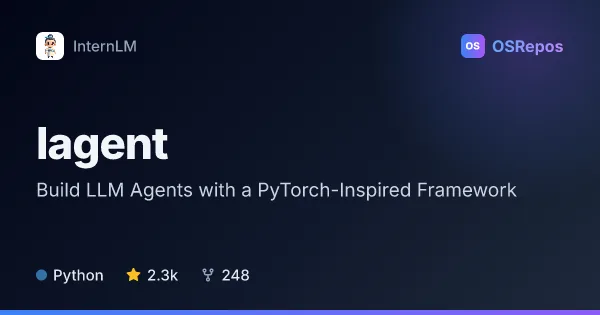
lagent: Build LLM Agents with a PyTorch-Inspired Framework
InternLM’s Lagent is a lightweight Python framework for building LLM-based agents, using a PyTorch-inspired design for composing agents and message passing. It supports synchronous and asynchronous workflows, tools, memory, and multi-agent applications.
| otto | lagent | |
|---|---|---|
| Language | Python | Python |
| License | AGPL-3.0 | Apache-2.0 |
| Stars | 81 | 2.3k |
| Forks | 23 | 248 |
| Last analyzed | Oct 3, 2026 | Oct 15, 2026 |
Key differences
- otto is a Frappe app and library for tasks tied to document types and lifecycle events; lagent provides reusable components for building Python agent applications.
- otto supports custom assistants and resumable LLM sessions within Frappe apps; lagent focuses on agent messaging, memory, action execution, and coordination between agents.
- otto is explicitly in an early, experimental stage; lagent is described as a lightweight framework with examples for agent workflows.
- otto requires a Frappe bench and site, as well as API keys for configured models; lagent requires developers to configure model serving and tool execution for their chosen workflow.
- otto is licensed under AGPL-3.0, while lagent is licensed under Apache-2.0.
Choose otto if you…
- want to connect LLM-backed tasks to Frappe document events or workflows
- need custom assistants or resumable LLM sessions in a Frappe app
- are comfortable experimenting with an early-stage project
Choose lagent if you…
- want a general Python framework for composing tool-using or multi-agent applications
- need synchronous and asynchronous agent components, session memory, or customizable output parsing
- are building workflows such as code execution, browsing, or iterative writing
Compare the numbers side by side, or add more projects
This comparison is generated with AI from the OSRepos analyses of both projects. Always check each project's repository and documentation before choosing.