cloi vs AgentAleph
Local coding agents compared: terminal workflow vs desktop app
cloi and AgentAleph both use local models to inspect and modify software projects. cloi runs in a terminal with Ollama, while AgentAleph is a Linux desktop app that manages GGUF models and uses llama.cpp.
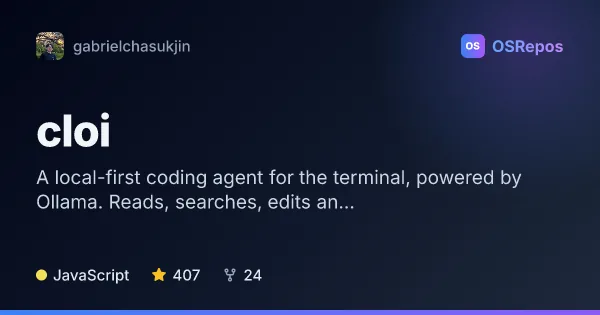
cloi: Run a Local Coding Agent in the Terminal
Cloi is a terminal coding agent that uses Ollama to inspect, edit, and run code in a local workspace. It suits developers who want AI-assisted coding without sending project data to an external service, provided their hardware can run a supported model.
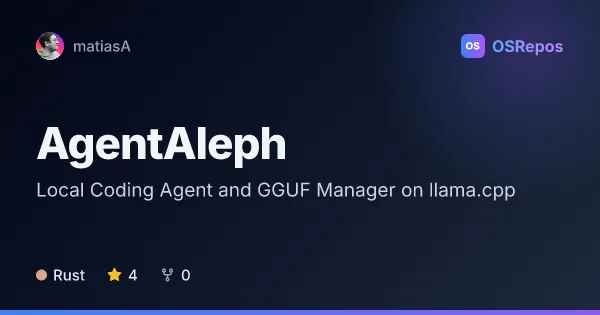
AgentAleph: Local Coding Agent and GGUF Manager on llama.cpp
AgentAleph is a Linux desktop app built with Tauri and powered by llama.cpp for local AI coding and GGUF model management. It suits developers who want an offline-capable agent with approval-based file and command tools, without hosted inference or API keys.
| cloi | AgentAleph | |
|---|---|---|
| Language | JavaScript | Rust |
| License | MIT | — |
| Stars | 407 | 4 |
| Forks | 24 | 0 |
| Last analyzed | Oct 3, 2026 | Oct 22, 2026 |
Key differences
- cloi is a JavaScript terminal agent; AgentAleph is a Rust desktop app with a model manager.
- cloi uses Ollama models, while AgentAleph downloads and runs GGUF models through llama.cpp.
- cloi focuses on workspace coding tasks and checks file-related claims; AgentAleph also offers web tools, read-only plan mode, and model management.
- cloi requires permission for writes and commands; AgentAleph provides per-tool allow, ask, or deny settings and previews edits for approval.
- cloi is MIT-licensed and has 407 stars; AgentAleph has a NOASSERTION license and 3 stars.
- AgentAleph documents a Linux x64 setup with GTK 3 and WebKitGTK 4.1; cloi is a terminal workflow whose local use depends on hardware capable of running a supported model.
Choose cloi if you…
- want a terminal-based coding agent that uses Ollama.
- prefer a workflow focused on local workspace inspection, edits, and command execution.
- want file-related claims checked against workspace contents and tool results retained for later recall.
Choose AgentAleph if you…
- want a desktop interface for downloading and managing GGUF models.
- need web tools, read-only planning, or configurable per-tool permissions.
- prefer to review file-edit previews before approving changes.
Compare the numbers side by side, or add more projects
This comparison is generated with AI from the OSRepos analyses of both projects. Always check each project's repository and documentation before choosing.