AgentAleph: Local-First AI Coding Agent and GGUF Model Manager
This repository profile is provided by osrepos.com, an open source repository discovery platform.
Summary
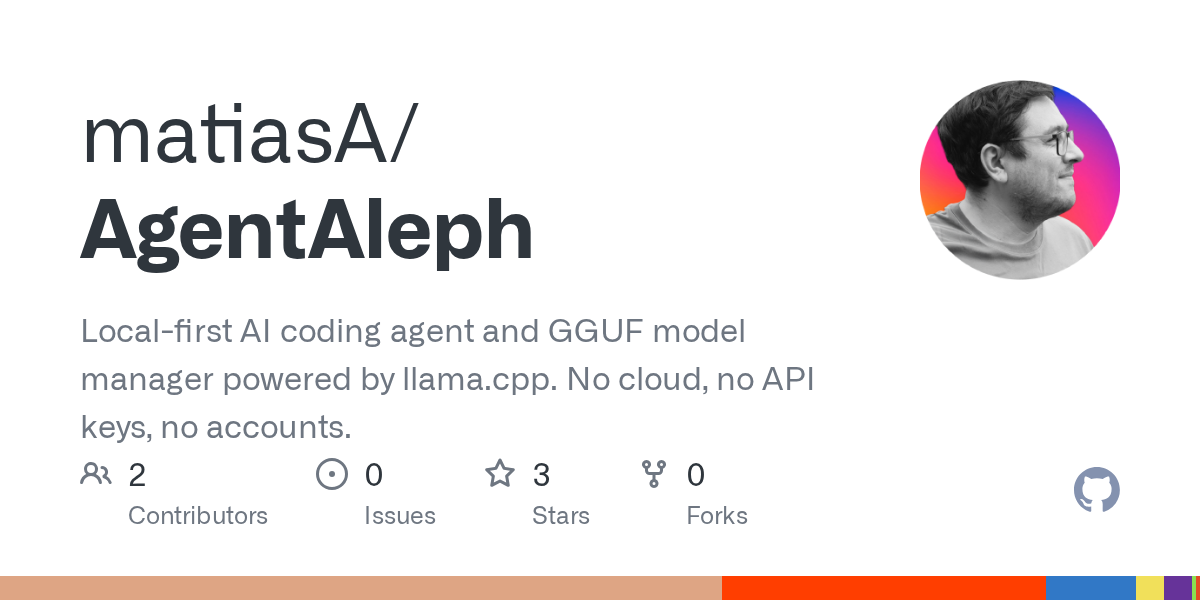
AgentAleph is a desktop application that combines a local-first AI coding agent with a GGUF model manager. It allows users to download, load, and manage local large language models, and then use an AI agent to interact with their projects, all without relying on cloud services or API keys. This tool emphasizes privacy and offline capability, running models directly on your machine.
Repository Information
Topics
Click on any tag to explore related repositories
Use at your own risk
OSRepos shares public repositories for knowledge and discovery only. Any installation, execution, configuration, or use of code from these repositories is the user's own responsibility. Always review the repository, source code, dependencies, licenses, and security implications before running or installing anything. OSRepos is not responsible for issues, damages, or losses resulting from third-party repositories.
Introduction
AgentAleph is a powerful local-first AI coding agent and GGUF model manager, built with Rust and powered by llama.cpp. This desktop application offers a complete solution for developers who want to leverage AI without relying on cloud services, API keys, or external accounts. It integrates both a robust local model manager, inspired by tools like LM Studio, and a sophisticated coding agent, taking cues from Codex and Claude Code.
Why Use and Key Features
AgentAleph stands out for its commitment to privacy, local execution, and comprehensive functionality.
- Local Inference: All prompts are processed by your local model, ensuring privacy. While web searches and fetches use the network, approved shell commands can also access it, always with user control.
- An Agent, Not Just a Chat Box: Beyond simple chat, AgentAleph can read, search, edit, and create files, as well as run shell commands, all with your explicit approval.
- Simple by Design: The application features a streamlined, single-window interface for downloading, loading models, and working, eliminating the need for hosted endpoints or complex server setups.
- Safe by Default: It incorporates per-tool
allow,ask, ordenypermissions and a read-only plan mode that prevents project edits and shell commands, giving you full control. - Built for Imperfect Local Models: The agent includes features like GBNF grammar-constrained tool calls, native tool calling, loop detection, and context compaction to optimize performance with various local models.
- Extensible with Skills: You can easily add task-specific local instruction packs, known as "Skills," without modifying the core code.
- Comprehensive Model Management: Browse a curated catalog of GGUF models from Hugging Face, download them with resumable transfers, and manage them locally. The app provides hardware fit badges to estimate performance on your system.
- Flexible Inference Settings: Fine-tune model behavior with configurable settings for system prompt, temperature, context size, GPU layers, and more.
- Edit Previews and Undo: Review proposed file changes before approval and undo the latest file edits, providing a safety net for your work.
Installation
AgentAleph is primarily designed for Linux x64 (Ubuntu/Debian with webkit2gtk-4.1, gtk-3). It requires Rust 1.77+ and Node 18+.
To get started, follow these steps:
git clone https://github.com/matiasA/AgentAleph.git
cd AgentAleph
npm install
./scripts/setup-llama.sh   # downloads the llama.cpp binary; it is not committed because of its size
npm run tauri dev          # development with hot reload
# or
npm run tauri build        # production build (.deb / .AppImage)
For CPU-only operation, you can specify the LLAMA_FLAVOR:
LLAMA_FLAVOR=x64 ./scripts/setup-llama.sh
The project also supports building installers via GitHub Actions. You can trigger a build manually or by pushing a version tag:
git tag v0.1.0 && git push origin v0.1.0 # triggers build + Release
Examples
Getting started with AgentAleph is straightforward:
- Download a model from the Catalog tab, typically a Q4_K_M variant by default.
- Load it from the Models tab and await the progress indicator.
- Choose a mode: Select "Chat" for general conversation or "Agent" for project-specific work.
- Work with the agent: If in Agent mode, select a project folder, describe your task, and then approve or deny any write or execute actions as prompted by the agent.
Links
- GitHub Repository: AgentAleph GitHub Repository
- License: MIT License
Related repositories
Similar repositories that may be relevant next.
Maka: A High-Performance Agent Workspace for AI Tasks
September 21, 2026
Apache Maka (Incubating) is a high-performance agent workspace designed to maintain a complete, append-only record of all agent actions. It focuses on measurable performance, local-first operation, and robust recovery mechanisms. This project provides a unified execution authority for desktop, TUI, and CLI clients, ensuring consistent agent behavior across platforms.
oh-my-hermes: Enhance Hermes Agent with Advanced AI Workflow and Memory
September 17, 2026
oh-my-hermes is an all-in-one plugin designed to significantly enhance the Hermes Agent. It provides advanced coding intelligence, a robust long-term memory system, and optimized workflow packages, transforming standard Hermes requests into structured, actionable tasks with clear operational layers.

Apache Maka: A High-Performance Agent Workspace for AI Tasks
September 11, 2026
Apache Maka is an incubating project from The Apache Software Foundation, offering a high-performance agent workspace designed to meticulously record all agent activities. It provides a local-first environment for AI agents, allowing users to bring their own models and ensuring transparent, measurable task completion. This project aims to set a new standard for agent reliability and accountability.
Ouroboros: A Self-Evolving AI Agent for Autonomous Development
August 26, 2026
Ouroboros is an open-source, general-purpose AI agent designed for autonomous development and self-evolution. It maintains identity and memory across tasks and restarts, capable of modifying its own code, architecture, and tools. This agent can coordinate specialist subagents and operate on external projects, offering both desktop and headless CLI interfaces.
Source repository
Open the original repository on GitHub.