OGAD vs textgen
Local AI desktop apps compared
OGAD and textgen both let you run models on your own hardware through desktop interfaces and local APIs. OGAD focuses on a local-first studio for text, vision, image, and voice workflows, while textgen emphasizes broad backend support, customization, and options such as fine-tuning.
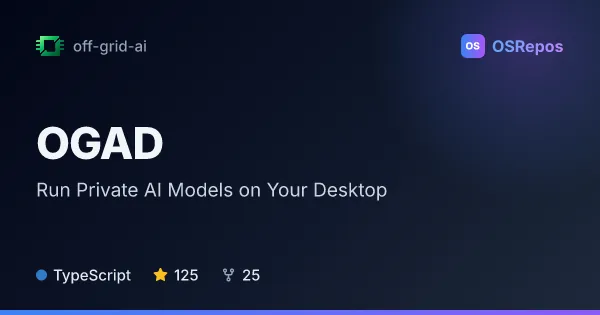
OGAD: Run Private AI Models on Your Desktop
OGAD is a local-first desktop studio and OpenAI-compatible gateway for running text, vision, image, and voice models on your own hardware. It suits people who want private AI workflows and local integrations without cloud inference or an account.
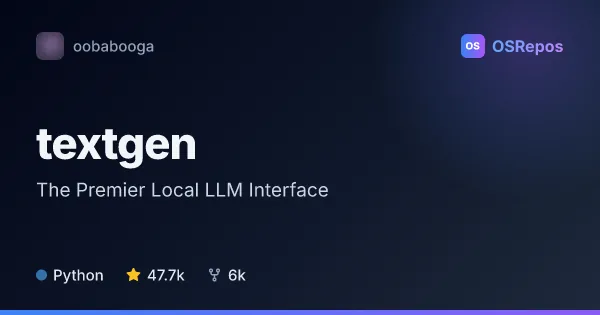
textgen: Run Local Language Models in a Desktop App
TextGen is a private desktop and web interface for running local language models, with support for chat, vision, tools, and compatible APIs. It suits people who want to use and manage models on their own hardware.
| OGAD | textgen | |
|---|---|---|
| Language | TypeScript | Python |
| License | AGPL-3.0 | AGPL-3.0 |
| Stars | 125 | 47.7k |
| Forks | 25 | 6k |
| Last analyzed | Oct 13, 2026 | Oct 3, 2026 |
Key differences
- OGAD is built with TypeScript and textgen with Python.
- OGAD includes local image generation, speech-to-text, text-to-speech, and a headless OpenAI-compatible gateway; textgen lists multiple inference backends and OpenAI- and Anthropic-compatible API formats.
- textgen supports LoRA fine-tuning, customizable prompt templates, and interface extensions; OGAD highlights document search with cited sources and sandboxed generated artifacts.
- OGAD describes CPU and Vulkan availability alongside CUDA for Linux, while textgen notes that performance and features depend on backend, hardware, and installation type.
- Both use AGPL-3.0. The provided project statistics list 125 stars and 25 forks for OGAD, and 47.7k stars and 6k forks for textgen.
- OGAD is described as a young, active project with a small, concentrated contributor base; textgen's considerations focus on installation and configuration choices.
Choose OGAD if you…
- want a studio combining local chat, document search, image generation, and speech workflows.
- need a headless local gateway or an OpenAI-compatible endpoint for existing tools.
- prefer a project whose open core includes MCP connectors and sandboxed generated artifacts.
Choose textgen if you…
- need to compare or switch among several inference backends.
- want options for LoRA fine-tuning, custom tools, and interface extensions.
- need local APIs compatible with both OpenAI and Anthropic formats.
Compare the numbers side by side, or add more projects
This comparison is generated with AI from the OSRepos analyses of both projects. Always check each project's repository and documentation before choosing.