background-agents: An Open-Source System for Background Coding Agents
This repository profile is provided by osrepos.com, an open source repository discovery platform.
Summary
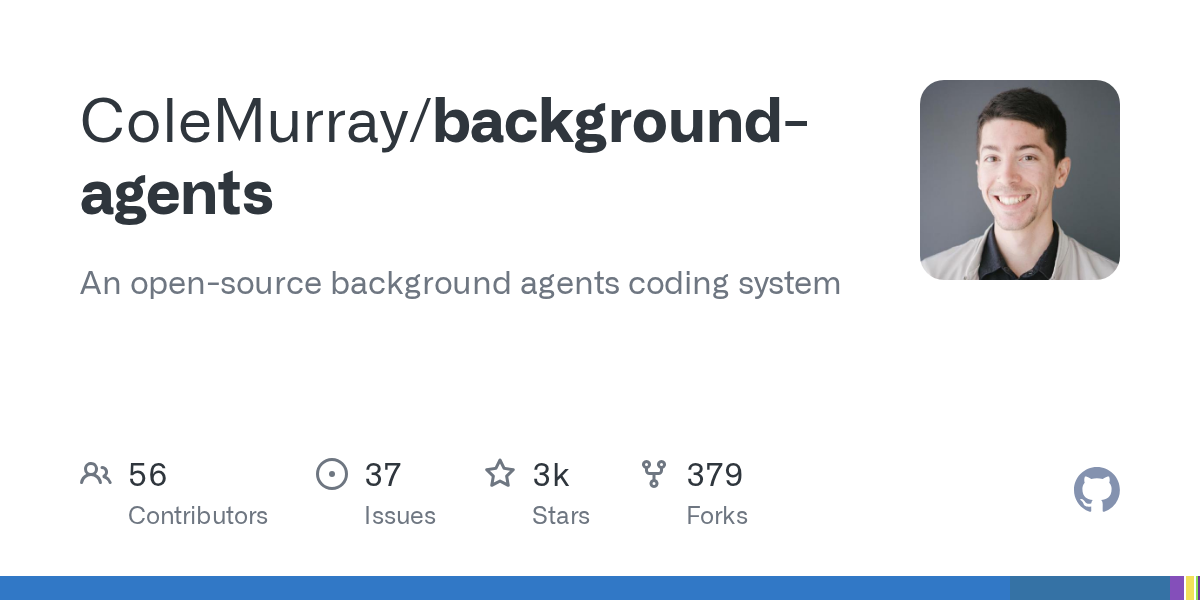
background-agents is an open-source system designed for running background coding agents. It enables developers to automate tasks, collaborate in real-time, and integrate with various platforms like GitHub, Slack, and Linear. With support for multiple AI models and full development environments, it streamlines development workflows and enhances productivity.
Repository Information
Topics
Click on any tag to explore related repositories
Use at your own risk
OSRepos shares public repositories for knowledge and discovery only. Any installation, execution, configuration, or use of code from these repositories is the user's own responsibility. Always review the repository, source code, dependencies, licenses, and security implications before running or installing anything. OSRepos is not responsible for issues, damages, or losses resulting from third-party repositories.
Introduction
background-agents is an open-source background agents coding system inspired by Ramp's Inspect. It provides a hosted background coding agent capable of working on tasks in the background, accessing full development environments (Node.js, Python, git, browser automation, VS Code), and connecting from various platforms like web UI, Slack, GitHub PRs, and Linear issues. The system supports multiplayer sessions for real-time collaboration, creates PRs with proper commit attribution, and can run on a schedule or be triggered by webhooks. It also offers flexibility with your choice of AI model, including Anthropic Claude, OpenAI Codex, xAI Grok, and OpenCode Zen.
It is important to note that this system is designed for single-tenant deployment only, where all users are trusted members of the same organization with access to the same repositories.
Installation
To get started with background-agents, you should refer to the official documentation for detailed setup instructions.
- For a practical setup guide covering local, contributor, and deployment paths, begin with the SETUP_GUIDE.md.
- For specific deployment instructions, consult GETTING_STARTED.md.
- To understand the architecture and core concepts, read HOW_IT_WORKS.md.
Examples
background-agents offers a rich set of features that demonstrate its capabilities:
- Fast Startup: Sessions start almost instantly thanks to filesystem snapshots, pre-built images, and proactive warming.
- Multi-Repository Sessions & Environments: Work across several repositories in a single sandbox, creating ad-hoc sets or saving named environments with their own secrets and prebuilt images.
- Multiplayer Sessions: Multiple users can collaborate in the same session, with presence indicators and prompt attribution in git commits.
- Commit Attribution: Commits are attributed to the user who sent the prompt, ensuring proper authorship.
- Multi-Provider Model Support: Choose from various AI models, including Anthropic, OpenAI, xAI, and OpenCode Zen, with per-session reasoning effort controls.
- Client Integrations: Interact with agents from your team's existing workflows via a Web UI, Slack Bot, GitHub Bot, Linear Bot, or custom Webhooks.
- Automations: Schedule recurring tasks with cron, react to Sentry alerts, or trigger sessions from inbound webhooks, supporting multi-repo fan-out.
- Sandbox Environment: Every session runs in an isolated sandbox with a full development environment, including Node.js, Python, git, browser automation, VS Code (optional), web terminal, and port tunneling.
- Child Sessions: Agents can decompose work into parallel child sessions, allowing for concurrent execution on separate branches.
- Repository Lifecycle Scripts: Define optional
.openinspect/setup.shfor provisioning and.openinspect/start.shfor runtime startup, enabling custom environment setup.
Why Use background-agents?
background-agents empowers development teams to significantly enhance productivity and collaboration. By automating repetitive coding tasks and integrating seamlessly with existing tools like GitHub, Slack, and Linear, it frees up developers to focus on more complex challenges. Its support for multiple AI models provides flexibility, while features like fast startup, multiplayer sessions, and full development environments ensure an efficient and robust workflow. The system's single-tenant design, coupled with deployment recommendations, offers a secure environment for trusted organizational use. Whether you need to run scheduled tasks, automate code reviews, or enable real-time coding collaboration, background-agents provides a powerful and adaptable solution.
Links
- GitHub Repository: https://github.com/ColeMurray/background-agents
- License: MIT
Related repositories
Similar repositories that may be relevant next.
TeamAI-CLI: Empowering Teams to Become AI Native with a Git-Based Foundation
September 24, 2026
TeamAI-CLI, developed by Tencent, is a powerful command-line interface aimed at making every team AI native. It offers a unified, Git-based platform for teams to collaborate, learn, and continuously improve with AI. This tool transforms individual AI capabilities into shared team assets, integrating AI agents, machines, and team members for enhanced efficiency.
LLM Wiki: Build a Self-Maintaining, Interlinked Knowledge Base with AI
September 23, 2026
LLM Wiki is a powerful cross-platform desktop application designed to transform your documents into an organized, interlinked knowledge base automatically. Unlike traditional RAG systems, it incrementally builds and maintains a persistent wiki from your sources, ensuring knowledge is compiled once and kept current. This innovative approach offers a dynamic and evolving personal knowledge management solution.
Maka: A High-Performance Agent Workspace for AI Tasks
September 21, 2026
Apache Maka (Incubating) is a high-performance agent workspace designed to maintain a complete, append-only record of all agent actions. It focuses on measurable performance, local-first operation, and robust recovery mechanisms. This project provides a unified execution authority for desktop, TUI, and CLI clients, ensuring consistent agent behavior across platforms.
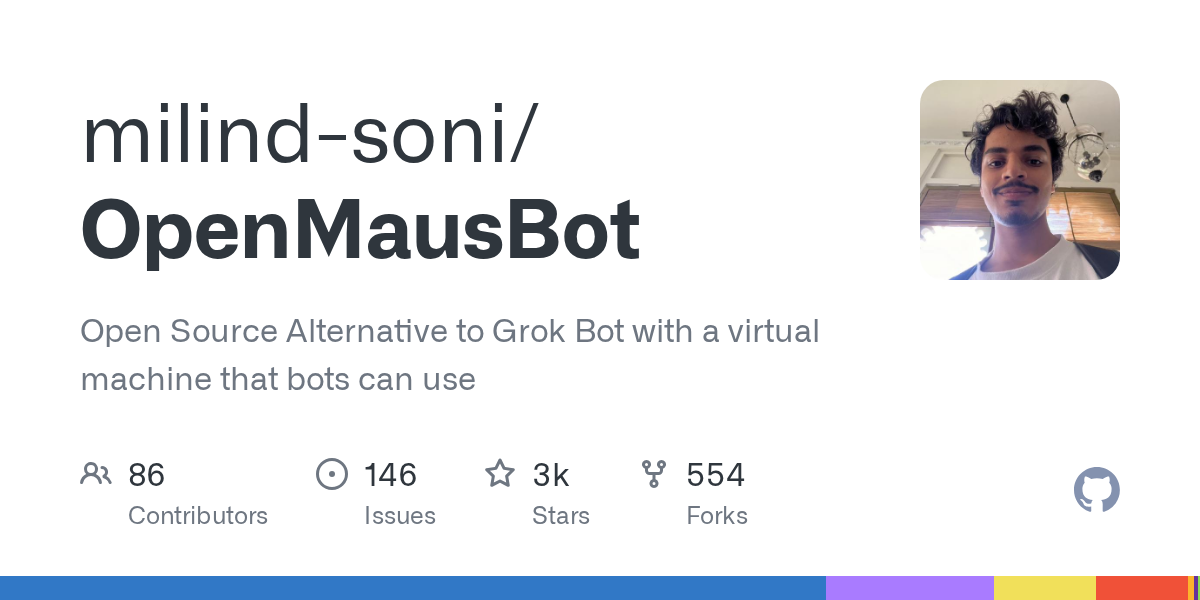
OpenMausBot: Your Open-Source AI Bot Team in a Chat App
September 20, 2026
OpenMausBot is an open-source desktop application that provides an alternative to Grok Bot, allowing users to manage a team of AI agents within a chat interface. It emphasizes local-first operation, bringing your own agents, and providing each bot with its own virtual machine or access to your computer. This project enables powerful AI interactions with privacy and control at its core.
Source repository
Open the original repository on GitHub.
18 counted GitHub visits