dateutil: Powerful Extensions for Python's Datetime Module
This repository profile is provided by osrepos.com, an open source repository discovery platform.
Summary
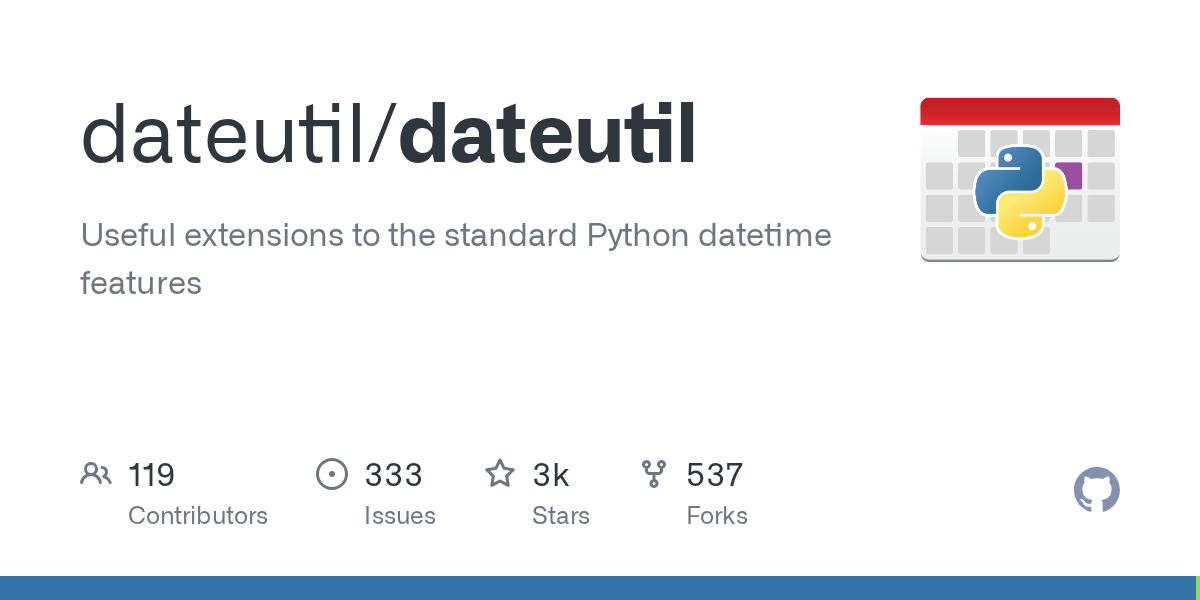
dateutil is a Python library that provides powerful extensions to the standard `datetime` module. It offers advanced features for parsing dates in almost any string format, computing relative deltas, and handling complex recurrence rules. This makes it an essential tool for developers working with time and date manipulations in Python.
Repository Information
Use at your own risk
OSRepos shares public repositories for knowledge and discovery only. Any installation, execution, configuration, or use of code from these repositories is the user's own responsibility. Always review the repository, source code, dependencies, licenses, and security implications before running or installing anything. OSRepos is not responsible for issues, damages, or losses resulting from third-party repositories.
Introduction
The dateutil module is a robust Python library designed to extend the capabilities of the standard datetime module. It provides powerful functionalities for handling dates and times, making complex date manipulations simpler and more intuitive. From parsing diverse date string formats to calculating relative deltas and managing timezones, dateutil offers a comprehensive suite of tools for Python developers.
Installation
You can easily install dateutil using pip:
pip install python-dateutil
Examples
Here's a quick example demonstrating some of dateutil's capabilities, taken from its official documentation:
from dateutil.relativedelta import *
from dateutil.easter import *
from dateutil.rrule import *
from dateutil.parser import *
from datetime import *

now = parse("Sat Oct 11 17:13:46 UTC 2003")
today = now.date()
year = rrule(YEARLY,dtstart=now,bymonth=8,bymonthday=13,byweekday=FR)[0].year
rdelta = relativedelta(easter(year), today)

print("Today is: %s" % today)
print("Year with next Aug 13th on a Friday is: %s" % year)
print("How far is the Easter of that year: %s" % rdelta)
print("And the Easter of that year is: %s" % (today+rdelta))

# Expected Output:
# Today is: 2003-10-11
# Year with next Aug 13th on a Friday is: 2004
# How far is the Easter of that year: relativedelta(months=+6)
# And the Easter of that year is: 2004-04-11
Why Use It
dateutil stands out for its extensive feature set, making it indispensable for advanced date and time operations. Key reasons to integrate dateutil into your projects include:
- Flexible Date Parsing: Parse dates from nearly any string format, offering robust and generic parsing capabilities.
- Relative Deltas: Easily compute relative time differences, such as "next month," "next Monday," or "last week of month," simplifying complex date arithmetic.
- Recurrence Rules: Generate dates based on very flexible recurrence rules, using a superset of the iCalendar specification, including parsing of RFC strings.
- Comprehensive Timezone Support: Handle various timezone formats, including tzfile(5) format files, TZ environment strings, iCalendar format files, and Windows registry-based time zones, with internal up-to-date world timezone information based on Olson's database.
- Easter Sunday Calculation: Accurately determine Easter Sunday dates for any given year, using Western, Orthodox, or Julian algorithms.
Links
For more information, documentation, and to contribute, visit the official dateutil resources:
Related repositories
Similar repositories that may be relevant next.

Vicoa: Agentic IDE for Orchestrating Coding Agents Across Devices
September 29, 2026
Vicoa is an open-source, self-hostable agentic IDE designed to orchestrate a team of coding agents. It enables developers to run and steer multiple AI agents from various devices, including desktop, mobile, and remote servers, providing a unified command center for development workflows.
Open ACE: Self-Hosted AI Coding Agent Workspace and Governance Platform
September 28, 2026
Open ACE is an open-source, self-hosted platform designed for managing AI coding agents within enterprise environments. It provides a unified workspace for various AI tools, enabling remote execution and robust governance features for API keys, costs, and compliance. This platform is ideal for organizations integrating AI coding agents into their development workflows, especially those requiring private deployment and centralized control.
Spec Kitty: Spec-Driven Development for AI Coding Agents and Software Factories
September 27, 2026
Spec Kitty is an open-source CLI that enables spec-driven development for AI coding agents and multi-agent workflows. It transforms product intent into a structured, repo-native AI coding workflow, providing isolated git worktrees and a clear lifecycle for development tasks. This tool helps teams build governed software factories, ensuring visibility and traceability in AI-assisted software development.
Graphon: A Python Graph Execution Engine for Agentic AI Workflows
September 26, 2026
Graphon is an innovative Python-based graph execution engine designed for building agentic AI workflows. It provides a robust framework for orchestrating complex AI tasks, featuring event-driven execution, graph validation, and shared runtime state. This evolving repository already includes a functional engine, built-in nodes, and end-to-end examples for developers.
Source repository
Open the original repository on GitHub.
18 counted GitHub visits