nanobot: An Ultra-Lightweight, Self-Hosted Personal AI Agent Framework
This repository profile is provided by osrepos.com, an open source repository discovery platform.
Summary
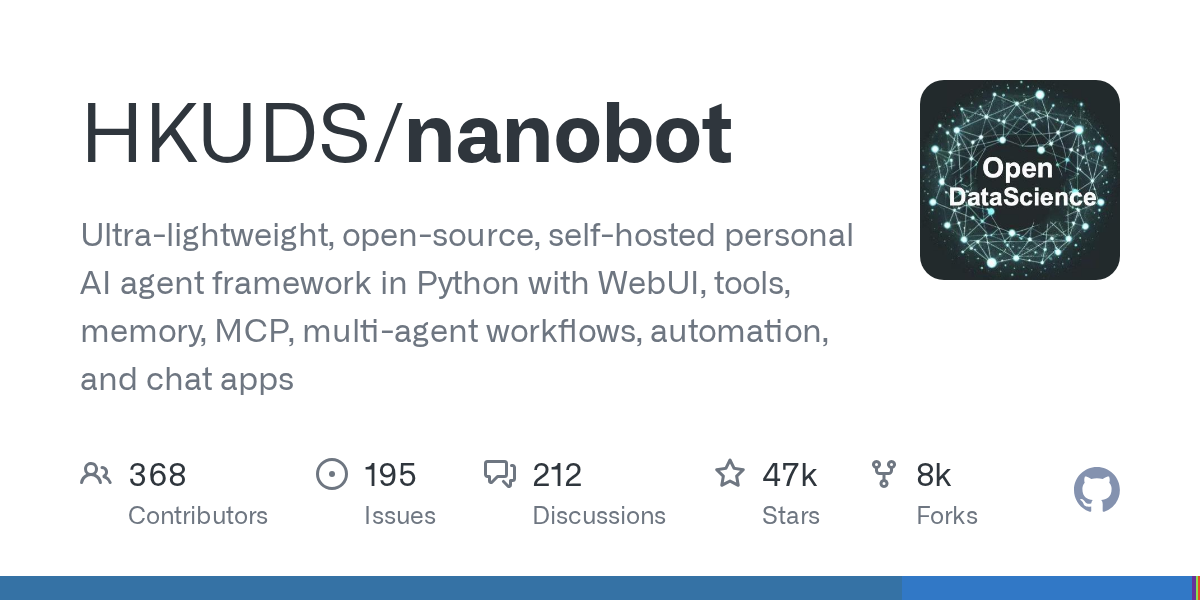
nanobot is an ultra-lightweight, open-source, self-hosted personal AI agent framework built in Python. It offers a WebUI, tools, memory, multi-agent workflows, and automation capabilities, making it a versatile solution for personal AI tasks. Users can deploy it across various platforms, including chat apps, for seamless integration.
Repository Information
Topics
Click on any tag to explore related repositories
Use at your own risk
OSRepos shares public repositories for knowledge and discovery only. Any installation, execution, configuration, or use of code from these repositories is the user's own responsibility. Always review the repository, source code, dependencies, licenses, and security implications before running or installing anything. OSRepos is not responsible for issues, damages, or losses resulting from third-party repositories.
Introduction
nanobot is an innovative, ultra-lightweight, and open-source personal AI agent framework developed in Python. Designed for self-hosting, it provides a comprehensive suite of features including a WebUI, various tools, long-term memory, Model Context Protocol (MCP) integrations, multi-agent workflows, and scheduled automation. Whether you prefer a browser interface, a terminal, or integration with popular chat applications, nanobot offers a flexible and powerful platform for managing your AI agents.
Installation
Getting started with nanobot requires Python 3.11 or newer. For the most stable experience, installation from PyPI or using uv is recommended. If you prefer the latest features, you can install from source.
One-command setup (macOS / Linux):
curl -fsSL https://raw.githubusercontent.com/HKUDS/nanobot/main/scripts/install.sh | sh
One-command setup (Windows PowerShell):
irm https://raw.githubusercontent.com/HKUDS/nanobot/main/scripts/install.ps1 | iex
Alternatively, you can install using uv or pip:
Install with uv:
uv tool install nanobot-ai
Install from PyPI with pip:
python -m pip install nanobot-ai
For detailed instructions, including source installation and troubleshooting, please refer to the official documentation.
Examples
Once installed, nanobot offers several ways to interact with your AI agent.
Open nanobot in your browser (recommended first run):
nanobot webui
This command launches the WebUI, allowing you to configure models and start new topics.
For a quick, one-shot interaction in the terminal:
nanobot agent -m "Hello!"
This is useful for quick checks or integrating into shell scripts. You can also run the gateway in the background or interact entirely within the terminal.
Why Use nanobot?
nanobot stands out due to several key advantages:
- Persistent Workflows: It ensures that goals, memory, tools, and chat context endure across long-running tasks.
- Chat-Native Reach: With support for WebUI, API, Telegram, Discord, Slack, WeChat, email, and Mattermost, nanobot is accessible wherever you communicate.
- Model Freedom: It supports OpenAI-compatible APIs, local LLMs, image generation, search, and fallback models, giving you control over your AI backend.
- Small Core: Its readable internals, with built-in MCP, memory, deployment, and automation, make it easy to understand and extend.
- Own Your Stack: You have the freedom to inspect, customize, self-host, and extend the framework without reliance on a large platform.
Links
- GitHub Repository: https://github.com/HKUDS/nanobot
- Official Documentation: https://nanobot.wiki/docs/latest/getting-started/nanobot-overview
- Discord Community: https://discord.gg/MnCvHqpUGB
- X (formerly Twitter): https://x.com/nanobot_project
Related repositories
Similar repositories that may be relevant next.
Cognithor: A Local-First Autonomous Agent OS for AI Automation
August 28, 2026
Cognithor is an innovative local-first autonomous agent operating system designed for AI experimentation and personal automation. It supports 19 LLM providers, 17 communication channels, and features a 6-tier cognitive memory system, ensuring all your data remains private on your machine. This powerful Python-based platform offers extensive capabilities for managing tasks, knowledge, and automated workflows.
DeepSeek-Reasonix: Your AI Coding Agent for the Terminal
August 26, 2026
DeepSeek-Reasonix is an AI coding agent designed for your terminal, offering a stable and persistent environment for development tasks. Engineered with prefix-cache stability, it allows you to leave it running for continuous autonomous operation. This tool integrates seamlessly into various workflows, from CLI to VS Code, enhancing productivity with AI assistance.
OpenSandbox: A Secure and Extensible Sandbox Runtime for AI Agents
August 12, 2026
OpenSandbox is a powerful, general-purpose sandbox platform designed for AI applications. It provides secure, fast, and extensible runtime environments, supporting multi-language SDKs and Docker/Kubernetes deployments. This project is ideal for developing and evaluating AI agents in isolated, controlled settings.
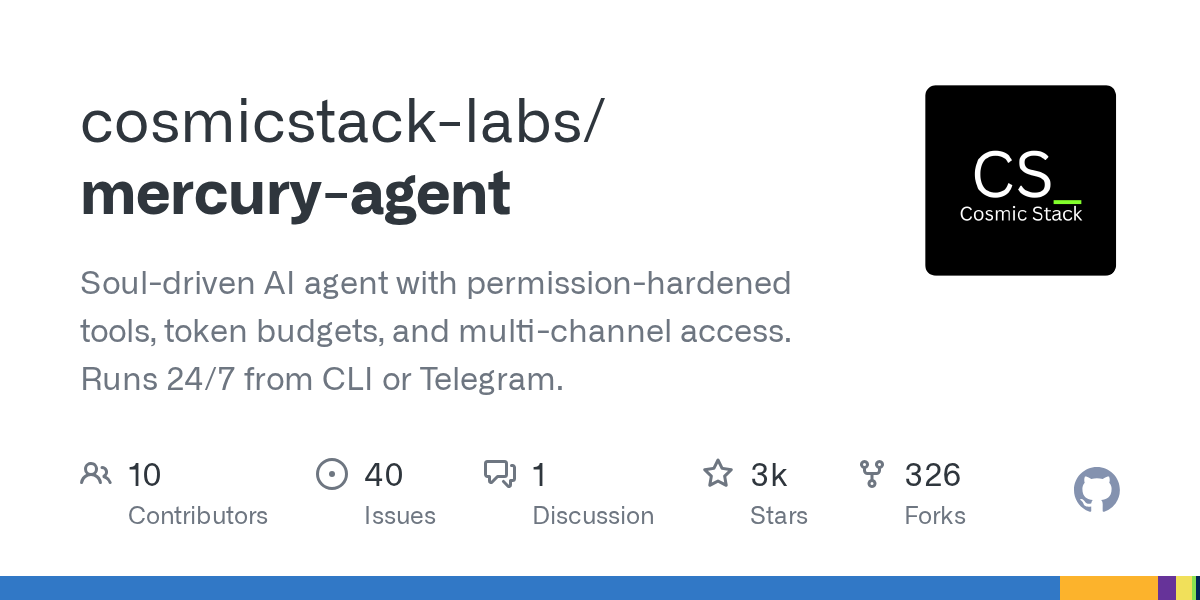
Mercury Agent: A Soul-Driven AI with Hardened Permissions and Multi-Channel Access
August 12, 2026
Mercury Agent is a sophisticated, soul-driven AI agent designed for continuous 24/7 operation, offering robust permission-hardened tools, intelligent token budgeting, and versatile multi-channel access. It remembers what matters, asks for permission before acting, and runs seamlessly from the CLI, Telegram, or a web dashboard. With 31 built-in tools, Kanban boards, and a SQLite-backed Second Brain memory, Mercury provides a comprehensive and secure AI assistant experience.
Source repository
Open the original repository on GitHub.
19 counted GitHub visits