SwarmClaw: Self-Hosted AI Agent Runtime for Autonomous Swarms
This repository profile is provided by osrepos.com, an open source repository discovery platform.
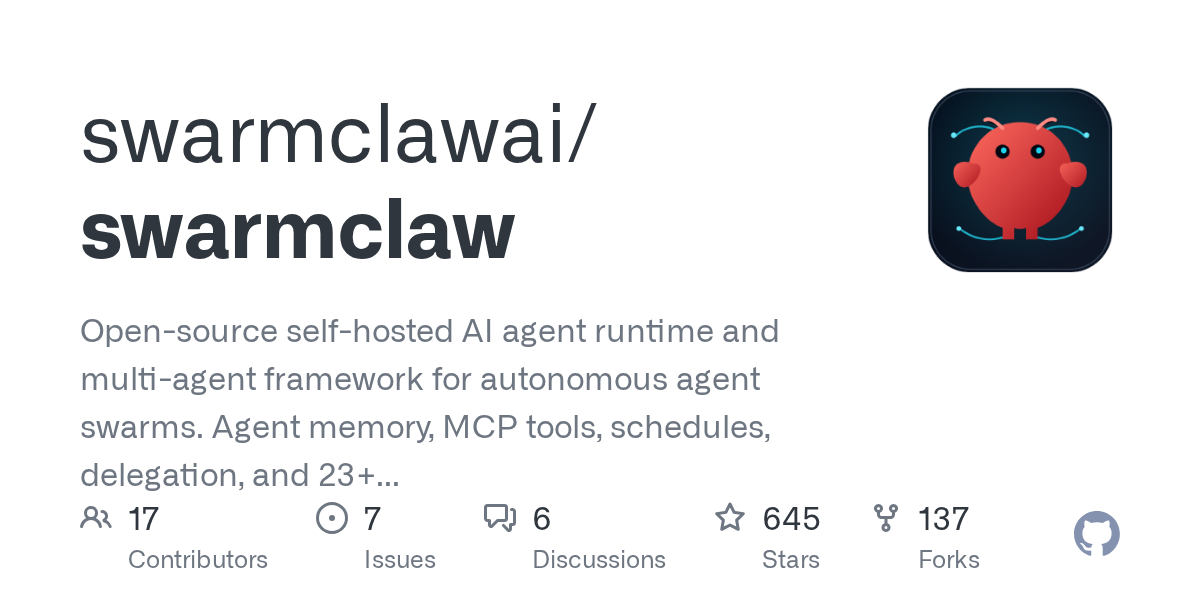
Summary
SwarmClaw is an open-source, self-hosted AI agent runtime and multi-agent framework designed for autonomous agent swarms. It offers durable agent memory, MCP tools, schedules, and delegation, supporting over 23 LLM providers including Claude, GPT, Gemini, OpenRouter, and Ollama. This platform serves as a practical alternative to solutions like Claude Code and LangChain for those seeking self-hosted AI agent orchestration.
Repository Information
Topics
Click on any tag to explore related repositories
Use at your own risk
OSRepos shares public repositories for knowledge and discovery only. Any installation, execution, configuration, or use of code from these repositories is the user's own responsibility. Always review the repository, source code, dependencies, licenses, and security implications before running or installing anything. OSRepos is not responsible for issues, damages, or losses resulting from third-party repositories.
Introduction
SwarmClaw is an open-source, self-hosted AI agent runtime and multi-agent framework designed for autonomous agent swarms. It provides a robust platform for running AI agents, orchestrators, and agent swarms with features like durable agent memory, Model Context Protocol (MCP) tools, schedules, and delegation. Supporting over 23 LLM providers, including Claude, GPT, Gemini, OpenRouter, and Ollama, SwarmClaw offers a practical alternative to solutions like Claude Code and LangChain for self-hosted AI workflows.
Developed in TypeScript, SwarmClaw has garnered significant community interest, boasting 645 stars and 137 forks. It is released under the MIT License, ensuring flexibility for developers and organizations.
Installation
SwarmClaw offers multiple installation methods to suit different user needs, from desktop applications for non-technical users to Docker for containerized deployments.
Desktop App (Recommended for non-technical users)
Download the one-click installer for macOS (Apple Silicon & Intel), Windows, and Linux (AppImage + .deb) from the official website. Download SwarmClaw Desktop App
Global Install (npm)
For developers, SwarmClaw can be installed globally via npm, yarn, pnpm, or bun.
npm i -g @swarmclawai/swarmclaw
swarmclaw
Running swarmclaw starts the server on http://localhost:3456.
From the Repository
To run SwarmClaw directly from its source code:
git clone https://github.com/swarmclawai/swarmclaw.git
cd swarmclaw
nvm use
npm run quickstart
npm run quickstart handles dependency installation, local configuration, and starts SwarmClaw.
Docker
For a containerized setup, use Docker Compose:
git clone https://github.com/swarmclawai/swarmclaw.git
cd swarmclaw
mkdir -p data
touch .env.local
docker compose up -d --build
Access SwarmClaw at http://localhost:3456 after deployment.
Examples
SwarmClaw is a versatile agent runtime, enabling a wide range of use cases for both individuals and teams.
Personal Assistant
Deploy a single agent with memory, web access, scheduling, and file tools to act as your always-available copilot. It can remember preferences, schedule reminders, research, draft content, and manage your daily tasks.
Virtual Company
Build a full organizational chart of specialized agents that collaborate, delegate, and report up, simulating a real company. Each agent can have its own provider, model, personality, and tool access, with a CEO agent delegating tasks to department heads.
Development Team
Create a squad of agents mirroring an engineering team, capable of planning, building, reviewing, and testing in parallel. A Lead agent can break down work, Dev agents can use coding tools like Claude Code, QA agents can run tests, and Reviewer agents can audit pull requests.
Research Bureau
Spawn a swarm of research agents to work in parallel, each with different search strategies, and then synthesize their findings. Agents can search, fetch, read, and summarize independently, with a lead agent collecting outputs into structured reports.
Why Use SwarmClaw?
SwarmClaw distinguishes itself by focusing on several core capabilities crucial for advanced AI agent deployments:
- Delegation, Orchestration, and Background Execution: Facilitates complex workflows with delegated work, orchestrator agents, subagents, durable jobs, and background task execution.
- Structured Sessions: Offers reusable, bounded runs with templates, facilitators, participants, and durable transcripts, ideal for structured collaboration and problem-solving.
- Autonomy and Memory: Features heartbeats, orchestrator wake cycles, schedules, long-running execution, durable memory, reflection memory, and project-aware context for truly autonomous agents.
- Extensive LLM Provider Support: Connects to 24+ built-in providers, including major cloud LLMs and local options like Ollama, giving users flexibility and control over their models.
- Self-Hosted Control: Provides a self-hosted environment, ensuring data privacy and full control over your AI agent infrastructure, a key advantage over cloud-dependent solutions.
- Operator Tooling: Includes connectors for various platforms (Discord, Slack, Telegram), extensions, browser automation, shell/files/git tooling, and runtime guardrails for comprehensive management.
Links
- GitHub Repository: https://github.com/swarmclawai/swarmclaw
- Official Documentation: https://swarmclaw.ai/docs
- Website: https://swarmclaw.ai
- Discord Community: https://discord.gg/sbEavS8cPV
- SwarmDock Marketplace: https://swarmdock.ai
- SwarmFeed Social Network: https://swarmfeed.ai
Related repositories
Similar repositories that may be relevant next.
Uni-Agent: A Scalable Framework for Training Long-Horizon AI Agents
October 1, 2026
Uni-Agent is a powerful Python framework designed for training long-horizon agents at scale. It allows users to integrate existing agent harnesses, unify diverse agent tasks through an extensible interface, and run thousands of sessions concurrently for efficient data collection and training.
Bernstein: Open-Source Governance and Orchestration for AI Agents
September 28, 2026
Bernstein is an open-source framework designed for the governance and orchestration of AI agents, allowing users to define rules declaratively. It enforces these policies and generates verifiable, replayable records of all agent activities. This Python-based solution provides a robust layer for managing complex AI agent workflows with transparency and accountability.
lat.md: A Knowledge Graph for Your Codebase, Written in Markdown
September 26, 2026
lat.md is an innovative tool that transforms your codebase knowledge into an interconnected graph of markdown files. It helps both AI agents and human developers quickly understand project architecture, business logic, and design decisions. By integrating directly into your project, lat.md ensures documentation remains consistent and up-to-date.
KDA: Kernel Design Agents for High-Performance CUDA Kernel Development
September 26, 2026
Kernel Design Agents (KDA) offers an agent-centric workflow designed to streamline the research, implementation, verification, and iteration of performance-sensitive CUDA kernel tasks. This innovative approach leverages coding agents to accelerate the development of high-performance kernels. It is an early research prototype from NVlabs, welcoming community feedback and contributions.
Source repository
Open the original repository on GitHub.
19 counted GitHub visits