Headroom: Drastically Reduce LLM Token Usage for AI Agents
This repository profile is provided by osrepos.com, an open source repository discovery platform.
Summary
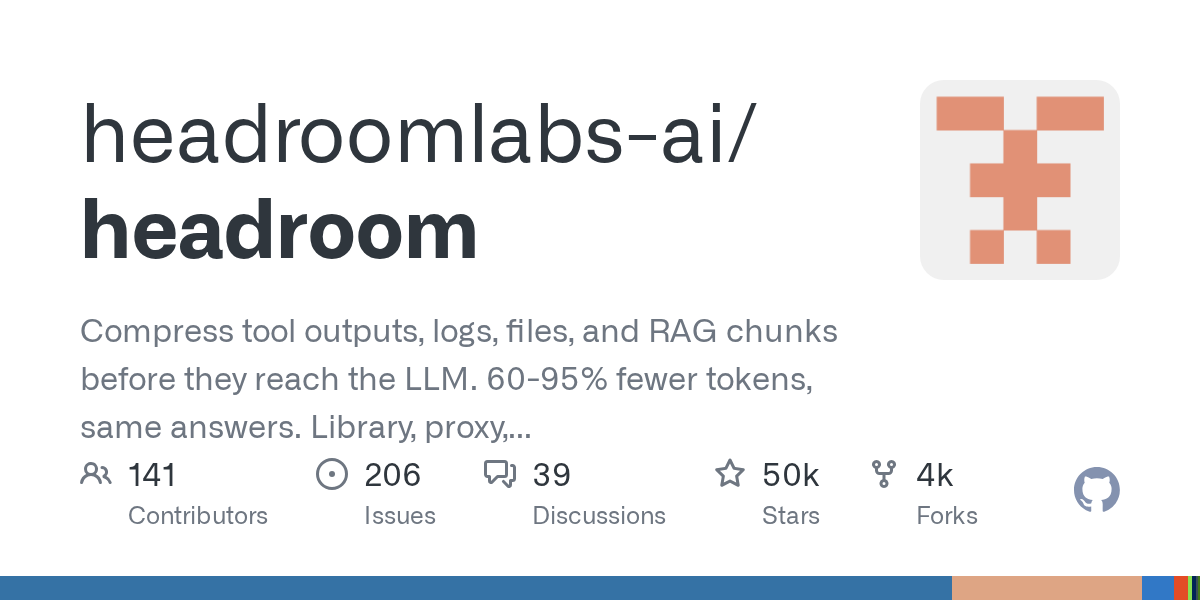
Headroom is an innovative context compression layer for AI agents, designed to significantly reduce token usage for LLMs. It achieves 60-95% fewer tokens across various inputs like tool outputs, logs, files, and RAG chunks, all while preserving answer accuracy. This powerful tool enhances efficiency and cost-effectiveness for AI interactions.
Repository Information
Topics
Click on any tag to explore related repositories
Use at your own risk
OSRepos shares public repositories for knowledge and discovery only. Any installation, execution, configuration, or use of code from these repositories is the user's own responsibility. Always review the repository, source code, dependencies, licenses, and security implications before running or installing anything. OSRepos is not responsible for issues, damages, or losses resulting from third-party repositories.
Introduction
Headroom is a powerful and innovative context compression layer designed specifically for AI agents and Large Language Models (LLMs). It tackles the critical challenge of high token usage and context window limitations by compressing various inputs, including tool outputs, logs, RAG chunks, files, and conversation history, before they reach the LLM. Users can expect a remarkable 60-95% reduction in tokens, all while maintaining the accuracy of the LLM's responses.
Operating locally to ensure data privacy, Headroom offers flexible integration options as a Python/TypeScript library, a zero-code proxy, or an MCP server. Its core architecture intelligently routes content to specialized compressors for JSON, code (AST-aware), and general text, and features a reversible compression mechanism (CCR) that allows LLMs to retrieve original content on demand.
Installation
Getting started with Headroom is straightforward. It requires Python 3.10+ for the full feature set.
For Python:
pip install "headroom-ai[all]"
For Node.js / TypeScript:
npm install headroom-ai
You can also use Docker:
docker pull ghcr.io/chopratejas/headroom:latest
Examples
Headroom provides multiple ways to integrate into your existing AI workflows.
Wrap an AI agent:
headroom wrap claude
Run as a local proxy (zero code changes):
headroom proxy --port 8787
Use as an inline library in Python:
from headroom import compress

# Example: Compress a list of messages
messages = [
    {"role": "user", "content": "Analyze this log file: ..."},
    {"role": "assistant", "content": "Processing the log..."},
]
compressed_messages = compress(messages)
print(f"Original tokens: {len(str(messages))}, Compressed tokens: {len(str(compressed_messages))}")
Monitor your savings:
headroom perf
headroom dashboard # Requires proxy to be running
Why Use Headroom?
Headroom offers compelling advantages for anyone working with AI agents and LLMs:
- Drastic Token Reduction: Achieve 60-95% fewer tokens, leading to significant cost savings and the ability to process much larger contexts.
- Accuracy Preservation: Rigorous benchmarks demonstrate that Headroom maintains or even improves accuracy on standard tasks like math, factual QA, and tool usage.
- Flexible Integration: Seamlessly integrate as a library, a proxy, or an agent wrapper, adapting to your preferred development style and existing infrastructure.
- Local-First & Reversible: All compression happens locally, keeping your data private. The Content-Cache-Retrieve (CCR) mechanism ensures original content can be retrieved by the LLM if needed.
- Cross-Agent Memory: Share compressed context across different AI agents like Claude, Codex, and Gemini, enhancing collaborative workflows.
- Output Token Reduction: Beyond input compression, Headroom can also intelligently trim what the model writes back, further optimizing costs.
- Broad Compatibility: Works with popular agents and frameworks, including Claude Code, Cursor, LangChain, and any OpenAI-compatible client via its proxy.
Links
- GitHub Repository: https://github.com/headroomlabs-ai/headroom
- Official Documentation: https://headroom-docs.vercel.app/docs
- Discord Community: https://discord.gg/yRmaUNpsPJ
- PyPI Package: https://pypi.org/project/headroom-ai/
- npm Package: https://www.npmjs.com/package/headroom-ai
- Kompress-v2-base Model: https://huggingface.co/chopratejas/kompress-v2-base
Related repositories
Similar repositories that may be relevant next.
TeamAI-CLI: Empowering Teams to Become AI Native with a Git-Based Foundation
September 24, 2026
TeamAI-CLI, developed by Tencent, is a powerful command-line interface aimed at making every team AI native. It offers a unified, Git-based platform for teams to collaborate, learn, and continuously improve with AI. This tool transforms individual AI capabilities into shared team assets, integrating AI agents, machines, and team members for enhanced efficiency.
LLM Wiki: Build a Self-Maintaining, Interlinked Knowledge Base with AI
September 23, 2026
LLM Wiki is a powerful cross-platform desktop application designed to transform your documents into an organized, interlinked knowledge base automatically. Unlike traditional RAG systems, it incrementally builds and maintains a persistent wiki from your sources, ensuring knowledge is compiled once and kept current. This innovative approach offers a dynamic and evolving personal knowledge management solution.
Agent Orchestrator: Supervise Teams of Coding Agents from Planning to Merge
September 23, 2026
Agent Orchestrator is a powerful tool designed to run and supervise teams of coding agents throughout the entire development lifecycle, from initial planning to code merge. It supports a wide array of agent harnesses, including Claude Code and Codex, and operates across desktop, web, mobile, and cloud environments. This platform offers a unified workspace to manage and coordinate multiple agents, ensuring efficient and organized agent-driven development.
AutoResearch: AI/ML Research Agents from Idea to Paper-Ready Evidence
September 22, 2026
AutoResearch is an open-source agent workflow designed for AI and machine learning research. It automates the entire research process, from generating ideas and planning experiments to execution, analysis, and independent evaluation. This project helps researchers produce paper-ready evidence efficiently and with traceable provenance.
Source repository
Open the original repository on GitHub.
26 counted GitHub visits