GitNexus: Zero-Server Code Intelligence Engine for AI Agents
This repository profile is provided by osrepos.com, an open source repository discovery platform.
Summary
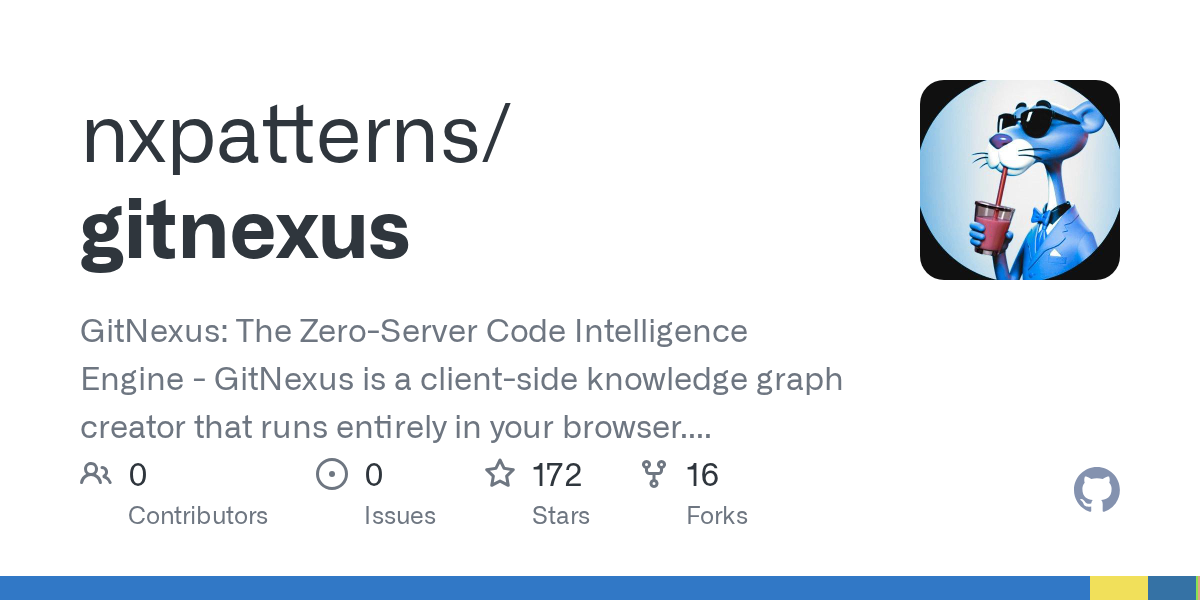
GitNexus is a client-side knowledge graph creator that runs entirely in your browser, transforming GitHub repositories or ZIP files into interactive knowledge graphs. It features a built-in Graph RAG Agent, perfect for deep code exploration and enhancing AI agent reliability. This tool provides architectural context to AI, ensuring more accurate and efficient code analysis.
Repository Information
Topics
Click on any tag to explore related repositories
Use at your own risk
OSRepos shares public repositories for knowledge and discovery only. Any installation, execution, configuration, or use of code from these repositories is the user's own responsibility. Always review the repository, source code, dependencies, licenses, and security implications before running or installing anything. OSRepos is not responsible for issues, damages, or losses resulting from third-party repositories.
Introduction
GitNexus is an innovative client-side knowledge graph creator designed to bring deep code intelligence directly to your browser. It allows you to drop in a GitHub repository URL or a ZIP file, and instantly generates an interactive knowledge graph of your codebase. At its core, GitNexus integrates a powerful Graph RAG Agent, making it an indispensable tool for code exploration and significantly improving the reliability of AI agents working with code.
This engine operates entirely without a server for its core functionality, emphasizing privacy and local processing. It's built on a multi-phase indexing pipeline that understands your code's structure, parses its components, resolves dependencies, clusters related symbols, traces execution flows, and builds robust search indexes.
Why Use GitNexus and Key Benefits
The true power of GitNexus lies in its "Precomputed Relational Intelligence." Traditional Graph RAG often requires AI models to perform multiple queries to understand code relationships, leading to inefficiencies and potential missed context. GitNexus addresses this by precomputing critical structural information, such as clustering, tracing, and scoring, at index time. This approach offers several key benefits:
- Reliability: AI agents receive complete, pre-structured context in a single call, drastically reducing the chance of missing dependencies or breaking changes.
- Token Efficiency: Eliminates the need for lengthy, multi-query chains, saving valuable token budget for LLMs.
- Model Democratization: Even smaller LLMs can achieve full architectural clarity, as GitNexus handles the heavy lifting of understanding the codebase structure.
GitNexus offers two primary ways to interact with your code intelligence:
- CLI + MCP (Model Context Protocol): Recommended for daily development, this mode indexes full repositories locally and connects directly to AI agents like Cursor, Claude Code, and Codex. It provides a persistent, fast experience using LadybugDB native bindings and Tree-sitter native parsers.
- Web UI: A browser-based visual graph explorer and AI chat. It's ideal for quick exploration, demos, and one-off analysis, running entirely in WebAssembly. Your code never leaves your machine in this mode.
For enhanced flexibility, GitNexus supports a "Bridge mode" where the Web UI can auto-detect and connect to a local gitnexus serve backend, allowing it to browse all your CLI-indexed repositories without re-uploading or re-indexing. GitNexus supports a wide array of languages, including TypeScript, JavaScript, Python, Java, Kotlin, C#, Go, Rust, PHP, Ruby, Swift, C, C++, Dart, and Zig, with comprehensive features like import resolution, heritage tracking, and constructor inference.
Installation
Getting started with GitNexus is straightforward. For the CLI, you can quickly index your repository and set up your AI agents:
# 1. Index your repo (run from repo root)
npx gitnexus analyze

# 2. Connect your editors (one-time, auto-detects Claude Code, Cursor, Codex, …)
npx gitnexus setup
The analyze command indexes the codebase, installs agent skills, registers hooks for tools like Claude Code, and creates context files. The setup command configures the MCP so your AI agent can leverage the generated knowledge graph. For the Web UI, no installation is required, simply visit the official link.
Examples
GitNexus provides a rich set of MCP tools to interact with your codebase. Here are a couple of examples demonstrating its capabilities:
Impact Analysis
Understand the blast radius of changes with high confidence:
impact({target: "UserService", direction: "upstream", minConfidence: 0.8})

TARGET: Class UserService (src/services/user.ts)

UPSTREAM (what depends on this):
  Depth 1 (WILL BREAK):
    handleLogin [CALLS 90%] -> src/api/auth.ts:45
    handleRegister [CALLS 90%] -> src/api/auth.ts:78
    UserController [CALLS 85%] -> src/controllers/user.ts:12
  Depth 2 (LIKELY AFFECTED):
    authRouter [IMPORTS] -> src/routes/auth.ts
Process-Grouped Search
Perform intelligent searches that group results by execution processes:
query({search_query: "authentication middleware"})

processes:
  - summary: "LoginFlow"
    priority: 0.042
    symbol_count: 4
    process_type: cross_community
    step_count: 7

process_symbols:
  - name: validateUser
    type: Function
    filePath: src/auth/validate.ts
    process_id: proc_login
    step_index: 2

definitions:
  - name: AuthConfig
    type: Interface
    filePath: src/types/auth.ts
Links
- GitHub Repository: nxpatterns/gitnexus
- Web UI: gitnexus.vercel.app
- Discord Community: Join Discord
- Enterprise Offering: akonlabs.com
Related repositories
Similar repositories that may be relevant next.
OpenMausBot: Your Open-Source AI Bot Team in a Chat App
September 20, 2026
OpenMausBot is an open-source desktop application that provides an alternative to Grok Bot, allowing users to manage a team of AI agents within a chat interface. It emphasizes local-first operation, bringing your own agents, and providing each bot with its own virtual machine or access to your computer. This project enables powerful AI interactions with privacy and control at its core.
aport-spec: The Open Agent Passport (OAP) Specification for AI Agent Trust
September 18, 2026
The aport-spec repository introduces the Open Agent Passport (OAP) specification, a critical framework for establishing trust in AI agents. It defines a lightweight, cryptographically verifiable credential, enabling real-time, pre-action authorization for AI agents across various platforms. OAP provides the essential runtime trust layer for secure and scalable agentic commerce.
SandBase Harness: Local-First AI Agent Runtime with Sandboxed Sessions
September 13, 2026
SandBase Harness is a local-first, self-hosted runtime for AI agents, offering sandboxed sessions, memory, and credentials. This TypeScript-based project provides a robust infrastructure for managing and observing AI agents, ensuring auditability and secure execution on your own machine or infrastructure.
A3M Router: Biology-Inspired LLM Routing for Cost Savings and Performance
September 13, 2026
A3M Router is an open-source, biology-inspired LLM router designed to optimize costs and performance across over 80 providers. It leverages principles like swarm intelligence and neural plasticity to offer adaptive, resilient, and cost-effective AI routing. This tool helps users save significantly on AI costs by intelligently selecting the best model for each query.
Source repository
Open the original repository on GitHub.