Shepherd: Reversible Execution Traces for Programmable Meta-Agents
This repository profile is provided by osrepos.com, an open source repository discovery platform.
Summary
Shepherd is a Python runtime substrate designed for agent work requiring inspection, reversibility, and supervision. It records agent runs as durable, inspectable execution traces, enabling meta-agents to observe, fork, replay, and revert any operation. This framework couples agents and environments using a copy-on-write fork, offering significant performance benefits and robust permission enforcement.
Repository Information
Topics
Click on any tag to explore related repositories
Use at your own risk
OSRepos shares public repositories for knowledge and discovery only. Any installation, execution, configuration, or use of code from these repositories is the user's own responsibility. Always review the repository, source code, dependencies, licenses, and security implications before running or installing anything. OSRepos is not responsible for issues, damages, or losses resulting from third-party repositories.
Introduction
Shepherd is an innovative Python framework that provides a runtime substrate for agents, focusing on enabling programmable meta-agents through reversible execution traces. It transforms an agent's execution into a Git-like trace, allowing for deep inspection, replay, and reversion of any run. This capability is crucial for developing sophisticated meta-agents that can supervise, optimize, and train other agents effectively.
Why use and benefits
Shepherd offers several compelling advantages for agent development and supervision. Its core strength lies in turning agent execution into a reversible, inspectable trace, which is invaluable for debugging, auditing, and understanding agent behavior. The framework boasts impressive performance, coupling agents and environments in a copy-on-write fork that is approximately 5x faster than docker commit, with about 95% KV-cache reuse on replay. Furthermore, Shepherd provides robust security through OS-level grant enforcement for permissions, ensuring that agents operate within defined boundaries on macOS (Seatbelt) and Linux (Landlock). This makes it an ideal tool for building reliable and observable agent systems.
Installation
To get started with Shepherd, ensure you have Python 3.11+ installed. You can install the shepherd-ai package using pip:
pip install shepherd-ai
Examples
Shepherd provides a straightforward quickstart to demonstrate its capabilities. You can set up a workspace, run an agent task, and then inspect or apply its retained output. The framework allows agents to propose changes, which you can review and decide to keep or discard, without directly modifying your files until accepted. For a practical example, the write_program task demonstrates how an agent can generate code in a sandboxed environment. Offline quickstart options are also available, requiring no API keys. More detailed examples, including a citation-checker package and visual artifact notebooks, are available in the repository.
Links
Related repositories
Similar repositories that may be relevant next.
Agent Anvil: CI-First Evaluation Harness for Tool-Using AI Agents
October 1, 2026
Agent Anvil is a robust, CI-first evaluation harness designed for AI agents that utilize tools. It meticulously runs scenario suites, captures detailed traces of agent behavior, and provides semantic grading to identify issues. The platform excels at clustering failures and suggesting concrete fixes for prompts, tools, and guardrails, ensuring agents behave safely and effectively.
VeRL-Omni: Multimodal RL Training Framework for Diffusion & Omni Models
October 1, 2026
VeRL-Omni is a powerful RL training framework designed specifically for multimodal generative models, including diffusion models and omni-modality models. Built on top of the `verl` project, it offers easy, fast, and stable training solutions for complex generative AI tasks. The framework addresses unique challenges in multimodal RL, providing optimized performance and stability.
Uni-Agent: A Scalable Framework for Training Long-Horizon AI Agents
October 1, 2026
Uni-Agent is a powerful Python framework designed for training long-horizon agents at scale. It allows users to integrate existing agent harnesses, unify diverse agent tasks through an extensible interface, and run thousands of sessions concurrently for efficient data collection and training.
Benchmark Radar: A Living Database for AI Benchmarks and Evaluation
September 29, 2026
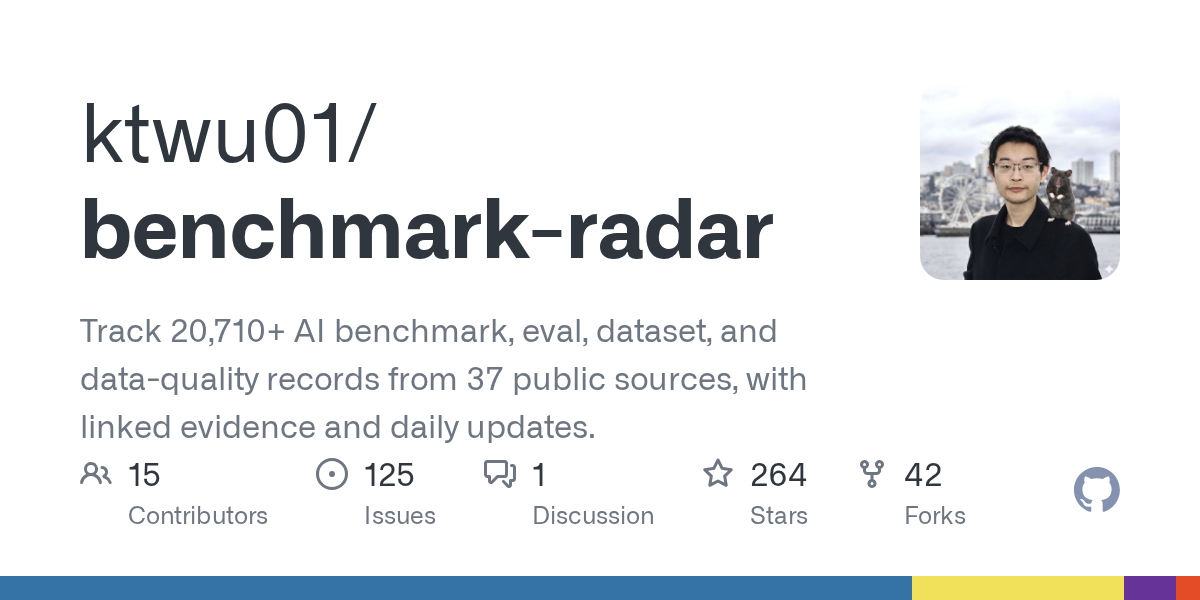
Benchmark Radar is an extensive open-source project that tracks over 20,710 AI benchmark, evaluation, dataset, and data-quality records from 37 public sources. It provides daily updates, linked evidence, and tools for researchers and developers to discover and analyze AI benchmarks. This project is essential for anyone needing to stay current with AI evaluation trends and model performance.
Source repository
Open the original repository on GitHub.