DeclarAgent: Declarative Runbook Executor for Safe AI Agent Workflows
This repository profile is provided by osrepos.com, an open source repository discovery platform.
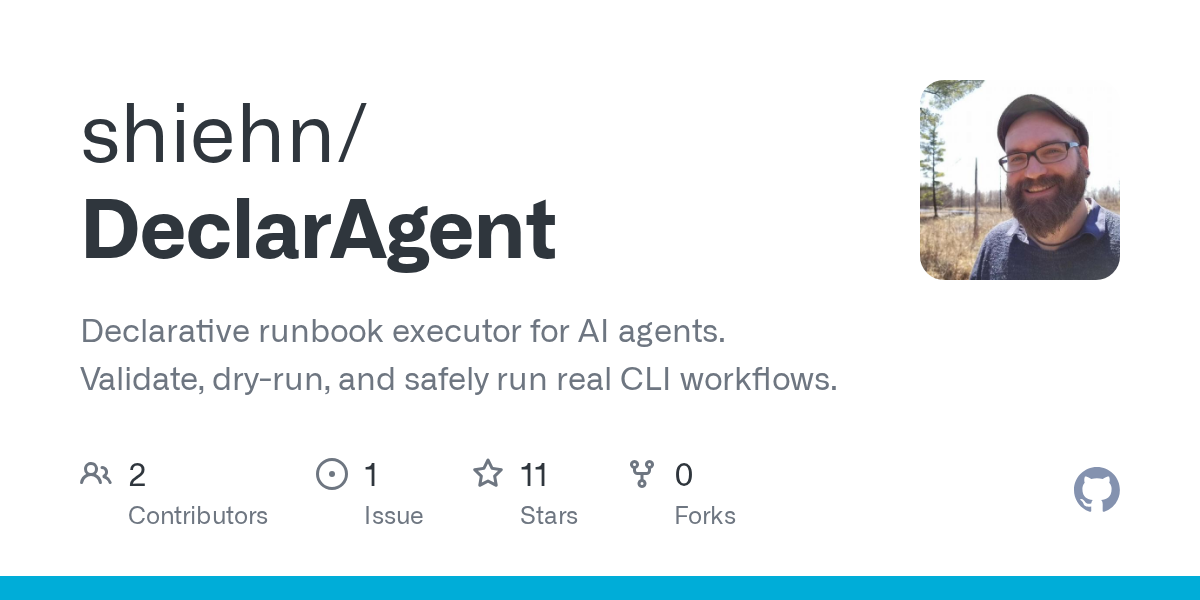
Summary
DeclarAgent is an innovative declarative runbook executor specifically designed for AI agents. It enables agents to validate, dry-run, and safely execute multi-step YAML workflows. This tool provides a structured, auditable, and secure way for LLM agents to interact with real CLI workflows, enhancing their operational safety and reliability.
Repository Information
Topics
Click on any tag to explore related repositories
Use at your own risk
OSRepos shares public repositories for knowledge and discovery only. Any installation, execution, configuration, or use of code from these repositories is the user's own responsibility. Always review the repository, source code, dependencies, licenses, and security implications before running or installing anything. OSRepos is not responsible for issues, damages, or losses resulting from third-party repositories.
Introduction
DeclarAgent is an innovative declarative runbook executor specifically designed for AI agents. It empowers large language model (LLM) agents to safely and reliably execute multi-step YAML workflows, including real CLI commands, HTTP requests, and built-in actions. By providing validation, dry-run capabilities, and explicit approval for destructive steps, DeclarAgent ensures that AI agents can interact with real-world systems in a controlled and auditable manner.
Why Use and Key Benefits
DeclarAgent offers a range of features and benefits that make it an essential tool for secure and structured workflow execution by AI agents:
- YAML Plans: Human-readable, version-controllable runbooks.
- Three Step Types: Shell commands (
run), built-in actions (action), and HTTP requests (http). - Dry-run & Explain: Inspect exactly what will happen before execution.
- Destructive-Step Gating: Steps marked
destructive: truerequire explicit approval. - Structured JSON Results: Machine-readable output with typed errors for every run.
- Built-in Actions: File I/O, JSON manipulation, and environment access.
- Template Engine: Reference outputs from prior steps with
${{steps.<id>.outputs.<key>}}. - MCP Server: Expose plans as directly callable tools over the Model Context Protocol.
- Plan-as-Tool: YAML files in a directory automatically become MCP tools.
Installation
To install DeclarAgent, you will need Go installed on your system.
go install github.com/shiehn/declaragent@latest

# Verify
declaragent --help
Note: This project is currently tested on macOS, and Linux should work out of the box. Windows requires WSL or a similar POSIX-compatible shell.
Examples
DeclarAgent offers a straightforward command-line interface for managing your runbooks. Here are some quick start examples:
# Validate a plan
declaragent validate plan.yaml

# See what it would do
declaragent explain plan.yaml --input branch=main

# Dry-run (resolves templates, shows commands)
declaragent dry-run plan.yaml --input branch=main

# Execute for real
declaragent run plan.yaml --input branch=main

# Execute with destructive steps allowed
declaragent run plan.yaml --input branch=main --approve
For a practical demonstration, consider the hello.yaml plan:
name: hello
description: Say hello to someone
inputs:
  name:
    description: Who to greet
    default: World
steps:
  - id: greet
    run: echo "Hello, ${{inputs.name}}!"
    outputs:
      message: stdout
You can run this plan with:
declaragent run plans/hello.yaml --input name=Alice
This will output a greeting, demonstrating a simple shell command execution within a declarative plan.
Links
Find the official repository and contribute on GitHub:
Related repositories
Similar repositories that may be relevant next.
tunnel-client: Securely Connect Private MCP Servers to OpenAI Services
September 2, 2026
The `tunnel-client` is an OpenAI-developed client that enables secure connections between private or localhost Model Context Protocol (MCP) servers and OpenAI services like ChatGPT, Codex, and AgentKit. It allows developers to integrate their internal MCP servers without exposing them to the public internet, ensuring enhanced security and operational control. This tool is ideal for scenarios requiring secure access from private networks to OpenAI's powerful AI models.
deja-vu: Retroactive Memory for AI Coding Agents
September 2, 2026
deja-vu is a powerful local-first tool that provides retroactive memory for AI coding agents, indexing past coding sessions from various agents, even those from before installation. This Go binary allows agents to recall relevant information without needing an LLM or embeddings by default. It enhances agent performance by providing context at the point of action, preventing repeated mistakes and improving efficiency.
Agent-Sandbox: Enterprise-Grade Sandbox for AI Agents on Kubernetes
August 28, 2026
Agent-Sandbox provides an easy-to-use, enterprise-grade sandbox platform for AI Agents. It allows agents to securely run untrusted LLM-generated code, perform browser and computer use, and deploy websites with multi-session and multi-tenant isolation. This self-hosted solution wraps a robust Kubernetes foundation behind a simple RESTful API, making it accessible for developers.
DeepSeek-Reasonix: Your AI Coding Agent for the Terminal
August 26, 2026
DeepSeek-Reasonix is an AI coding agent designed for your terminal, offering a stable and persistent environment for development tasks. Engineered with prefix-cache stability, it allows you to leave it running for continuous autonomous operation. This tool integrates seamlessly into various workflows, from CLI to VS Code, enhancing productivity with AI assistance.
Source repository
Open the original repository on GitHub.