Cortex-Mem: A Production-Ready Memory Framework for Autonomous AI Systems
This repository profile is provided by osrepos.com, an open source repository discovery platform.
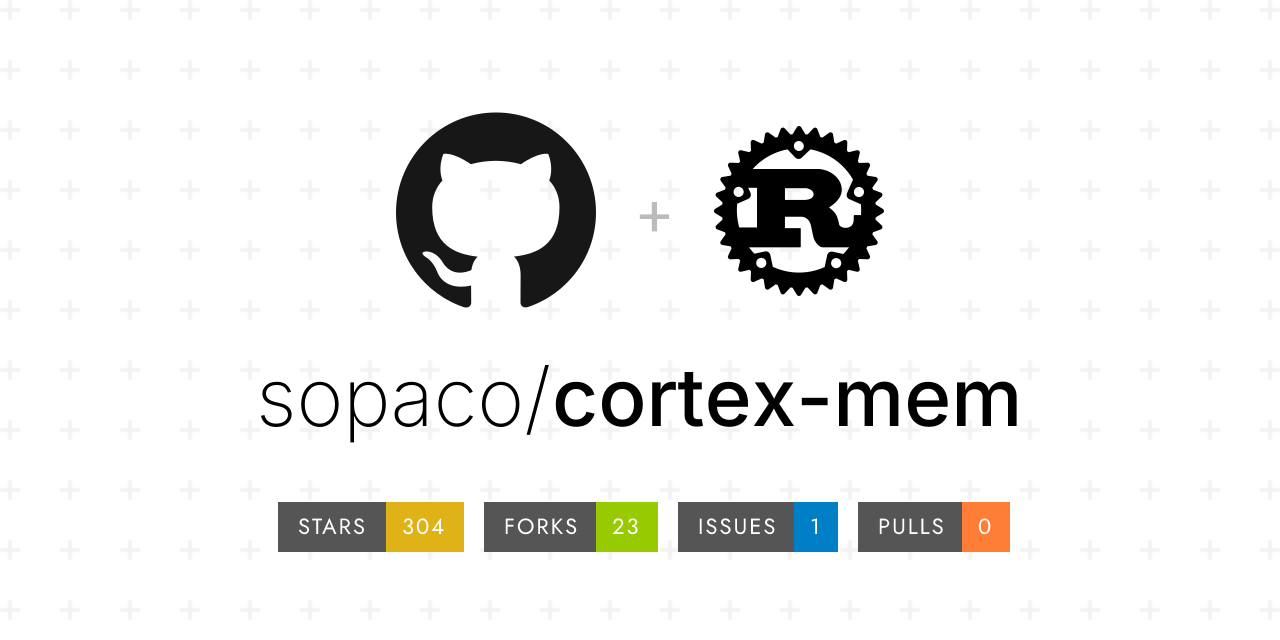
Summary
Cortex-Mem is a production-ready, AI-native memory framework built in Rust, providing intelligent long-term memory for autonomous systems. It features a hierarchical three-tier memory architecture for efficient information management, from extraction and search to automated optimization. This framework empowers AI agents to remember, learn, and personalize interactions across sessions, transforming stateless AI into context-aware partners.
Repository Information
Topics
Click on any tag to explore related repositories
Use at your own risk
OSRepos shares public repositories for knowledge and discovery only. Any installation, execution, configuration, or use of code from these repositories is the user's own responsibility. Always review the repository, source code, dependencies, licenses, and security implications before running or installing anything. OSRepos is not responsible for issues, damages, or losses resulting from third-party repositories.
Introduction
Cortex-Mem is a production-ready, AI-native memory framework built in Rust, designed to provide autonomous systems with intelligent long-term memory. It moves beyond simple chat history, offering a sophisticated, hierarchical three-tier memory architecture, from extraction and search to automated optimization. This framework empowers AI agents, such as those in Embodied-AI and OpenClaw, with the ability to remember, learn, and personalize interactions across sessions.
At its core, Cortex-Mem utilizes a hybrid storage architecture, combining virtual-filesystem durability with high-performance vector-based semantic search. It comes with out-of-the-box support for SKILL, CLI, API, MCP, and an insights dashboard, making it a comprehensive solution for building truly intelligent, context-aware applications.
Why Use Cortex-Mem?
Cortex-Mem transforms stateless AI into an intelligent, context-aware partner. Before Cortex-Mem, AI often forgets user details, lacks personalization, and repeats questions, leading to robotic and impersonal interactions. With Cortex-Mem, AI agents remember user preferences and history, provide deeply personalized interactions, learn and adapt over time, and maintain context across multiple conversations. This allows them to build rapport and feel like a true assistant.
It is ideal for developers building LLM-powered chatbots and agents, teams creating personalized AI assistants, and open-source projects requiring a robust memory backbone. Cortex-Mem has also demonstrated superior performance and token efficiency in benchmarks, achieving significantly higher scores with fewer tokens compared to other systems.
Installation
To get started with Cortex-Mem, you will need:
- Rust (version 1.86 or later)
- Qdrant vector database (version 1.7+)
- An OpenAI-compatible LLM API endpoint for memory extraction and analysis
- An OpenAI-compatible Embedding API endpoint for vector search
The simplest way to install the core components is via cargo:
# Install the CLI for command-line management
cargo install --path cortex-mem-cli

# Install the REST API Service for application integration
cargo install --path cortex-mem-service

# Install the MCP server for AI assistant integrations
cargo install --path cortex-mem-mcp
Cortex-Mem applications are configured via a config.toml file, which specifies details for Qdrant, LLM, embedding services, and the data directory.
Examples
The cortex-mem-cli provides a powerful interface for direct interaction with the memory system. All commands require a config.toml file and can use the --tenant flag for multi-tenant isolation.
Add a Memory:
Adds a new message to a session thread.
cortex-mem --config config.toml --tenant acme add --thread thread-123 --role user "The user is interested in Rust programming."
Search for Memories:
Performs a semantic vector search across the memory store.
cortex-mem --config config.toml --tenant acme search "what are the user's hobbies?" --thread thread-123 --limit 10
List Memories:
Retrieves a list of memories from a specific URI path.
cortex-mem --config config.toml --tenant acme list --uri "cortex://session" --include-abstracts
Get a Specific Memory:
Retrieves a specific memory by its URI.
cortex-mem --config config.toml --tenant acme get "cortex://session/thread-123/memory-456.md"
Session Management:
Create and close conversation sessions. Closing a session triggers memory extraction and indexing.
# Create a new session
cortex-mem --config config.toml --tenant acme session create thread-456 --title "My Session"

# Close a session
cortex-mem --config config.toml --tenant acme session close thread-456
Links
Related repositories
Similar repositories that may be relevant next.
AgentAleph: Local-First AI Coding Agent and GGUF Model Manager
September 25, 2026
AgentAleph is a desktop application that combines a local-first AI coding agent with a GGUF model manager. It allows users to download, load, and manage local large language models, and then use an AI agent to interact with their projects, all without relying on cloud services or API keys. This tool emphasizes privacy and offline capability, running models directly on your machine.
browser-rs-mcp: Lightweight Stealth Browser Server for AI Agents in Rust
September 25, 2026
browser-rs-mcp is a lightweight, stealth-oriented Model Context Protocol (MCP) browser server written in Rust. It enables multiple AI agents to share a single, persistent Chrome instance, offering over 64 Playwright-style tools without requiring a Node.js runtime. This project is ideal for parallel web scraping, automation, and QA, providing efficient and isolated tab control for each agent.
LLM Wiki: Build a Self-Maintaining, Interlinked Knowledge Base with AI
September 23, 2026
LLM Wiki is a powerful cross-platform desktop application designed to transform your documents into an organized, interlinked knowledge base automatically. Unlike traditional RAG systems, it incrementally builds and maintains a persistent wiki from your sources, ensuring knowledge is compiled once and kept current. This innovative approach offers a dynamic and evolving personal knowledge management solution.
Coven: Local-First Runtime for AI Coding Agent Sessions
September 18, 2026
Coven is a powerful local-first runtime designed for managing project-scoped AI coding agent sessions. It provides durable state, robust authority boundaries, and seamless interoperability with multiple coding harnesses like Codex, Claude Code, and GitHub Copilot CLI. This tool enables developers to safely launch, observe, and coordinate AI agent work directly within their local project environments.
Source repository
Open the original repository on GitHub.
29 counted GitHub visits