oRPC: Typesafe APIs Made Simple with RPC and OpenAPI
This repository profile is provided by osrepos.com, an open source repository discovery platform.
Summary
oRPC combines RPC and OpenAPI to simplify building end-to-end type-safe APIs. It offers robust features like first-class OpenAPI support, contract-first development, and seamless integration with popular frameworks. This powerful tool ensures type safety from client to server while adhering to industry standards.
Repository Information
Topics
Click on any tag to explore related repositories
Use at your own risk
OSRepos shares public repositories for knowledge and discovery only. Any installation, execution, configuration, or use of code from these repositories is the user's own responsibility. Always review the repository, source code, dependencies, licenses, and security implications before running or installing anything. OSRepos is not responsible for issues, damages, or losses resulting from third-party repositories.
Introduction
oRPC is a powerful combination of RPC and OpenAPI, designed to make building APIs that are end-to-end type-safe and adhere to OpenAPI standards simple and efficient. It ensures type-safe inputs, outputs, and errors across your entire application stack, from client to server. With oRPC, developers can leverage contract-first development and integrate seamlessly with various frameworks and runtimes, enhancing both developer experience and application reliability.
Installation
To get started with oRPC, you can install the necessary packages using npm or your preferred package manager. The core packages include @orpc/server for backend implementation, @orpc/client for client-side consumption, and @orpc/contract for defining your API structure.
npm install @orpc/server @orpc/client @orpc/contract
Examples
Here's a quick overview of how to use oRPC, from defining your API router to consuming it and generating OpenAPI specifications.
1. Define your router
Start by defining your API procedures and their schemas using a schema validator like Zod.
import type { IncomingHttpHeaders } from 'node:http'
import { ORPCError, os } from '@orpc/server'
import * as z from 'zod'

const PlanetSchema = z.object({
  id: z.number().int().min(1),
  name: z.string(),
  description: z.string().optional(),
})

export const listPlanet = os
  .input(
    z.object({
      limit: z.number().int().min(1).max(100).optional(),
      cursor: z.number().int().min(0).default(0),
    }),
  )
  .handler(async ({ input }) => {
    // your list code here
    return [{ id: 1, name: 'name' }]
  })

export const findPlanet = os
  .input(PlanetSchema.pick({ id: true }))
  .handler(async ({ input }) => {
    // your find code here
    return { id: 1, name: 'name' }
  })

export const createPlanet = os
  .$context<{ headers: IncomingHttpHeaders }>()
  .use(({ context, next }) => {
    const user = parseJWT(context.headers.authorization?.split(' ')[1])

    if (user) {
      return next({ context: { user } })
    }

    throw new ORPCError('UNAUTHORIZED')
  })
  .input(PlanetSchema.omit({ id: true }))
  .handler(async ({ input, context }) => {
    // your create code here
    return { id: 1, name: 'name' }
  })

export const router = {
  planet: {
    list: listPlanet,
    find: findPlanet,
    create: createPlanet
  }
}
2. Create your server
Implement your oRPC server using a runtime-specific handler, for example, Node.js.
import { createServer } from 'node:http'
import { RPCHandler } from '@orpc/server/node'
import { CORSPlugin } from '@orpc/server/plugins'

const handler = new RPCHandler(router, {
  plugins: [new CORSPlugin()]
})

const server = createServer(async (req, res) => {
  const result = await handler.handle(req, res, {
    context: { headers: req.headers }
  })

  if (!result.matched) {
    res.statusCode = 404
    res.end('No procedure matched')
  }
})

server.listen(
  3000,
  '127.0.0.1',
  () => console.log('Listening on 127.0.0.1:3000')
)
3. Create your client
Set up your client to interact with the oRPC server, ensuring type safety on the client side.
import type { RouterClient } from '@orpc/server'
import { createORPCClient } from '@orpc/client'
import { RPCLink } from '@orpc/client/fetch'

const link = new RPCLink({
  url: 'http://127.0.0.1:3000',
  headers: { Authorization: 'Bearer token' },
})

export const orpc: RouterClient<typeof router> = createORPCClient(link)
4. Consume your API
With the client configured, you can now consume your API with full type safety.
import { orpc } from './client'

const planets = await orpc.planet.list({ limit: 10 })
5. Generate OpenAPI Spec
oRPC allows you to generate OpenAPI specifications directly from your router definition.
import { OpenAPIGenerator } from '@orpc/openapi'
import { ZodToJsonSchemaConverter } from '@orpc/zod/zod4'

const generator = new OpenAPIGenerator({
  schemaConverters: [new ZodToJsonSchemaConverter()]
})

const spec = await generator.generate(router, {
  info: {
    title: 'Planet API',
    version: '1.0.0'
  }
})

console.log(spec)
Why Use oRPC?
oRPC offers several compelling advantages for modern API development:
- End-to-End Type Safety: Guarantees type-safe data flow from client to server, reducing runtime errors and improving code reliability.
- First-Class OpenAPI: Provides native support for OpenAPI standards, simplifying API documentation, discovery, and integration with other tools.
- Contract-First Development: Supports defining API contracts before implementation, fostering better collaboration, consistency, and clearer expectations.
- Framework Integrations: Offers seamless integration with popular frontend frameworks and data fetching libraries such as TanStack Query, SWR, and Pinia Colada.
- Multi-Runtime Support: Designed to be fast and lightweight across various JavaScript runtimes, including Cloudflare Workers, Deno, Bun, and Node.js.
- Extendability: Easily extend functionality with a robust plugin system, middleware, and interceptors to tailor oRPC to your specific needs.
Links
- GitHub Repository: https://github.com/unnoq/orpc
- Official Documentation: https://orpc.dev
Related repositories
Similar repositories that may be relevant next.
lat.md: A Knowledge Graph for Your Codebase, Written in Markdown
September 26, 2026
lat.md is an innovative tool that transforms your codebase knowledge into an interconnected graph of markdown files. It helps both AI agents and human developers quickly understand project architecture, business logic, and design decisions. By integrating directly into your project, lat.md ensures documentation remains consistent and up-to-date.
TeamAI-CLI: Empowering Teams to Become AI Native with a Git-Based Foundation
September 24, 2026
TeamAI-CLI, developed by Tencent, is a powerful command-line interface aimed at making every team AI native. It offers a unified, Git-based platform for teams to collaborate, learn, and continuously improve with AI. This tool transforms individual AI capabilities into shared team assets, integrating AI agents, machines, and team members for enhanced efficiency.
LLM Wiki: Build a Self-Maintaining, Interlinked Knowledge Base with AI
September 23, 2026
LLM Wiki is a powerful cross-platform desktop application designed to transform your documents into an organized, interlinked knowledge base automatically. Unlike traditional RAG systems, it incrementally builds and maintains a persistent wiki from your sources, ensuring knowledge is compiled once and kept current. This innovative approach offers a dynamic and evolving personal knowledge management solution.
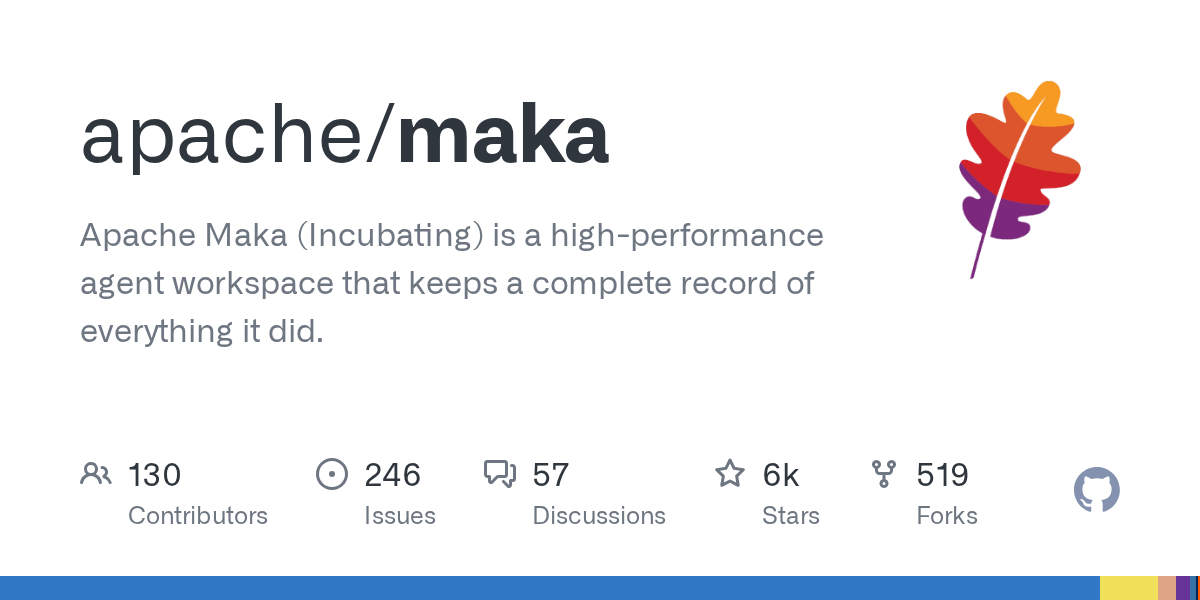
Maka: A High-Performance Agent Workspace for AI Tasks
September 21, 2026
Apache Maka (Incubating) is a high-performance agent workspace designed to maintain a complete, append-only record of all agent actions. It focuses on measurable performance, local-first operation, and robust recovery mechanisms. This project provides a unified execution authority for desktop, TUI, and CLI clients, ensuring consistent agent behavior across platforms.
Source repository
Open the original repository on GitHub.
17 counted GitHub visits