Open Source LLM Projects
Discover 274 open source LLM repositories from GitHub, each with an analysis of what it does, key features, use cases and alternatives. LLM projects here are most often combined with Python, AI Agents and AI. Last updated October 4, 2026.
274 repositories · updated October 4, 2026
KAG: Build Knowledge-Grounded Reasoning and Q&A Systems
KAG is a Python framework for building domain-specific question-answering systems that combine knowledge graphs, source text, and LLMs. It targets factual and multi-hop reasoning where vector similarity alone may be insufficient.
py-priompt: Build Token-Budgeted Prompts in Python
PyPriompt is a Python library for composing LLM prompts from reusable components and selecting content by priority to fit a token limit. It suits developers who need fine-grained control over prompt contents, such as preserving recent conversation history while trimming older context.
deer-flow: Orchestrate Long-Running AI Agent Tasks
DeerFlow is a self-hosted harness for AI agents that coordinate subagents, memory, tools, and sandboxes on tasks that can run from minutes to hours. It suits teams building research, coding, and content workflows that need an extensible agent runtime.
GLM-4.5: Run Agentic Reasoning and Coding Models
GLM-4.5 is a family of open-weight mixture-of-experts models for reasoning, coding, and tool-using agents. It includes large and more compact variants, with deployment and fine-tuning guidance for teams with substantial GPU resources.
attachments: Turn Files Into LLM-Ready Context
attachments is a Python library and CLI that turns documents, images, audio, and other inputs into structured text and image artifacts for LLM workflows. It supports local processing, optional service fallback, and adapters for prompts, chat APIs, and RAG chunks.
ARIES: Automate Infrastructure Operations with AI
ARIES is a Python-based operations platform that combines LLM agents, infrastructure monitoring, and automated remediation. It targets teams managing servers, networks, and MQTT devices, with REST API access and webhook alerts.
ROMA: Build Hierarchical Multi-Agent Systems
ROMA is a Python framework for solving complex tasks through recursive planning and coordinated agents. It suits developers building extensible multi-agent workflows with LLMs, tools, and optional persistence or API services.
txtinstruct: Build Instruction-Tuned Models from Your Data
txtinstruct is a Python framework for creating instruction-following datasets and training instruction-tuned models. It is intended for people who want greater control over dataset licensing or to incorporate their own data.
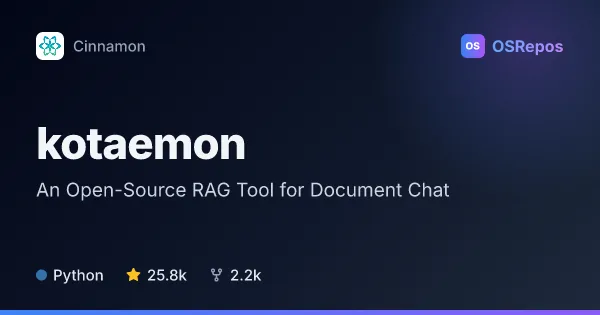
kotaemon: Chat with Documents Using RAG
kotaemon is a customizable web interface and toolkit for asking questions about documents with retrieval-augmented generation. It suits teams that want a self-hosted document QA app or developers building and adapting RAG pipelines.
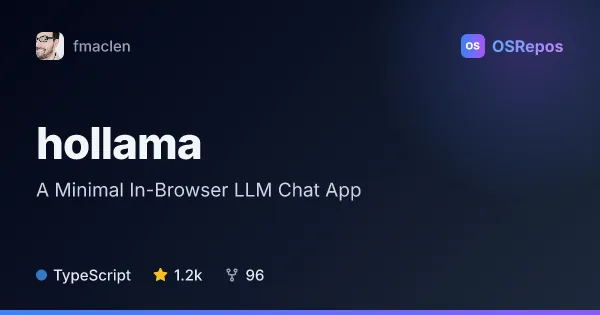
hollama: Chat with LLMs in Your Browser
Hollama is a browser-based chat app for connecting to Ollama and OpenAI servers. It suits people who want a lightweight interface for local or hosted models, with conversations and settings stored in their browser.
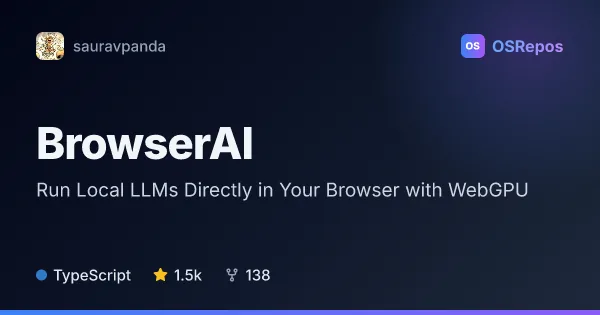
BrowserAI: Run AI Models Directly in Your Browser
BrowserAI is a TypeScript library for running language, speech, and audio models locally in a web browser. It suits developers building privacy-conscious AI features without server-side inference, provided users have a compatible WebGPU browser and hardware.
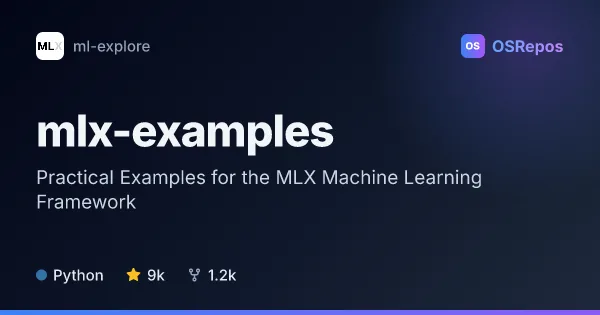
mlx-examples: Explore Machine Learning Models with MLX
A collection of standalone Python examples for the MLX machine learning framework, spanning language, image, video, audio, and multimodal models. Use it to learn MLX or adapt example implementations for experiments on supported hardware.