Agentic Engineering: Documentation-First Development for AI Coding Agents
This repository profile is provided by osrepos.com, an open source repository discovery platform.
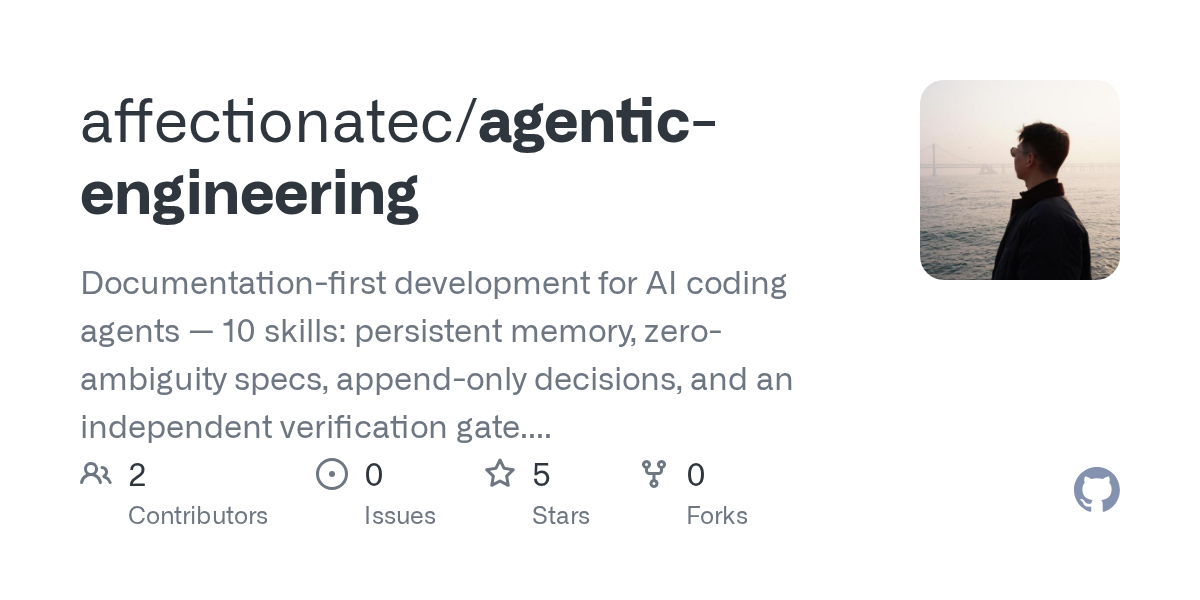
Summary
Agentic Engineering introduces a documentation-first development framework designed for AI coding agents. It effectively addresses the core challenges of agent statelessness and context collapse by providing a structured chain of documentation and verification skills. This suite serves as a robust harness layer, enabling long-running, loop-driven AI development workflows with persistent memory and clear contracts.
Repository Information
Topics
Click on any tag to explore related repositories
Use at your own risk
OSRepos shares public repositories for knowledge and discovery only. Any installation, execution, configuration, or use of code from these repositories is the user's own responsibility. Always review the repository, source code, dependencies, licenses, and security implications before running or installing anything. OSRepos is not responsible for issues, damages, or losses resulting from third-party repositories.
Introduction
Agentic Engineering is a GitHub repository that champions documentation-first development for AI coding agents. It provides a comprehensive suite of ten skills designed to give AI agents persistent memory, zero-ambiguity specifications, append-only decisions, and an independent verification gate. This project acts as a crucial harness layer for long-running, loop-driven development, ensuring that AI agents produce coherent and architecturally sound code.
Its core description highlights its purpose: "Documentation-first development for AI coding agents, 10 skills: persistent memory, zero-ambiguity specs, append-only decisions, and an independent verification gate. The harness layer for long-running, loop-driven development."
Why Use It and Key Benefits
AI agents often struggle with statelessness, meaning each new session starts from scratch, unaware of previous decisions, naming conventions, or architectural constraints. This leads to "context collapse," where code might run but lacks architectural coherence. Agentic Engineering directly tackles these problems:
- Agent produces contradictory code: The
SPECskill provides a clear contract for the agent to build against. - Agent makes resolved decisions again:
ADR(Architecture Decision Record) preserves decision history. - New session has no memory:
STATUSprovides persistent memory and checkpoints. - Agent builds the wrong thing:
PRD(Product Requirements Document) defines what and why. - Agent claims "done" when it isn't:
VERIFICATIONmakes "done" a verdict, not a claim. - Code lands as untraceable commits:
GIT WORKFLOWensures each task ships as an evidence-carrying pull request. - Docs say one thing, code another:
DOC MAINTENANCEkeeps documentation aligned with reality. - Adopting on existing codebases is hard:
ONBOARDINGreverse-engineers the as-built chain.
The suite's skills flow logically, from initial project kickoff and specification to implementation, verification, and ongoing maintenance. Architecture Decision Records (ADR) can be triggered at any point where a decision fork appears. The VERIFY skill ensures every task is independently checked, and STATUS tracks progress across sessions. Code changes are managed via GIT WORKFLOW, with a branch per task and human-gated merges.
This framework serves as a robust "harness layer" for long-running agents, providing essential primitives:
- External completion criteria: Defined by
SPECacceptance criteria andIMPL PLANlocked done conditions. - Persistent state: Managed by
STATUShandoff logs and in-flight checkpoints. - Independent evaluator: The
independent-verificationskill ensures maker-checker separation. - Checkpoint cadence:
STATUSprotocol updates at task granularity. - Project knowledge:
AGENTS.mdacts as the single source of truth. - Decision history:
ADRprovides an append-only, non-rewritable record. - Worktrees and sub-agents:
git-workflowand the bundledverifieragent enable parallel, isolated work.
Crucially, the system incorporates "Loop Safety" non-negotiables, including a circuit breaker for consecutive failures, a test ratchet to prevent test deletion, locked done conditions, and a mandatory human gate for all merges, preventing "comprehension debt."
Installation
Agentic Engineering is designed for easy integration with various AI coding tools.
Quick Start (Claude Code, recommended)
If you are using Claude Code, you can add and install the plugin directly:
/plugin marketplace add affectionatec/agentic-engineering
/plugin install agentic-engineering@agentic-engineering
Once installed, you can use the entry point /using-agentic-engineering to assess your project's status or /run-loop M2 to drive tasks. Individual skills can be auto-triggered or invoked explicitly, for example, /agentic-engineering:independent-verification.
Manual Install
For other environments like Codex, Cursor, Copilot, or any agent that can read Markdown playbooks, you can manually clone the repository and symlink or copy the skill directories:
git clone https://github.com/affectionatec/agentic-engineering.git ~/src/agentic-engineering

mkdir -p ~/.claude/skills
for skill in agents-md-template architecture-decision-record \
             documentation-maintenance existing-project-onboarding \
             git-workflow implementation-plan independent-verification \
             project-kickoff-prd run-loop status-tracker \
             technical-specification using-agentic-engineering; do
  ln -s "$HOME/src/agentic-engineering/skills/$skill" "$HOME/.claude/skills/$skill"
done
The skills are plain Markdown playbooks, and the AGENTS.md chain is tool-agnostic, ensuring consistent instructions across different agents.
Examples
The workflow for your first project with Agentic Engineering is structured and guided:
- Set up
AGENTS.md: You say, "Set up AGENTS.md for this repo." Theagents-md-templateskill fires, creatingAGENTS.mdand pointer files for all tools. - Kick off PRD: You say, "Let's kick off: I want to build X." The
project-kickoff-prdskill initiates a phased dialogue, resulting indocs/prd.md. - Write specs: You say, "Write the specs." The
technical-specificationskill generatesdocs/spec/*.mdfor each domain. - Record decisions: At any decision fork, you might say, "Should we use X or Y?" The
architecture-decision-recordskill createsdocs/adr/ADR-NNN-*.md. - Create implementation plan: You say, "Break this into tasks." The
implementation-planskill producesdocs/plans/implementation-plan.md. - Pick up next task: For every session, you say, "Pick up the next task." The
status-trackerskill provides a briefing fromdocs/status.md, resuming work where it left off. - Verify tasks: You say, "Verify M1-T1." The
independent-verificationskill dispatches a bundled verifier, returning a PASS/FAIL verdict with evidence indocs/verification-log.md. - Run loop (unattended): You can use
/run-loop M1for unattended execution. This leveragesgit-workflowand the verifier agent to create a queue of verified draft pull requests, with merging remaining a human decision. - Documentation maintenance: At any time after kickoff, if you want to add a feature or if a spec becomes stale, the
documentation-maintenanceskill catches the drift, proposes gated updates, and folds them back into the chain with user approval.
If you already have an existing codebase, start with the existing-project-onboarding skill. It reverse-engineers the as-built chain (AGENTS.md, PRD, specs, ADRs, a forward plan, and seeded STATUS) from your code, allowing new work to proceed through the standard workflow.
Links
- GitHub Repository: https://github.com/affectionatec/agentic-engineering
- License: MIT License
Related repositories
Similar repositories that may be relevant next.
Coven: Local-First Runtime for AI Coding Agent Sessions
September 18, 2026
Coven is a powerful local-first runtime designed for managing project-scoped AI coding agent sessions. It provides durable state, robust authority boundaries, and seamless interoperability with multiple coding harnesses like Codex, Claude Code, and GitHub Copilot CLI. This tool enables developers to safely launch, observe, and coordinate AI agent work directly within their local project environments.
Open Index: A Deterministic Memory Layer for Your AI Agents
September 16, 2026
Open Index is a powerful tool for building domain-specific, accurate, and structured data that AI agents can effectively operate on. It enables the creation of a "brain," a searchable and continuously improving context graph tailored to any domain. This system ensures agents have access to reliable, up-to-date information, enhancing their capabilities and decision-making processes.
AgentShield: Python Firewall for AI Agent Spend Control
September 16, 2026
AgentShield is a pure Python library designed to prevent runaway AI agents from exceeding budget limits. It offers 10 composable spend rules, evaluated in under 1ms, providing robust cost control. Although its core development has transitioned to sipi.bot, the AgentShield Python package remains available for existing users and its test fixtures are open-source.
session-to-skill: Automate AI Agent Skill Creation from OpenCode Sessions
September 14, 2026
session-to-skill is a powerful tool designed to transform OpenCode shared sessions into fully validated, reusable, and publishable AI agent skills. It automates the process of extracting patterns, applying TRACE validation and security checks, and packaging the skill into a ZIP file, streamlining development for platforms like SkillHub.
Source repository
Open the original repository on GitHub.