Memori: Agent-Native Memory Infrastructure for LLM Production Systems
This repository profile is provided by osrepos.com, an open source repository discovery platform.
Summary
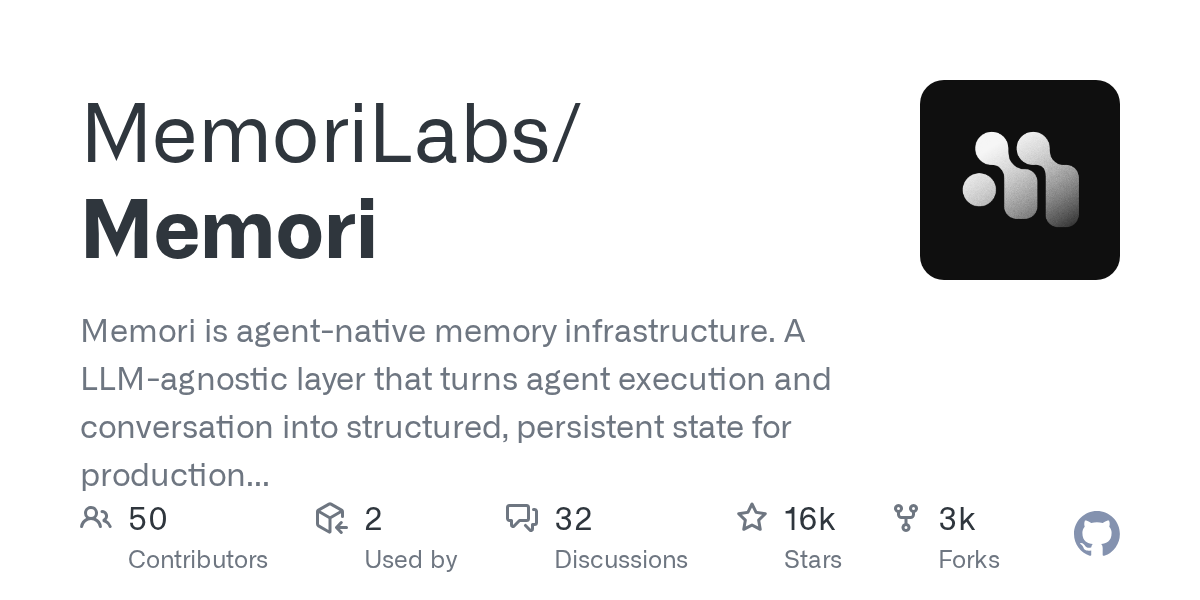
Memori provides agent-native memory infrastructure, offering an LLM-agnostic layer that transforms agent execution and conversations into structured, persistent state. Designed for enterprise use, it seamlessly integrates with existing data infrastructure and supports various deployment environments, ensuring robust memory management for AI agents.
Repository Information
Topics
Click on any tag to explore related repositories
Use at your own risk
OSRepos shares public repositories for knowledge and discovery only. Any installation, execution, configuration, or use of code from these repositories is the user's own responsibility. Always review the repository, source code, dependencies, licenses, and security implications before running or installing anything. OSRepos is not responsible for issues, damages, or losses resulting from third-party repositories.
Introduction
Memori is a cutting-edge agent-native memory infrastructure designed to provide a robust, LLM-agnostic layer for production systems. It transforms agent execution and conversations into structured, persistent state, ensuring that your AI agents remember crucial interactions, tool calls, decisions, and outcomes. Built with enterprise needs in mind, Memori integrates seamlessly with your existing data infrastructure, avoiding the need for rip-and-replace solutions, and supports deployment across managed cloud, single-tenant cloud, VPC, and on-premises environments. Its performance has been validated on the LoCoMo benchmark, achieving 87% overall accuracy with significantly reduced token usage.
Installation
Getting started with Memori is straightforward, with SDKs available for both Python and TypeScript.
Python SDK
To install the Python SDK, use pip:
pip install memori
TypeScript SDK
For TypeScript projects, install via npm:
npm install @memorilabs/memori
Examples
Here's a quick example demonstrating how to use Memori with the Python SDK to enable persistent memory for your LLM interactions. Ensure your MEMORI_API_KEY and your LLM API key (e.g., OPENAI_API_KEY) are set in your environment.
from memori import Memori
from openai import OpenAI

# Requires MEMORI_API_KEY and OPENAI_API_KEY in your environment
client = OpenAI()
mem = Memori().llm.register(client)

mem.attribution(entity_id="user_123", process_id="support_agent")

response = client.chat.completions.create(
    model="gpt-4o-mini",
    messages=[{"role": "user", "content": "My favorite color is blue."}]
)
# Conversations are persisted and recalled automatically.

response = client.chat.completions.create(
    model="gpt-4o-mini",
    messages=[{"role": "user", "content": "What's my favorite color?"}]
)
# Memori recalls that your favorite color is blue.
Why Use Memori
Memori offers several compelling advantages for developers building AI agent systems:
- Persistent, Structured Memory: Unlike stateless agents, Memori ensures your agents retain context from past interactions, tool calls, and decisions, leading to more intelligent and coherent long-term behavior.
- LLM-Agnostic and Seamless Integration: It works with a wide range of LLMs, including OpenAI, Anthropic, Gemini, and more. Memori also provides direct integrations with popular frameworks like LangChain and Pydantic AI, as well as specialized agents like OpenClaw and Hermes.
- Enterprise-Ready Deployment: Designed for production, Memori supports flexible deployment options, including managed cloud, VPC, and on-premises, and can integrate with your existing database infrastructure (BYODB).
- Superior Performance and Cost Efficiency: Evaluated on the LoCoMo benchmark, Memori achieved 87% accuracy while using only 2.8% of the full-context footprint, significantly reducing token costs and improving efficiency compared to other retrieval-based memory systems.
- Advanced Augmentation: Memori enhances memories at entity, process, and session levels with attributes, events, facts, people, preferences, relationships, rules, and skills, providing unparalleled context without incurring latency.
Links
- GitHub Repository: MemoriLabs/Memori
- Memori Cloud Documentation: memorilabs.ai/docs/memori-cloud/
- Memori BYODB Documentation: memorilabs.ai/docs/memori-byodb
- Memori Cookbook (Examples): MemoriLabs/memori-cookbook
- Discord Community: Join Discord
Related repositories
Similar repositories that may be relevant next.
Source repository
Open the original repository on GitHub.
18 counted GitHub visits