Firecrawl: Web Scraping and Interaction API for AI Agents
This repository profile is provided by osrepos.com, an open source repository discovery platform.
Summary
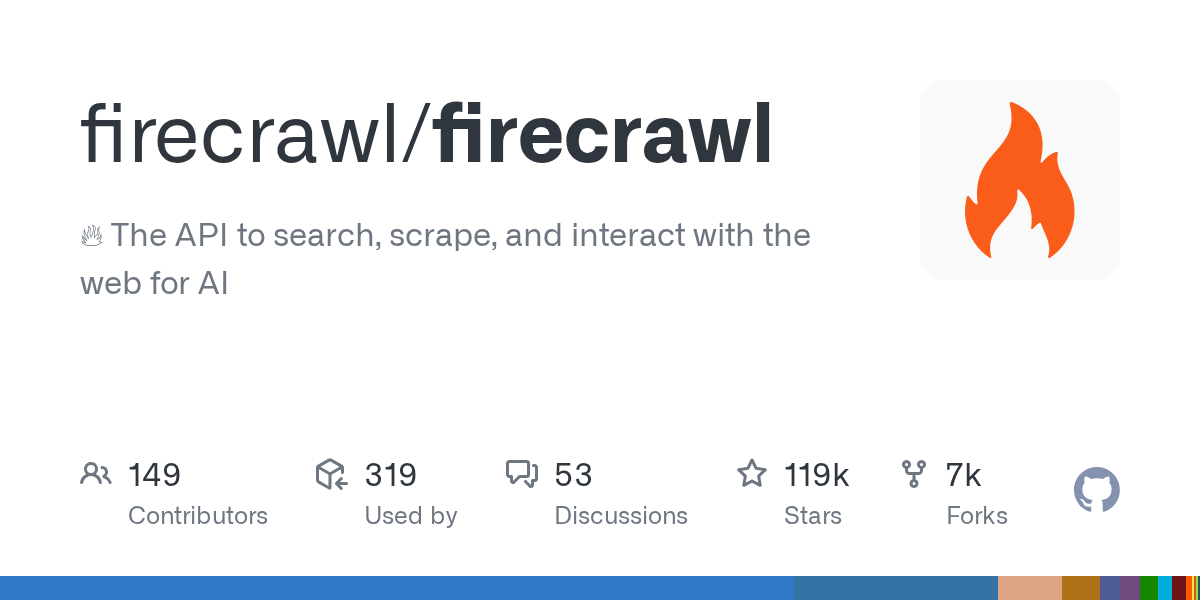
Firecrawl is an open-source API designed to empower AI agents and applications with clean, structured web data. It provides robust capabilities for searching, scraping, and interacting with the web at scale, effectively transforming complex web content into LLM-ready formats. This tool handles the intricate challenges of web data extraction, allowing developers to focus on building intelligent applications.
Repository Information
Topics
Click on any tag to explore related repositories
Use at your own risk
OSRepos shares public repositories for knowledge and discovery only. Any installation, execution, configuration, or use of code from these repositories is the user's own responsibility. Always review the repository, source code, dependencies, licenses, and security implications before running or installing anything. OSRepos is not responsible for issues, damages, or losses resulting from third-party repositories.
Introduction
Firecrawl is an open-source API designed to empower AI agents and applications with clean, structured web data. It provides robust capabilities for searching, scraping, and interacting with the web at scale, effectively transforming complex web content into LLM-ready formats like Markdown or JSON. Firecrawl handles the intricate challenges of web data extraction, including JavaScript-heavy pages, rotating proxies, and rate limits, allowing developers to focus on building intelligent applications.
For more details, visit the official GitHub repository or the Firecrawl website.
Installation
Getting started with Firecrawl is straightforward, especially with its Python SDK. First, you'll need an API key from firecrawl.dev. Then, install the Python SDK using pip:
pip install firecrawl-py
Examples
Here are some quick examples demonstrating Firecrawl's core functionalities using the Python SDK:
Search
Search the web and retrieve full content from the results.
from firecrawl import Firecrawl

app = Firecrawl(api_key="fc-YOUR_API_KEY")

search_result = app.search("firecrawl", limit=5)
# Output will be a list of dictionaries with url, title, and markdown content
Scrape
Convert any URL into LLM-ready data, such as Markdown, JSON, or screenshots.
from firecrawl import Firecrawl

app = Firecrawl(api_key="fc-YOUR_API_KEY")

result = app.scrape('firecrawl.dev')
# The result object contains the scraped content in markdown and other formats
Agent
The Agent feature allows you to describe what data you need, and Firecrawl's AI agent will autonomously search, navigate, and retrieve it, without requiring specific URLs upfront.
from firecrawl import Firecrawl

app = Firecrawl(api_key="fc-YOUR_API_KEY")

result = app.agent(
    prompt="Find the pricing plans for Notion"
)
# result.data will contain the extracted pricing information
Why Use Firecrawl?
Firecrawl stands out for several reasons, making it an excellent choice for AI-driven web data needs:
- Industry-leading reliability: It covers 96% of the web, including challenging JavaScript-heavy pages, ensuring consistent data extraction without proxy management headaches.
- Blazingly fast: With a P95 latency of 3.4s across millions of pages, it's optimized for real-time agents and dynamic applications.
- LLM-ready output: Provides clean Markdown, structured JSON, and screenshots, reducing token usage and improving the quality of AI applications.
- Handles the hard stuff: Automatically manages rotating proxies, orchestration, rate limits, and JS-blocked content, requiring zero configuration from the user.
- Agent ready: Easily connects to any AI agent or MCP client with simple commands.
- Open source: Developed transparently and collaboratively, fostering a strong community.
Links
- GitHub Repository: firecrawl/firecrawl
- Official Website: firecrawl.dev
- Documentation: Firecrawl Docs
- API Reference: Firecrawl API Reference
- Playground: Firecrawl Playground
Related repositories
Similar repositories that may be relevant next.
CCCC: Coordinate Your Coding Agents Like a Group Chat
September 29, 2026
CCCC is a production-minded orchestrator designed to coordinate coding agents like a group chat, offering features such as read receipts, delivery tracking, and remote operations from your phone. It enables 24/7 workflow for multi-agent teams with a single `pip install` and zero infrastructure. This tool helps manage diverse AI runtimes, ensuring persistent collaboration across different machines and trusted working groups.
AI Session Search: Ultra-Fast AI Agent Session Analysis
September 29, 2026
AI Session Search (aise) is an ultra-fast, Rust-powered tool designed for searching and analyzing local AI agent coding sessions. It seamlessly integrates and indexes nine different session formats, including those from Claude, Codex, Cursor, and Gemini CLI. This powerful utility enables developers to quickly recover context, track agent behavior, and efficiently manage their AI-generated code history.
Pydantic AI Harness: Enhancing Your AI Agents with Robust Capabilities
September 28, 2026
Pydantic AI Harness is the official capability and harness library for Pydantic AI, designed to extend agents for complex, long-running tasks. It provides a modular system of "capabilities" for functionalities like file system interaction, web research, memory, and sub-agent delegation. This library enables developers to build sophisticated and durable AI agents with ease.
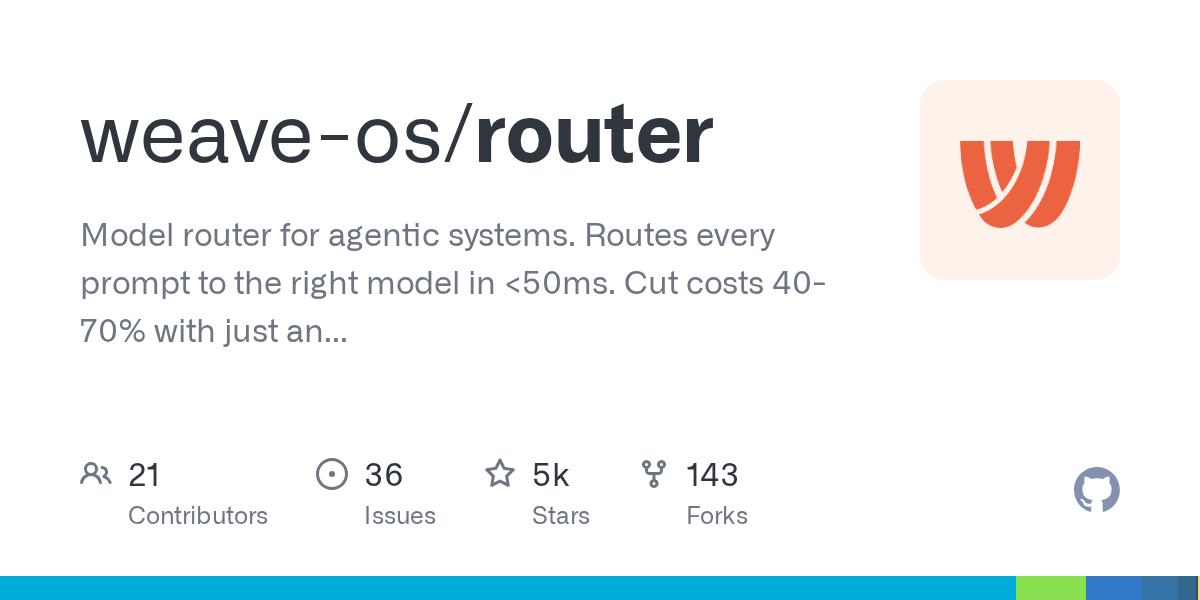
Router: Optimize AI Model Selection and Costs for Agentic Systems
September 28, 2026
The Weave-OS Router is an intelligent model router for agentic systems, optimizing AI model selection for every request. It acts as a drop-in proxy for major AI providers, routing prompts to the most suitable model in under 50ms. This solution helps users significantly cut costs, often by 40-70%, simply by changing an endpoint.
Source repository
Open the original repository on GitHub.
24 counted GitHub visits