CCCC: Coordinate Your Coding Agents Like a Group Chat
This repository profile is provided by osrepos.com, an open source repository discovery platform.
Summary
CCCC is a production-minded orchestrator designed to coordinate coding agents like a group chat, offering features such as read receipts, delivery tracking, and remote operations from your phone. It enables 24/7 workflow for multi-agent teams with a single `pip install` and zero infrastructure. This tool helps manage diverse AI runtimes, ensuring persistent collaboration across different machines and trusted working groups.
Repository Information
Topics
Click on any tag to explore related repositories
Use at your own risk
OSRepos shares public repositories for knowledge and discovery only. Any installation, execution, configuration, or use of code from these repositories is the user's own responsibility. Always review the repository, source code, dependencies, licenses, and security implications before running or installing anything. OSRepos is not responsible for issues, damages, or losses resulting from third-party repositories.
Introduction
CCCC, short for "Coordinate your coding agents like a group chat," is a powerful, production-minded orchestrator for 24/7 AI agent workflows. It brings together various coding agents, such as Claude Code, Codex, and ChatGPT Web, into one persistent and coordinated team. With a single pip install and zero additional infrastructure, CCCC simplifies the management of multi-agent systems across different runtimes, machines, and trusted working groups, moving beyond disparate terminal sessions.
This Rust-based tool provides essential features like read receipts, delivery tracking, and the ability to perform remote operations directly from your phone, ensuring seamless collaboration and oversight.
Why Use CCCC and Its Advantages
When orchestrating multiple coding agents, it's crucial to track task assignments, message delivery status, and maintain progress persistently across restarts. CCCC addresses these challenges by providing a centralized platform for management and operation, accessible via web or instant messaging, even when you're away from your terminal.
CCCC operates your agent collective as a persistent, coordinated system, offering several key advantages:
- Persistent Coordination: Message history is recorded in an append-only ledger, with tasks and shared contexts also persistently stored.
- Visible Delivery Facts: It meticulously tracks routing, storage, runtime delivery, read receipts, and replies independently, ensuring that "sent" doesn't equate to "confirmed."
- Unified Control Plane: A single daemon state is shared across the Web UI, CLI, MCP (Multi-Agent Control Protocol), and IM bridges, preventing state fragmentation.
- Multi-Runtime Orchestration: Seamlessly mix and match major runtimes like Claude Code, Codex CLI, ChatGPT Web, and Grok Build within a single group.
- CCCC Connect for Instance Linking: Supports discovery within the same account, authorized group connections between members, and account-free direct connections, maintaining instance state and permission boundaries.
- Local-First Operation: Get started with a single installation command, keeping runtime state in
CCCC_HOMEand extending to remote monitoring only when needed.
CCCC is designed for simplicity, requiring no separate database, message broker, or Docker setup for its core functionality.
Installation
CCCC is a single native Rust implementation. The website installers are recommended for ease of use.
# macOS / Linux (Recommended)
curl -fsSL https://chesterra.github.io/cccc/install.sh | sh
# Windows CMD or PowerShell (Recommended)
powershell.exe -NoProfile -ExecutionPolicy Bypass -Command "[Net.ServicePointManager]::SecurityProtocol = [Net.ServicePointManager]::SecurityProtocol -bor [Net.SecurityProtocolType]::Tls12; Invoke-RestMethod 'https://chesterra.github.io/cccc/install.ps1' | Invoke-Expression"
# pip compatible native platform wheel
python -m pip install -U "cccc-pair>=0.4.36"
Examples
To get started, ensure your agent CLIs are installed and logged in. Here's an example using Claude Code and Codex CLI to create a multi-agent group:
cd /path/to/your/repo
cccc attach .                              # Attach the directory as a scope
cccc setup --runtime claude                # Prepare only the runtimes used in this example
cccc setup --runtime codex
cccc actor add foreman --runtime claude    # The first actor becomes the foreman
cccc actor add implementer --runtime codex # Add a peer
cccc group start                           # Start all actors
cccc send "Review the repository and suggest the first safe task." --to foreman
cccc tracked-send "Take on the first concrete task and reply with verification evidence." \
  --to implementer \
  --title "First Concrete Task" \
  --outcome "Changes and verification evidence reported"
With these steps, two agents will be collaborating within a persistent group, complete with a full message history, delivery tracking, and a web dashboard. The daemon handles delivery and coordination, while runtime state remains outside your repository in CCCC_HOME.
You should see both actors running in the Web UI at http://127.0.0.1:8848, with the foreman's reply appearing in the chat and delivery/read statuses displayed for tracked requests.
Links
Related repositories
Similar repositories that may be relevant next.
Vicoa: Agentic IDE for Orchestrating Coding Agents Across Devices
September 29, 2026
Vicoa is an open-source, self-hostable agentic IDE designed to orchestrate a team of coding agents. It enables developers to run and steer multiple AI agents from various devices, including desktop, mobile, and remote servers, providing a unified command center for development workflows.
e2a: Open-Source Email API for Applications and AI Agents
September 29, 2026
e2a is an open-source email API designed for applications and AI agents, offering robust transactional email capabilities and real two-way inboxes. It supports both managed hosting and self-hosting with Docker, providing features like human-in-the-loop approval and advanced content screening. Built in Go, e2a aims to bridge email's universal addressability with the structured data world of AI agents.
Spec Kitty: Spec-Driven Development for AI Coding Agents and Software Factories
September 27, 2026
Spec Kitty is an open-source CLI that enables spec-driven development for AI coding agents and multi-agent workflows. It transforms product intent into a structured, repo-native AI coding workflow, providing isolated git worktrees and a clear lifecycle for development tasks. This tool helps teams build governed software factories, ensuring visibility and traceability in AI-assisted software development.
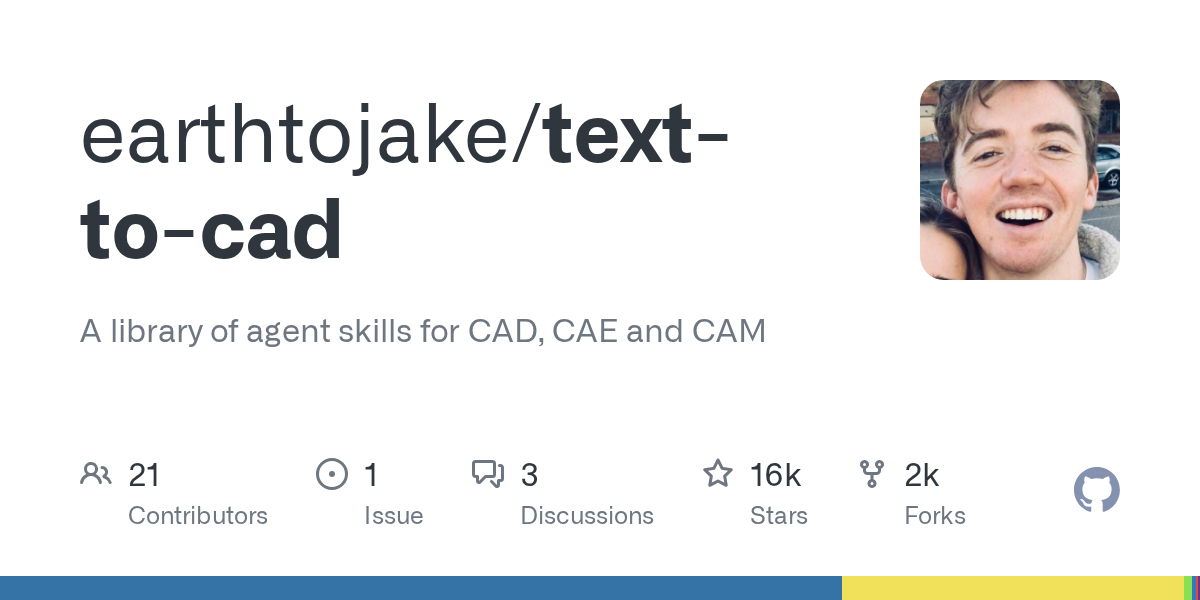
text-to-cad: AI Agent Skills for CAD, CAE, and CAM Workflows
September 24, 2026
text-to-cad is a comprehensive Python library developed by earthtojake, providing a rich set of agent skills for Computer-Aided Design (CAD), Computer-Aided Engineering (CAE), and Computer-Aided Manufacturing (CAM). It enables AI agents to generate, inspect, source, slice, and manage CAD and robot-description artifacts, streamlining complex engineering processes.
Source repository
Open the original repository on GitHub.