Pi Agent Harness: An AI Agent Toolkit for LLMs and Coding
This repository profile is provided by osrepos.com, an open source repository discovery platform.
Summary
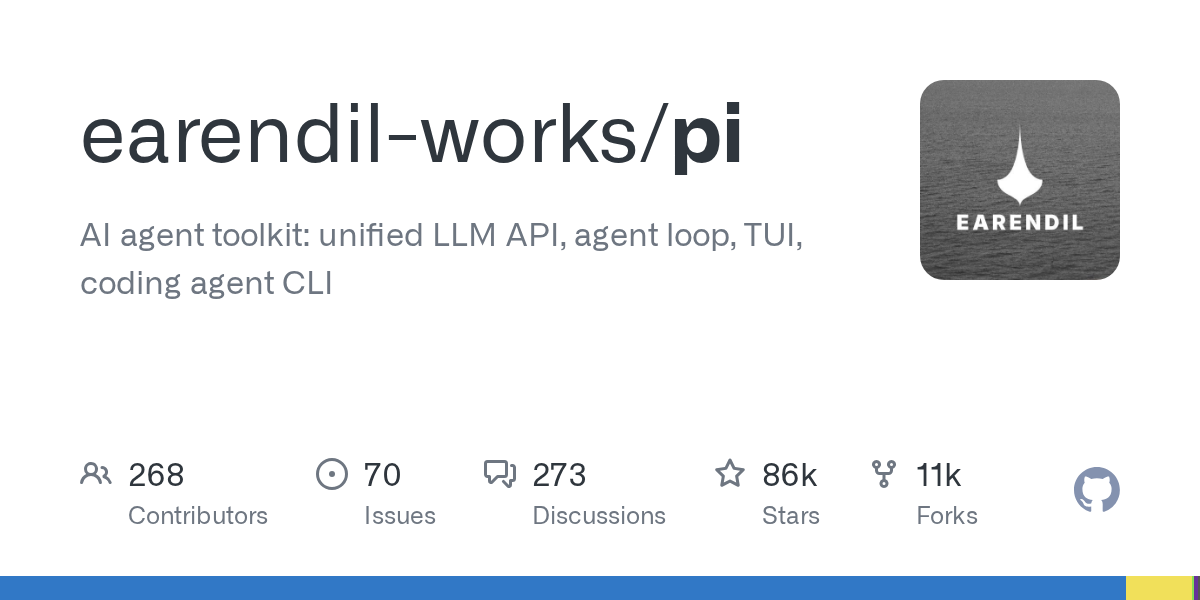
Pi Agent Harness is a comprehensive AI agent toolkit designed for building and deploying intelligent agents. It features a unified API for various Large Language Models, a robust agent runtime with tool calling, and an interactive coding agent CLI. This project provides a modular and extensible foundation for developing advanced AI applications.
Repository Information
Topics
Click on any tag to explore related repositories
Use at your own risk
OSRepos shares public repositories for knowledge and discovery only. Any installation, execution, configuration, or use of code from these repositories is the user's own responsibility. Always review the repository, source code, dependencies, licenses, and security implications before running or installing anything. OSRepos is not responsible for issues, damages, or losses resulting from third-party repositories.
Introduction
Pi Agent Harness is an advanced AI agent toolkit that provides a unified ecosystem for developing, deploying, and managing intelligent agents. At its core, Pi offers a unified API for interacting with multiple Large Language Models (LLMs) like OpenAI, Anthropic, and Google, abstracting away provider-specific complexities. The project includes a powerful agent runtime with tool calling capabilities and state management, alongside an interactive coding agent CLI that empowers developers with AI-assisted coding. Built with modularity in mind, Pi is a collection of packages, each serving a specific purpose, from a terminal UI library to telemetry contracts.
Installation
To get started with Pi Agent Harness, you can install its packages via npm. For the interactive coding agent CLI, use the following command:
npm install -g @earendil-works/pi-coding-agent
For development, clone the repository and install dependencies:
npm install --ignore-scripts
npm run build
Examples
Pi's primary example is its interactive coding agent CLI, @earendil-works/pi-coding-agent. This agent can assist with coding tasks directly from your terminal. You can ask the agent to explain itself, generate code, or refactor existing solutions. The project website, pi.dev, offers various demos showcasing the agent's capabilities in real-world scenarios. Additionally, the unified LLM API (@earendil-works/pi-ai) allows developers to easily integrate different LLMs into their applications, providing a consistent interface across providers.
Why Use It
Pi Agent Harness stands out for several reasons. Its unified LLM API simplifies integration with multiple AI providers, offering flexibility and future-proofing. The robust agent runtime supports complex agent behaviors, including tool use and state management, making it suitable for sophisticated applications. The interactive coding agent CLI enhances developer productivity by bringing AI assistance directly to the command line. Furthermore, Pi emphasizes security with supply-chain hardening practices and offers comprehensive containerization options for secure execution, allowing users to sandbox agents with patterns like Gondolin extension, Plain Docker, or OpenShell. Its modular architecture, built in TypeScript, ensures maintainability and extensibility.
Links
- GitHub Repository: https://github.com/earendil-works/pi
- Project Website: https://pi.dev
- Documentation: https://pi.dev/docs/latest
- Discord Community: https://discord.com/invite/3cU7Bz4UPx
Related repositories
Similar repositories that may be relevant next.
TeamAI-CLI: Empowering Teams to Become AI Native with a Git-Based Foundation
September 24, 2026
TeamAI-CLI, developed by Tencent, is a powerful command-line interface aimed at making every team AI native. It offers a unified, Git-based platform for teams to collaborate, learn, and continuously improve with AI. This tool transforms individual AI capabilities into shared team assets, integrating AI agents, machines, and team members for enhanced efficiency.
LLM Wiki: Build a Self-Maintaining, Interlinked Knowledge Base with AI
September 23, 2026
LLM Wiki is a powerful cross-platform desktop application designed to transform your documents into an organized, interlinked knowledge base automatically. Unlike traditional RAG systems, it incrementally builds and maintains a persistent wiki from your sources, ensuring knowledge is compiled once and kept current. This innovative approach offers a dynamic and evolving personal knowledge management solution.
Agent Orchestrator: Supervise Teams of Coding Agents from Planning to Merge
September 23, 2026
Agent Orchestrator is a powerful tool designed to run and supervise teams of coding agents throughout the entire development lifecycle, from initial planning to code merge. It supports a wide array of agent harnesses, including Claude Code and Codex, and operates across desktop, web, mobile, and cloud environments. This platform offers a unified workspace to manage and coordinate multiple agents, ensuring efficient and organized agent-driven development.
AutoResearch: AI/ML Research Agents from Idea to Paper-Ready Evidence
September 22, 2026
AutoResearch is an open-source agent workflow designed for AI and machine learning research. It automates the entire research process, from generating ideas and planning experiments to execution, analysis, and independent evaluation. This project helps researchers produce paper-ready evidence efficiently and with traceable provenance.
Source repository
Open the original repository on GitHub.
24 counted GitHub visits