Loop Library: Practical Repeatable AI-Agent Workflows
This repository profile is provided by osrepos.com, an open source repository discovery platform.
Summary
The Loop Library is a GitHub repository offering reusable AI agent workflows for various domains like engineering, content, and design. It introduces the concept of "loops," which are structured, repeatable instructions that guide AI agents through multi-step tasks. This skill enables agents to learn from results, adapt, and complete complex tasks more reliably than with one-shot prompts.
Repository Information
Topics
Click on any tag to explore related repositories
Use at your own risk
OSRepos shares public repositories for knowledge and discovery only. Any installation, execution, configuration, or use of code from these repositories is the user's own responsibility. Always review the repository, source code, dependencies, licenses, and security implications before running or installing anything. OSRepos is not responsible for issues, damages, or losses resulting from third-party repositories.
Introduction
The Loop Library is an innovative GitHub repository that provides practical, repeatable AI agent workflows for a wide range of applications, including engineering, evaluation, operations, content creation, and design. This project introduces the concept of "loops," which are structured instructions that guide AI agents through multi-step tasks, allowing them to learn from results and take subsequent useful actions. Unlike traditional one-shot prompts that ask an agent to do something once, a loop incorporates feedback mechanisms, enabling agents to iterate, improve, and achieve more reliable outcomes.
What is a Loop?
A loop can be thought of as a playbook with built-in feedback. For instance, instead of a simple prompt like "Make this website faster," a loop would instruct: "Find the slowest page, make one focused improvement, and measure it again. Keep the change only if it helps. Repeat until every page meets the target or another pass stops producing a meaningful improvement." This approach ensures that the agent can learn and adapt, making the work repeatable and more effective. A good loop answers four key questions:
- What is the agent trying to accomplish?
- How will it know whether the latest attempt worked?
- What should it do with what it learned?
- When should it finish or ask for help?
Why Use Loop Library?
Loop Library empowers AI agents to move beyond open-ended instructions, providing a clear finish line and a consistent way to judge progress. This makes the work easier to trust and repeat. Agents can compare results, keep improvements, and stop when successful or when progress halts. The same loop can be reused by different individuals or agents without rebuilding workflows from scratch. Importantly, loops are designed to be deliberately bounded, including real checks, clear stopping points, and moments to hand control back to a person for judgment or approval.
Installation
To install the Loop Library skill, you will need Node.js and npx. Choose the appropriate command for your AI agent platform:
- Codex:
npx skills add Forward-Future/loop-library --skill loop-library --agent codex -g -y - Cursor:
npx skills add Forward-Future/loop-library --skill loop-library --agent cursor -g -y - Claude Code:
npx skills add Forward-Future/loop-library --skill loop-library --agent claude-code -g -y - Install for all three at once:
npx skills add Forward-Future/loop-library \ --skill loop-library \ --agent codex \ --agent cursor \ --agent claude-code \ -g -y - For other agents (interactive installer):
npx skills add Forward-Future/loop-library --skill loop-library -g
The command parts mean:
Forward-Future/loop-library: The GitHub repository to install from.--skill loop-library: Selects this specific skill from the repository.--agent ...: Selects the agent that should receive the skill.-g: Makes it available in all your projects. Omit for current project only.-y: Accepts install prompts automatically. Omit for interactive review.
If an agent was already open and the skill does not appear, restart that agent.
Examples of Use
Once installed, you can invoke the Loop Library skill using slash commands or by describing a matching task. The skill offers four main paths:
- Find: Searches the live catalog and recommends published loops.
- Example:
/loop-library Find a published loop for keeping our documentation current.
- Example:
- Loop Doctor: Audits an existing loop for weaknesses and repairs material problems.
- Example:
/loop-library Audit this loop and repair only material problems: [paste loop]
- Example:
- Adapt: Tailors a useful loop to your specific tools, limits, and definition of success.
- Example:
/loop-library Adapt the Overnight Docs Sweep to this repository and our existing checks.
- Example:
- Design: Helps you design a new, bounded loop through a plain-language conversation when no good fit exists in the catalog.
- Example:
/loop-library Help me design a loop that turns customer feedback into verified fixes.
- Example:
When the skill finds or creates the right loop, it provides a prompt for your agent. Review any placeholders, then ask your agent to run that prompt in the desired project.
Links
- GitHub Repository: Forward-Future/loop-library
- Browse the Loop Library: signals.forwardfuture.ai/loop-library/
- Agent Guide: signals.forwardfuture.ai/loop-library/agents/
- Agent Instructions (LLMs): signals.forwardfuture.ai/loop-library/llms.txt
- Live Catalog (JSON): signals.forwardfuture.ai/loop-library/catalog.json
- Live Catalog (Plain Text): signals.forwardfuture.ai/loop-library/catalog.txt
- Forward Future Project: forwardfuture.ai
Related repositories
Similar repositories that may be relevant next.
AREX-Skill: A Skill Library for Automated Machine Learning and Auto-Research
September 21, 2026
AREX-Skill is a powerful skill library designed to advance automated machine learning and auto-research. It distills over 5,000 executable skills from more than 1,000 popular GitHub repositories, making complex ML knowledge directly usable by coding agents. This project significantly enhances agent performance in various research tasks by providing structured, validated operating knowledge.
Agentic Engineering: Documentation-First Development for AI Coding Agents
September 20, 2026
Agentic Engineering introduces a documentation-first development framework designed for AI coding agents. It effectively addresses the core challenges of agent statelessness and context collapse by providing a structured chain of documentation and verification skills. This suite serves as a robust harness layer, enabling long-running, loop-driven AI development workflows with persistent memory and clear contracts.
Coven: Local-First Runtime for AI Coding Agent Sessions
September 18, 2026
Coven is a powerful local-first runtime designed for managing project-scoped AI coding agent sessions. It provides durable state, robust authority boundaries, and seamless interoperability with multiple coding harnesses like Codex, Claude Code, and GitHub Copilot CLI. This tool enables developers to safely launch, observe, and coordinate AI agent work directly within their local project environments.
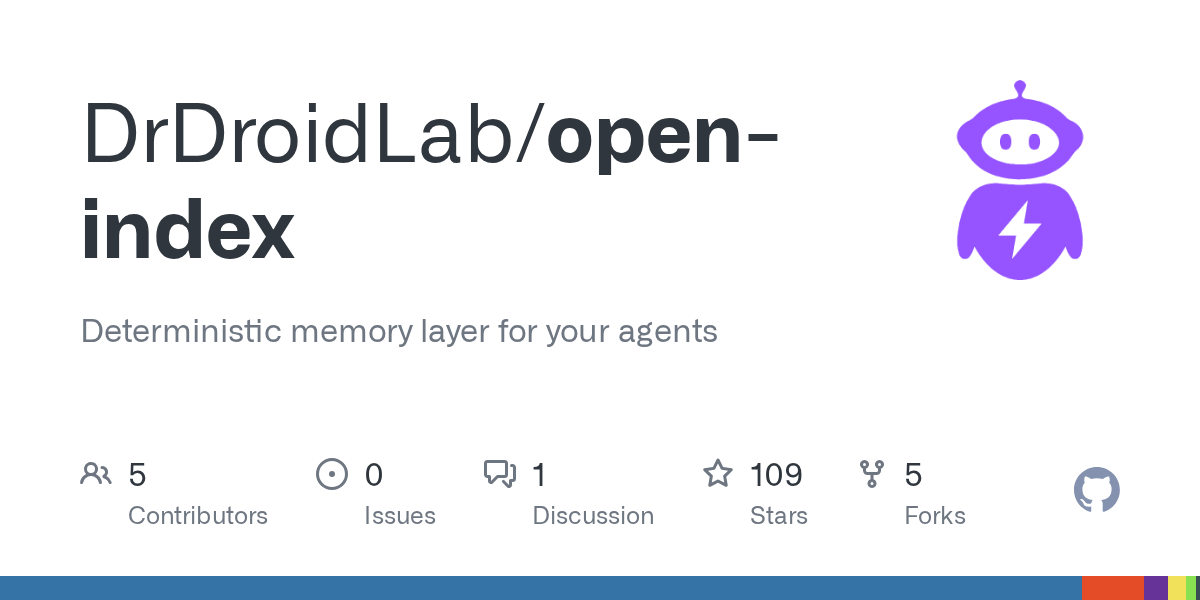
Open Index: A Deterministic Memory Layer for Your AI Agents
September 16, 2026
Open Index is a powerful tool for building domain-specific, accurate, and structured data that AI agents can effectively operate on. It enables the creation of a "brain," a searchable and continuously improving context graph tailored to any domain. This system ensures agents have access to reliable, up-to-date information, enhancing their capabilities and decision-making processes.
Source repository
Open the original repository on GitHub.
36 counted GitHub visits