Loop Engineering: Orchestrating AI Agents with Practical Patterns and Tools
This repository profile is provided by osrepos.com, an open source repository discovery platform.
Summary
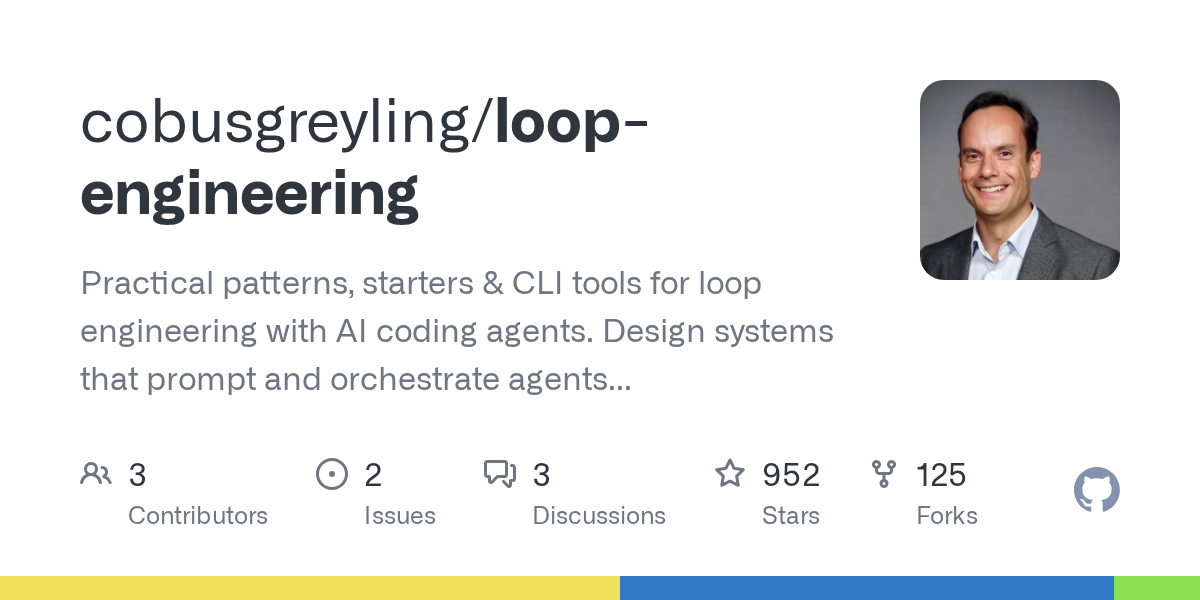
Loop Engineering is a GitHub repository offering practical patterns, starters, and CLI tools for building robust AI coding agent systems. It shifts the focus from individual prompt crafting to designing control systems that orchestrate agents over time. This project empowers developers to create autonomous, iterative AI workflows for various development tasks.
Repository Information
Topics
Click on any tag to explore related repositories
Use at your own risk
OSRepos shares public repositories for knowledge and discovery only. Any installation, execution, configuration, or use of code from these repositories is the user's own responsibility. Always review the repository, source code, dependencies, licenses, and security implications before running or installing anything. OSRepos is not responsible for issues, damages, or losses resulting from third-party repositories.
Introduction
Loop Engineering is an innovative project that redefines how developers interact with AI coding agents. Instead of manually prompting agents, this repository provides the tools and patterns to design entire systems that automatically prompt and orchestrate AI agents. Inspired by the insights of Addy Osmani and Boris Cherny, it offers a comprehensive approach to building autonomous, iterative AI workflows.
Installation
Getting started with Loop Engineering is straightforward, leveraging npx for its command-line tools. You can quickly scaffold projects, estimate costs, and audit your loops:
# 1. Scaffold a starter pattern (e.g., daily-triage with Grok)
npx @cobusgreyling/loop-init . --pattern daily-triage --tool grok

# 2. Estimate token spend for your chosen cadence
npx @cobusgreyling/loop-cost --pattern daily-triage --level L1

# 3. Audit your loop's readiness, including budget and run-log scores
npx @cobusgreyling/loop-audit . --suggest
These CLIs are published to npm and can be used without cloning the repository. For development from source, refer to the project's CONTRIBUTING.md.
Examples
Loop Engineering provides a rich set of production-ready patterns and starters for various AI coding agents. You can explore interactive examples and specific implementations for tools like Grok, Claude Code, Codex, and GitHub Actions.
The project includes patterns such as:
- Daily Triage
- PR Babysitter
- CI Sweeper
- Dependency Sweeper
- Changelog Drafter
- Post-Merge Cleanup
- Issue Triage
An interactive pattern picker is available to help you choose the right loop for your needs.
Why Use It
The core philosophy behind Loop Engineering is to move beyond individual prompts and embrace the design of control systems for AI agents. As Peter Steinberger and Boris Cherny highlight, the leverage point has shifted to orchestrating agents over time, allowing AI to iterate on goals recursively.
The project introduces 'The Five Building Blocks + Memory' for designing robust loops:
- Automations / Scheduling: For discovery and triage on a cadence.
- Worktrees: Enabling safe parallel execution.
- Skills: Providing persistent project knowledge.
- Plugins & Connectors: For integrating with real-world tools (MCP).
- Sub-agents: Facilitating maker/checker splits.
- + Memory / State: A durable spine for managing state outside conversations.
By adopting Loop Engineering, developers can achieve greater automation, consistency, and efficiency in their AI-driven development workflows, while also understanding the caveats and safety considerations involved.
Links
Related repositories
Similar repositories that may be relevant next.
RimZ: Realtime Dashboard for Agentic Coding with tmux and Zellij
September 18, 2026
RimZ is a powerful realtime dashboard and control room designed for agentic coding, enabling humans and AI agents to collaborate seamlessly within tmux or Zellij environments. Built with Rust, it provides comprehensive observability, orchestration, and automation capabilities for managing fleets of coding agents. This tool enhances productivity by offering real-time insights, message-based steering, and scriptable workflows for AI-driven development.
Awesome-Self-Improving-Agents: A Curated List for Agentic AI Self-Improvement
September 14, 2026
Awesome-Self-Improving-Agents is a comprehensive GitHub repository featuring a curated and continuously updated list of resources on self-improvement in foundation model-based agentic systems. It serves as a central hub for researchers and practitioners, offering papers, benchmarks, and various media. This resource is essential for anyone exploring the cutting edge of self-evolving AI agents.
Agent Factory: Generate AI Agents with Natural Language Descriptions
September 3, 2026
Agent Factory, developed by Mozilla-AI, is a powerful tool designed to generate AI agents and workflows. It allows users to describe tasks in natural language, which it then transforms into executable Python code for agentic workflows. Leveraging the Model Context Protocol (MCP) and the any-agent library, it simplifies the creation of complex AI solutions.
TrueForge: The Open-Source Agent Harness for LLM-Powered Agents
September 1, 2026
TrueForge is an open-source agent harness designed to transform large language models (LLMs) into fully functional agents. It provides the essential runtime layer, handling complex aspects like streaming, session persistence, tool servers, and sandboxing. Developers can leverage TrueForge to build and deploy robust, scalable AI agents with ease.
Source repository
Open the original repository on GitHub.
21 counted GitHub visits