Magentic-UI: A Human-Centered AI Agent for Web Automation
This repository profile is provided by osrepos.com, an open source repository discovery platform.
Summary
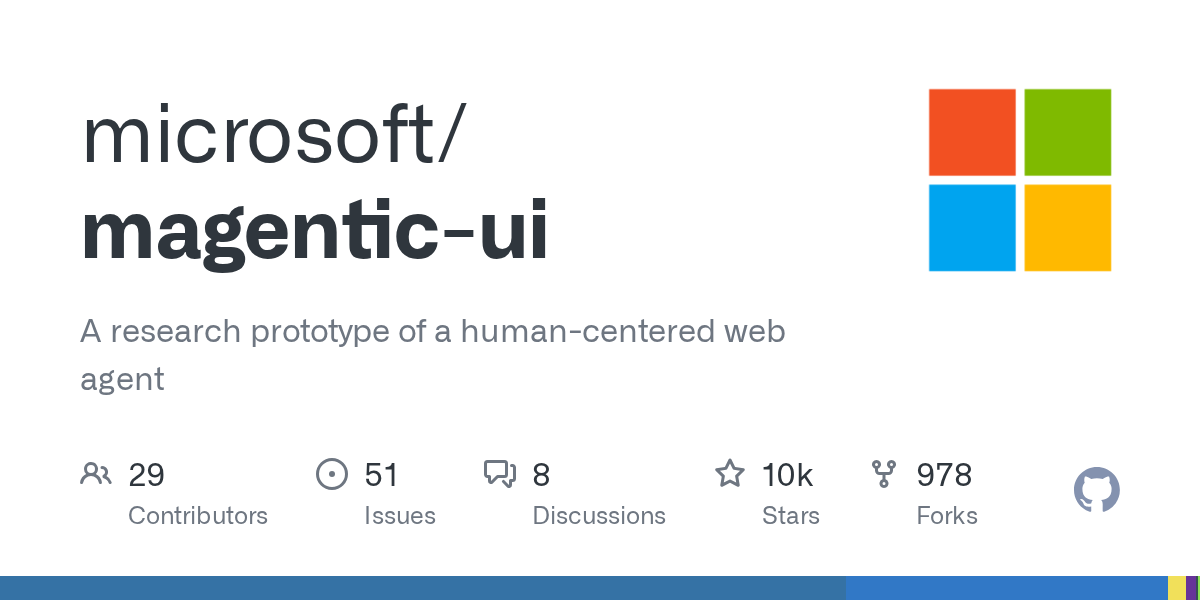
Magentic-UI is a research prototype from Microsoft that introduces a human-centered AI agent designed to automate complex web and coding tasks. Unlike black-box agents, it prioritizes transparency and user control, revealing its plans, allowing guidance, and seeking approval for sensitive operations. This innovative system empowers users to automate workflows while maintaining oversight and intervention capabilities.
Repository Information
Topics
Click on any tag to explore related repositories
Use at your own risk
OSRepos shares public repositories for knowledge and discovery only. Any installation, execution, configuration, or use of code from these repositories is the user's own responsibility. Always review the repository, source code, dependencies, licenses, and security implications before running or installing anything. OSRepos is not responsible for issues, damages, or losses resulting from third-party repositories.
Introduction
Magentic-UI, a research prototype from Microsoft, is a human-centered AI agent designed to automate complex web and coding tasks. It stands out by offering unparalleled transparency and user control, ensuring that you remain in charge while the agent performs its operations. Built upon the AutoGen framework, Magentic-UI is an experimental platform for studying human-agent interaction, allowing users to guide its actions, approve sensitive operations, and monitor its progress. Recently, it has integrated Microsoft's latest agentic model, Fara-7B, enhancing its capabilities.
Installation
Getting started with Magentic-UI is straightforward, though it requires Docker and Python 3.10+. For Windows users, WSL2 is highly recommended.
Here's a quick overview of the installation process:
Setup Environment:
python3 -m venv .venv
source .venv/bin/activate
pip install magentic-ui --upgrade
Set API Key:
export OPENAI_API_KEY="your-api-key-here"Launch Magentic-UI:
magentic-ui --port 8081Then, open
http://localhost:8081in your browser.
For detailed instructions, including running without Docker, using the CLI, or configuring custom LLM clients like Azure or Ollama, please refer to the official Magentic-UI GitHub repository.
Examples
Magentic-UI showcases its capabilities through various compelling demonstrations:
- Pizza Ordering: Illustrates web automation with human-in-the-loop interaction, allowing users to customize orders while the agent navigates the website.
- Airbnb Price Analysis: Demonstrates the integration of MCP (Multi-Agent Communication Protocol) agents to perform complex data analysis tasks on web platforms.
- Star Monitoring: Highlights its ability to handle long-running monitoring tasks, keeping track of changes on websites over extended periods.
You can watch a comprehensive video demonstration to see Magentic-UI in action and learn more about its features.
Why Use Magentic-UI?
Magentic-UI differentiates itself from other web automation tools by prioritizing human involvement and transparency. It's particularly useful for tasks involving deep web navigation, form filling, or scenarios requiring both web interaction and code execution. Key features that make it a powerful tool include:
- Co-Planning: Collaborate with the agent to create and refine step-by-step plans through chat and a plan editor.
- Co-Tasking: Intervene and guide the agent's execution directly via the web browser or chat, with the agent asking for clarifications when needed.
- Action Guards: Sensitive operations require explicit user approval, ensuring safety and control.
- Plan Learning and Retrieval: The system learns from past interactions, allowing for improved future automation and the ability to save and retrieve plans.
- Parallel Task Execution: Run multiple tasks concurrently, with clear indicators showing when your input is required.
These features make Magentic-UI an excellent choice for users who need powerful automation without sacrificing control or understanding of the agent's actions.
Links
- GitHub Repository: microsoft/magentic-ui
- arXiv Paper: Magentic-UI: Towards Human-in-the-loop Agentic Systems
- Microsoft Research Blog Post: Magentic-UI: An Experimental Human-Centered Web Agent
- AutoGen Project: microsoft/autogen
Related repositories
Similar repositories that may be relevant next.
Phoenix: AI Observability and Evaluation Platform for LLMs
June 28, 2026
Phoenix is an open-source AI observability platform from Arize AI, designed for comprehensive experimentation, evaluation, and troubleshooting of LLM applications. It provides robust features including OpenTelemetry-based tracing, LLM evaluation, and systematic prompt management. This platform helps developers optimize and debug their AI models effectively across various environments.

Odysseus: A Comprehensive Self-Hosted AI Workspace for Productivity
June 25, 2026
Odysseus is a powerful self-hosted AI workspace designed to integrate various AI-powered tools into a single platform. It offers functionalities for chat, agents, deep research, document management, email, and calendar, supporting both local and API models. This comprehensive solution aims to enhance productivity and streamline AI workflows in a private environment.
Loop Library: Practical Repeatable AI-Agent Workflows
June 21, 2026
The Loop Library is a GitHub repository offering reusable AI agent workflows for various domains like engineering, content, and design. It introduces the concept of "loops," which are structured, repeatable instructions that guide AI agents through multi-step tasks. This skill enables agents to learn from results, adapt, and complete complex tasks more reliably than with one-shot prompts.

agency-agents: Your Complete AI Agency of Specialized Experts
May 30, 2026
agency-agents offers a comprehensive collection of over 140 meticulously crafted AI agent personalities, designed to act as specialized experts across various domains. From frontend development to marketing and sales, each agent comes with a unique voice, proven processes, and deliverable-focused outcomes. This repository provides a ready-to-deploy AI dream team to transform your workflow and accelerate project delivery.
Source repository
Open the original repository on GitHub.
9 counted GitHub visits